
Wonderful India (as it was) in English, Bengali, and Urdu

IN A SECONDHAND BOOKSHOP in Thame (Oxfordshire) I purchased a book called “Wonderful India”. It must have been published by 1943 because inside its front cover there is the name of its first owner, LW Morris, and next to that he added “Royal Air Force, Calcutta, July 1943”. The book is trilingual. Its text is written in Bengali (Bangla), English, and Urdu. It was published by The Statesman and Times of India Book Department. The Statesman is a newspaper that was founded in 1818, and published simultaneously in Calcutta, New Delhi, Siliguri and Bhubaneswar. The Times of India was founded 20 years later. The gloriously illustrated book, which covers pre-Partition India, as well as Sri Lanka, Burma, and Nepal, contains no text in Hindi. In British India, the official languages were English and Standard Urdu, and later Standard Hindi (https://en.wikipedia.org/wiki/Languages_with_legal_status_in_India#History). Oddly, for many years Bengalis were opposed to using their language as an officially recognised one, for a long time preferring to use Persian for formal (especially commercial) use (https://thespace.ink/bengali-and-persian-in-british-raj/). Yet despite this, the book I found favours Bengali and omits Hindi. I suspect that  because the book might well have been published in Bengal, the Bengali script has been included. Hindi written in the Devanagari script only became the official language of India in September 1949, several years after “Wonderful India” was published.

Dhaka (now in Bangladesh)

The book covers all the regions of pre-Independence India as well as some of its neighbours. It is rich in black and white photographs, many of which are superb examples of photographic technique. Each picture is captioned in Bengali, English, and Urdu. The only pieces of prose are the general introduction (which includes a photograph of Mahatma Gandhi) and introductory paragraphs at the beginning of each section. The Urdu introduction is at the rear of the book, and is next to a picture of Jawaharlal Nehru. There is no picture of any member of the British Indian hierarchy.  

Bangalore, a place which I have visited often, is given only one sentence at the beginning of the section on Mysore and Coorg:

“The British retain some territory at Bangalore, which is the administrative headquarters of the state, while Mysore is the capital.”

There are three photographs of the city, Sadly, not the most interesting in the book.  To compensate for this, the book is filled with pictures of touristic sights and daily life of India as it was before WW2 had ended. The book provides a fascinating window on a part of the world that has in many aspects changed beyond recognition.
Faces of India for Queen Victoria

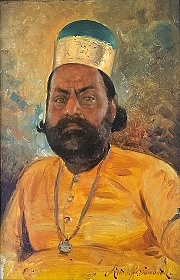
THE CORRIDORS LEADING to the spectacular Durbar Room in Osborne House on the Isle of Wight are lined with portraits of people born in pre-independence India, either painted or photographed during the 19th century. Most of these images depict members of the Indian aristocracy (e.g., rulers of Princely States). A few depict less exalted persons, such as craftsmen and the designer of the Durbar Room.

Maharajah Duleep Singh (1838-1893), who surrendered the Koh-i-Noor diamond to Queen Victoria, is portrayed in a few pictures, notably one by the famous German artist Franz Xaver Winterhalter (1805-1873). Many other paintings were created by the Austrian painter Rudolf Swoboda (1859-1914). Queen Victoria liked his painting style and commissioned him to create more than 40 portraits of Indian people. In 1886, the queen paid for him to travel to India, and gave him £300 in travelling expenses. Her instructions to the young artist were:

“The Sketches Her Majesty wishes to have – are of the various types of the different nationalities. They should consist of heads of the same size as those already done for The Queen, and also small full lengths, as well as sketches of landscapes, buildings, and other scenes. Her Majesty does not want any large pictures done at first, but thinks that perhaps you could bring away material for making them should they eventually be wished for.” (www.rct.uk/collection/403755/gulzar).

Many of these can be seen hanging in Osborne House. Amongst his many Indian portraits, there is at least one painted not in India but in England. Queen Victoria had several servants, who were born in British India and the Princely States associated with it. The best known of these ‘imported’ servants was her favourite Mohammed Abdul Karim (1863-1909), her ‘munshi’ (teacher), who helped her study Hindustani, which she learned to write competently in the Urdu script. Amongst Swoboda’s paintings of Indians hanging in Osborne House, there is one of a non-Indian, a lady from Cyprus, and another, a Cape Malay woman from  Cape Town (South Africa). Why they are there, I have not yet found out, but maybe Swoboda spotted them at the Colonial Exhibition held in London in 1886.

Not all the portraits of Indians are painted. Some of them are hand-coloured photographs. A few of these photos are signed by their creators, one of which was the photographic studio of Gobind Ram and Oodey Ram in Jaipur. Along with a studio in Calcutta the Ram brothers were pioneers in photography in 19th century India. One source (www.indiatoday.in/lifestyle/whats-hot/story/tryst-with-colonial-india-205124-2014-08-22) stated:

“Apparently, studio photography was practised by many Maharajas as a means of leisure, mostly using their courtesans as subjects. The Ravi Varma Studios of Calcutta and Gobind Ram-Oodey Ram Studio in Jaipur are just two examples.”

As can be seen at Osborne, these photographers also made portraits of the maharajahs and their families.

Although Queen Victoria loved Osborne House, I cannot see its appeal apart from the wonderful Durbar Room. For me, seeing this lavishly decorated hall and the collection portraits of the Indian people are the main delights of this otherwise rather gloomy residence.