
An artist struck by illness but not defeated

AT TWO TEMPLE PLACE, which is close to Temple Underground station, there is an exhibition, “The Weight of Being”, showing until 19 April 2026. The theme of the exhibition is “vulnerability, resilience, and mental health in art”. The show contains a good number of paintings and other creations by the artist John Wilson McCracken (1936-1982), an artist who is new to me. The reason for his inclusion in the show will become obvious soon.

From an early age, McCracken, who was born in Belfast and educated in Birmingham, displayed artistic talent. In 1956, he applied to enter London’s prestigious Slade School of Fine Art, and was accepted as a student. One of his teachers there was the artist Lucien Freud, who was a visiting tutor at the school. Soon, McCracken became a regular at the Colony Room, a drinking hole in Soho. It was here that leading artists including Freud, Francis Bacon, Frank Auerbach, and others met to drink, discuss, and argue. McCracken found himself in one of the epicentres of the world of then modern British art, and valued his encounters in this inspiring artistic milieu.
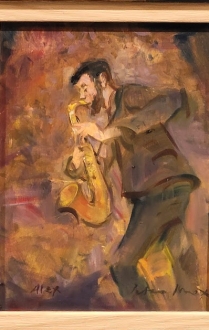
Near the end of his second year at the Slade, disaster struck. McCracken had a severe nervous breakdown. He was hospitalised, and diagnosed with schizophrenia. In the late 1950s and early 1960s, being diagnosed with ‘mental disease’ was a great social stigma, and an impediment for a young artist hoping for success in the London art world. His mother decided that the family should move away from London to the northeast, far away from London’s temptations and the intense atmosphere of the city’s art scene. They moved to Hartlepool, where the family had relatives.

McCracken continued his art education at West Hartlepool College of Art, where later he became a teacher. In addition, he worked in the town’s public Gray Art Gallery. While there, he not only arranged for a Lucien Freud exhibition to be brought from London to the gallery, but also got the gallery to acquire a wide range of then modern artworks by artists including LS Lowry, Frank Auerbach, John Bratby, and others. At that time, the works of these now very famous artists were affordable, and by purchasing them, McCracken ensured that the gallery acquired an important collection of modern British art. In addition, he formed a collective of artists called Front Group, whose members believed that contemporary art should not be confined to galleries in London.

While all this was going on in Hartlepool, McCracken never stopped painting. Most of his work depicts people. But like Francis Bacon, whom he knew, his subjects often are in awkward poses. Whereas Bacon distorted his subjects in a modern expressionist way, McCracken depicts them more realistically. As Angela Thomas, the curator of the exhibition, wrote in the catalogue:

Like Freud he captured the humanity of his subjects: their gestures, postures, and unspoken stories, rendered with empathy and attentiveness.

I am not greatly enthusiastic about Lucien Freud’s art, but what I have seen of McCracken I much prefer. Freud does not seem to like the people he portrays; he highlights their less attractive features. In contrast, McCracken appears to see what is likeable about his subjects, and gives them an empathetic rendering.
CREATIONS IN GLASS FROM INDUSTRY AND ARTISTS AND A PUNJABI PUB

TWO TEMPLE PLACE was built for the American businessman William Waldorf Astor (1848-1919) in 1895. Located close to Temple Underground Station and Middle Temple, this distinctive edifice is said to be designed in the ‘neo-Gothic’ style, although I would prefer to describe it, and especially its interior, as ‘Tudor Revival’. Every year, between late January and late April, the building, which is now owned and maintained by the Bulldog Trust charity, houses an exhibition, which is always worth viewing. This year’s exhibition, which continues until the 21st of April 2024, is called “The Glass Heart”.

The exhibition is described on the Two Temple Place website (https://twotempleplace.org/) as follows:

“It will explore the narratives central to glass art and manufacturing, and celebrate the timeless skills, artistry and innovation required to work with this challenging material.”

And it does that very successfully by exhibiting a superb collection of glass creations ranging from industrial products, such as Pyrex, through stained glass, to intriguing artistic creations that defy the imagination. I will not attempt to describe all of these exhibits – each one of them both fascinating and beautiful – but I will concentrate on one small collection of items relating to the Red Lion – a pub in West Bromwich (West Midlands).

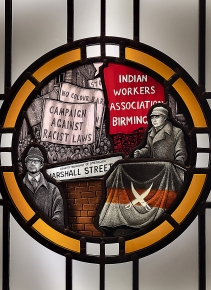
The Red Lion is a ‘desi’ pub owned by Indians, whose families originated in the Punjab, and came to work in the factories of Britain’s Black Country. Although all are welcome, the pub is mainly a socialising place for local people whose families came from the Subcontinent. It is one of several desi pubs in the former industrial heartland. In 2016, Steven Cartwright, who runs a studio that produces creative and decorative glassworks, was commissioned to create some stained-glass windows to decorate the Red Bull. His mission was to create traditional pub style stained-glass, but with an interesting slant – it was to celebrate the rich culture of the desi pub in the West Midlands. To do this, as Steven explained on his website (www.cartwrightglassdesigns.co.uk/projects/red-lion):

“I designed the window to give the appearance of a traditional pub but with a twist. The window utilises some of the colours and elements of the sub continent and tells the story of the punjabi community who migrated to the area in the 50’s. It also celebrates the establishment of the Indian workers association by Avtar Singh Jouhl and the visit of Malcolm X at their invitation.”

At the exhibition in Two Temple Place, there is a small piece of this pub’s stained-glass and some photographs of the rest of it.

What particularly intrigued me was the mention of The Indian Workers Association (‘IWA’) of Birmingham. The IWA was founded in the 1930s by Indian workers from Coventry to combat racist objections to them both by the British trade unions and the British people in general. The quote mentioned Avtar Singh Jouhl. He was born in the Punjab (British India) in 1937, and after the 1947 Partition, he came to London to study at the London School of Economics, arriving in 1958. Three years later, he moved to Smethwick in the Midlands, where he became an industrial worker. There, he saw and experienced racist anti-Indian conditions that prevailed at the time, He joined the IWA, and soon, along with others, he founded its Birmingham branch.

In February 1965, Jouhi invited the civil rights campaigner Malcolm X to visit Smethwick. A few days before his assassination, Malcolm X said of Smethwick:

“This is worse than America. This is worse than Harlem.”

In Jouhi’s obituary (The Guardian, 4th of November 2022), the following was written:

“The anti-racism campaign that attracted Malcolm X to Smethwick was spearheaded by Avtar Singh Jouhl, who has died aged 84 … Jouhl, as general secretary (1961-64; 1979-2015) and national organiser (1964-79) of the Indian Workers’ Association (IWA), challenged trade union members, factory owners and publicans to end this racism … When it came to breaking the colour bar in the town’s pubs, the IWA’s tactics were similar to those used by the Freedom Riders in the US in the previous decade. White university students were enlisted to order drinks, then hand them to British Indians, such as Jouhl. The landlord would invariably eject them, while the students challenged the eviction. The IWA then used evidence of these actions to successfully oppose the publican’s licence when it came up for renewal … This targeted campaign led to discrimination in pubs being outlawed in the Race Relations Act (1965) and paved the way for Britons of Indian heritage to become publicans themselves and set up what are commonly now known as “desi pubs”.

It was his actions described above and many others that helped to suppress racism in the Midlands and elsewhere in Britain. And it is very pleasing to see that what he achieved is being celebrated in glass in a pub owned and frequented by the people whom he helped. I visited the exhibition at Two Temple Place because I enjoy viewing glass artefacts. Little did I know that I would leave the exhibition having been introduced to an important political movement, about which I had known nothing.