THERE IS A COPY of an icon, originally painted in Constantinople, in Truro Cathedral. This well-executed replica stands near the west end of the chancel. It depicts the Holy Child, Jesus, being held by the Virgin Mary. It exemplifies what we were told several years ago whilst being shown around a collection of icons in the Sicilian town of Piana degli Albanese, whose population is descended from Albanians who fled from the Ottomans in the late 15th century. These folk speak not only Italian but also a dialect of Albanian, known as Arberesh.
The icon in Truro shows the Virgin Mary dressed in dark blue and Jesus dressed in red. Our guide in Piana had shown us that in all the icons, the same thing can be seen. Conventionally, in Byzantine icons, Jesus is almost always dressed in red and the Virgin Mary in blue. The copy of the icon on display in Truro Cathedral is no exception to this tradition.
AN HOUR IN TRURO is hardly enough to get to know the county town of Cornwall well, but it is long enough to discover that the city’s centre is attractive and interesting. In 1876 the Diocese of Truro was founded and in the following year, it gained the status of ‘city’, making it the southernmost city in mainland Britain. Until the diocese was established, the county of Cornwall including the Scilly Isles and a couple of parishes in Devon were in the Diocese of Exeter. Given that the Christian faith was well established in this southwestern part of England at least 100 years before the first Archbishop of Canterbury was appointed, it was high time that Cornwall had its own diocese and archbishop.
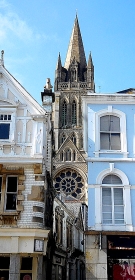
Truro Cathedral
Between 1880 and 1910, a gothic revival cathedral designed by John Loughborough Pearson (1817-1897) was constructed on the site of the 15th century parish church of St Mary. Parts of this old church were incorporated into the new cathedral and the top of its granite spire stands in a garden next to it. One of only three British cathedrals with three spires, Truro’s cathedral was the first new cathedral to be built in England after many centuries. Although a relatively recent structure compared with many of Britain’s other cathedrals, it is a fitting design for the mediaeval heart of the city with its narrow winding streets.
The name Truro might be derived from the Cornish words meaning ‘three rivers’ or ‘the settlement on the River Uro’. In any case, Truro has a river running through it, which helped stimulate the growth of the city’s prosperity. During the 18th and 19th centuries, the tin mining industry added to Truro’s wealth. Lemon Street, where we parked, is evidence of that; it looks like a Georgian street in Bath or some parts of London. The arrival of a direct railway line between the city and London in the 1860s provided a further boost to the city’s success. Earlier in mediaeval towns, Truro, which is inland and therefore difficult to reach by seaborne foreign invaders, became an important port. In addition, it was a stannary town, where revenue from the tin industry was collected, yet another source of the town’s wealth.
Our brief first visit to Truro (at the end of a long day out) has whetted my appetite for another lengthier exploration of the city, which at first sight seems to have many interesting features to excite tourists who have an interest in history.


 yamey
yamey 