
A MAJOR ATTRACTION FOR VISITORS TO ISTANBUL

I AM ALWAYS WARY about visiting the ‘must-see’ places partly because I hate queuing and do not particularly enjoy crowds. Also, one of the few flaws in my personality is that I love visiting places that are off the beaten track taken by most visitors to a town or city. That said, I visited one of Istanbul’s most popular tourist attractions today – The Grand Bazaar – on my way to places less often seen by tourists.

The Grand Bazaar (Kapali Çarşi = ‘covered bazaar’) covers a huge area, and is like a city within a city. It has 62 covered streets and about 4000 shops. It’s construction commenced in about 1455/56 – a very few years after the Ottoman conquest of Constantinople/Istanbul. Much of its construction occurred during the second half of the 15th century, and it was largely completed by the beginning of the 17th century.
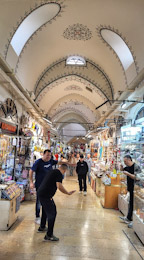
Many things impressed me about the Bazaar. It is very clean. The numerous shops are mainly tidy. Until we entered the place, I had not realised that it is built on a hillside. Many of its gently curving streets (or wide corridors) are far from level – they slope gently. The beautiful curved ceilings, supported by numerous arches, are wonderfully decorated with painted Ottoman motifs and patterns – tasteful not garish. Despite the presence of many people – tourists and locals – the bazaar did not feel crowded. Because of the great width of the streets, the bazaar did not have the bustling feeling that many large bazaars in India have.

All in all, despite my initial reservations about entering such a ‘mustn’t miss’ attraction, I greatly enjoyed visiting the Grand Bazaar, and am very pleased I did.

Where fishermen once lived

FUNCHAL IN MADEIRA is a place well suited for unhurried exploration. At first, I was worried that 11 days might be too long for a stay here, but this is not the case: it is far too short. There is plenty to see and do without queuing for the famous cable car or for the toboggan ride down a steep road. There are interesting museums to see, but a great deal of pleasure can be derived from wandering leisurely around the older parts of the place.

Cable car passing above Zona Velha in Funchal

One area, which despite being rather ‘touristy’, is the Zona Velha. East of the old patrician  areas around the cathedral and the university, the Zona Velha used to be the poorer part of the city, where fishermen and their  families lived in rather narrow crowded streets near the seashore and the venerable Forte São Tiago.  This fortress was one of a chain of four or five forts that used to protect Funchal from seaborne attackers.

The streets of the Zona Velha have become trendy and there has been a conscious attempt to make the area bohemian. Many of the doors have been painted with often entertaining designs and pictures. There are plenty of small bars and restaurants,  but we were advised by some ladies who work in a museum that these tend to be of poor quality and are best avoided.

High above the Zona there is a terrace overlooking a sea bathing area. Near this, there is an old church, the Igreja de Santiago Menor, which was closed when we visited the district. The café next to the terrace provided excellent coffee at a surprisingly reasonable price given the wonderful sea view from its tables: we paid 3 Euros for two coffees and a pastry.

As touristic areas go, the Zona Velha is certainly worth strolling through. It is probably best to go there earlier in the day before the roads are filled with tables  and chairs next to the eateries.