I AM ATTRACTED to the Art Deco style of architecture that had its heyday during the period between WW1 and WW2. Although there is no concentration of buildings made in this style in London, such as can be found in Bombay, there are plenty of examples scattered around the city. One of these is on Wilton Street, facing one side of Victoria railway station.
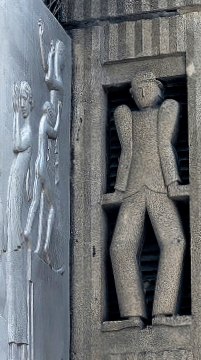
Details of decoration at the Apollo theatre
Originally built to be a cinema, it was completed in 1930. Its architects were William Edward Trent (1874 – 1948) and E Walmsley Lewis (1898–1977). Plans were made to demolish the Apollo in the 1950s, but, fortunately, they were never realised. In the 1970s, it hosted several musical events including rock concerts. In 1981, the Apollo re-opened as a theatre. Since then, it has hosted musical theatre (‘musicals’) including “Fiddler on the Roof”, “The Sound of Music”, and “Camelot”. Since September 2006, it has been showing the musical “Wicked”.
Surrounded by twenty-first century and nineteenth century buildings, this Art Deco theatre makes for a pleasing element in the architectural ensemble around the railway station.
THE PARK THEATRE in London’s Finsbury Park was opened in 2013. We have seen many productions there and they have all been good to excellent. “The Meat Kings! (Inc.) of Brooklyn Heights”, written by Hannah Doran, is showing until 29 November 2025, is no exception, as we discovered after watching it last night (1 November 2025). A word of warning is owed to vegetarians and vegans: the play is set in the meat cutting room of a family butcher’s shop somewhere in New York City. But do not let this deter you because the main points of the play are not about carving and slicing meat.
In the play, Paula Caffarelli is the owner of Cafarelli & Sons. Her great grandfather, an immigrant from Sicily, founded the firm 100 years ago. She tends to hire people released from prison to work in her cutting room. Three of her employees are ex-convicts and the fourth is an immigrant from Mexico. One of the ex-prisoners, Billy (acted brilliantly by Ash Hunter), must earn to pay his mother’s exorbitant medical fees. David, who used to make a fortune on Wall Street but has fallen on hard times, Is Paula’s senior meat cutter. JD is the Mexican. During the play, Paula takes on a new cutter, T, also recently released from prison. At the beginning of the play, Paula’s staff fool around and take life easily. However, it is not long before Paula’s business begins to suffer economically, and her staff members reveal their personal problems. Things reach a stage where Paula needs to reduce the number of her staff, and some of her cutters begin plotting against the others.
This well-acted, superb play is both entertaining and disturbing, but never uninteresting. As the theatre’s website explained, the play:
“… carves into the dark underbelly of America’s anti-immigration policies and the brutal sacrifices that drive the pursuit of prosperity.”
It adds a note of warning:
“This production contains butchery; references to prison, suicide and illness; discussions of racism & xenophobia. Also contains strong language and references of a sexual nature. Please note, this production does not use real meat.”
The play comes to a tragic end as the characters, to use an appropriate phrase, knife each other in the back. I enjoyed the play, and believe that seeing it would not disturb those who avoid eating meat. However, it might put you off crossing the Atlantic from east to west.
THE BENGALI POLYMATH Rabindranath Tagore (1861-1941) is modern India’s most important cultural figure. In 1913, he was awarded the Nobel Prize for literature, and in 1915 he was honoured with a knighthood by King George V. Following the massacre at Jallianwala Bagh in 1919, which was instigated by a British military commander, he renounced the knighthood. Five years before this, Tagore, who did not tolerate injustice, wrote “Streer Patra” (‘A Wife’s Letter’), a short story that highlighted and questioned the domination of women by men in 19th and early 20th century families. Kolkata’s leading English language actress and two colleagues have created a play “I am Mrinal”, which is based on Tagore’s short story.
Piali Ray on stage
On the 9th of September 2025, I watched a performance of this play at London’s Nehru Centre. Piali Ray skilfully and convincingly acted all the roles in the play. These were: Mrinal, the wife of the second eldest son in the family; Bindu, an orphaned child, related to one of Mrinal’s in-laws; Mrinal’s brother-in-law’s wife; and Mrinal’s husband. Against everyone except Mrinal’s wishes, Bindu was accepted into the household. Mrinal’s husband disapproves of Bindu’s presence in the joint family home, but childless Mrinal treasures this young girl’s presence. Mrinal’s husband is keen to evict Bindu, and eventually decides to marry her off to an insane man. In desperation, Bindu sets herself alight, and she dies. Then, Mrinal flees from Kolkata to Puri, where, at the end of the play, she writes a letter to her husband, explaining that she will never return to the domestic bondage that she had to endure for 15 years as his wife. Tagore’s story vividly illustrates the oppression of women in conventional Bengali families, and his feeling that this injustice needed to be combatted. It was written in 1914, the year the First World War commenced. It might not have been “the war to end all wars”, but after it was over, women in many parts of the world began to question their roles in society, and to improve their status.
During Piali’s performance, she switched roles effortlessly, and one was never in doubt as to whom she was portraying at any given moment. Even when she was playing the role of the husband, one forgot that she was not actually a man playing this part. She used a different tone of voice and set of gestures for each of the characters. Throughout the performance, there was music playing in the background. It impressed me that Piali’s movements on stage seemed to harmonize with the music. Her performance was not simply dramatic but also balletic.
It was fascinating watching this play not only because it gave an insight into the oppressive conditions experienced by women in traditional bourgeois Bengali joint families in the early 20th century, but also because it gave me a chance to watch a skilled actress conveying the story so beautifully.
Adam Yamey is the author of “88 Days in India: A Journey of Memory and Discovery” [https://www.amazon.co.uk/dp/B0FKTFBFM2], and several other books about Indian topics.
WE ARE REGULAR theatregoers. We enjoy live theatre. In some indescribable way watching a live theatre performance engages the viewer to a far greater extent than does watching a cinematographic production (a ‘movie’). During a live theatre performance, the actors seem to physically affect the audience in a way that almost feels physical. Because of this, we have been reluctant to see any of the specially televised live performances of plays being held at the National Theatre on the Southbank.
Well, yesterday evening, 4 September 2025, we bit the bullet and watched a televised, live screening of the play “Inter Alia” by Suzie Miller, which was being performed at the National Theatre that same evening. We had back row seats at the Picture House cinema in Finsbury Park. The cinema has a huge screen and an excellent sound system. Our seats were comfortable.
We were amazed at how wonderful it was watching the televised live production. The camera operators, who were filming the play at the National Theatre whilst we watched it on the screen did a superb job. We watched the play as if through the eyes of someone seated in the best seat in the theatre. We saw what we would have seen had we splashed out for the most expensive seats in the house. The filming was not done from multiple angles, but only as we might have watched it while seated in the theatre. And the most surprising thing was that, unlike in a movie, it felt as if we were as much engaged with the actors as if we had been in the theatre with them.
For less than the price of the cheapest seats in the theatre, we had the best view of the play and were able to hear every word perfectly. Apparently, we were not alone. The cinema was full, and while we were watching, the same show was being watched in about 600 cinemas in the UK, and would later be available worldwide. Our first experience of National Theatre Live, as the televised performance is named, has got us ‘hooked’.
OVER THE YEARS, we have watched several plays, which are best seen after eating rather than when hungry. In all of these, the actors have prepared and even cooked food on the stage. Many years ago, we watched a play about the artist Van Gogh’s stay in London. The stage set for this drama, which we saw over 20 years ago, included a kitchen. During the show, a roast meal complete with meat and vegetables was prepared in front of the audience. It smelled great, but we were not invited to eat any of it.
More recently we saw a play called “The Arab-Israeli Cookbook” on the small stage of the tiny Gate Theatre, which is above a pub in Notting Hill Gate. The audience was seated only a few feet away from two ladies, one of whom was preparing Israeli dishes, and the other Palestinian food. The drama explored the ongoing conflict in that country beset by conflict and tragedy: Israel. What was being prepared on stage was delicious. I am pleased that we had eaten before watching the preparation of mouthwatering food, which we were not offered.
Today, the 21st of September 2024, we watched a play, “My English Persian Kitchen”, written by Hannah Khalil. Starring only one actor, Isabella Nefar, it is showing at the Soho Theatre in Dean Street until the 5th of October 2024. Throughout the 70 minutes of this one act play, Ms Nefar prepares an Iranian herb and noodle soup, Ash-e-Reshteh, on a kitchen unit placed in the middle of the stage. While she tells us the secrets of making this soup, she also relates the problems of being a married woman in Iran and how she fled from the country and her husband. She also describes her arrival in London and how she reacted to life there, and how others reacted to her. Every now and then, she has flashbacks to her difficult marital experiences back in Iran. As the play comes to an end, her soup becomes ready to eat. She invites the audience on the stage to taste what she had prepared while we were watching. All in all, it was a great piece of drama. My wife tried the soup, and said it tasted good. I did not try it because it contains beans and lentils, neither of which I particularly enjoy.
I went to Soho Theatre after having a lighter than usual lunch. As the actress prepared the dish, the cooking smells did increase my feelings of hunger. I should have eaten more before reaching the theatre.
MUCH HAS CHANGED IN Golders Green since I was a small child in the 1950s. However, a few things have remained more or less the same. My earliest memories of Golders Green Underground station and its neighbouring open-air bus terminus date back to about 1960, when I began travelling by bus to school in Swiss Cottage.
The Underground station used to have two entrances. One, which faces the bus yard, is still in use. The other, which was approached by a long, covered walkway from beneath the bridge crossing Finchley Road, was closed to the public many years ago, but the passageway still exists. It was this entrance that my family used when using the train to travel into central London. There was also a covered staircase situated between these two entrances – this, now disused, was opened during rush hours. It led to the small parking area where the H2 bus, which serves Hampstead Garden Suburb, begins its journey. During my childhood, there was no public transport in the Suburb. Every day, I used to make the 10-minute walk to Golders Green station, passing the crematorium and the Jewish cemetery on my way.
Overlooking the eastern edge of the bus yard, is what was once the Hippodrome Theatre. When I was a lad, this was a flourishing theatre showing plays and pantomimes. Later, it was taken over by the BBC. After they left it, various religious organisations have used it for their meetings. Built in 1913, six years after the Underground was extended from Hampstead to Golders Green, this building’s exterior looks much as it did when I first remember seeing it.
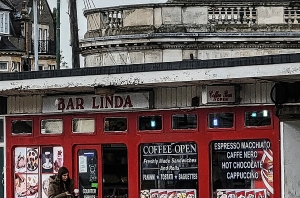
The western edge of the bus yard has always been lined with a row of single storey sheds. Most of these have been used as shops and offices for London Transport. One of them houses a small café called Bar Linda. This was not in existence when I first used to visit the station, but I believe that it opened in the 1960s. Although this friendly little place has been serving customers for many decades, the first time I ventured inside it was in about 2017 when I was about to walk around Golders Green to take photographs for a blog article I was planning to write. I have re-visited it several times since then.
Although Golders Green might not be as aesthetically pleasing as its neighbours, Hampstead and Hampstead Garden Suburb, it is an area full of interest. Much has happened there since 1907 when it began growing from a rural hamlet into a leafy suburb. You can discover much more about Golders Green – its past, my memories of it, and its vibrant present – by reading my book “GOLDERS GREEN & HAMPSTEAD GARDEN SUBURB: VISIONS OF ARCADIA”, which is available (paperback and/or Kindle, from Amazon websites, such as:
WHILE DRINKING IN the first-floor bar of the Duke of York’s Theatre (‘DOY’) in London’s St Martin’s Lane, I noticed an interesting small commemoration plaque. But before discussing that, first a few words about the theatre.
The DOY was opened in 1892 with the name ‘The Trafalgar Square Theatre’. Later, it was given its present name in honour of the Duke of York, who later became King George V. It was designed by the leading theatre and music hall architect Walter Emden (1847-1913). Amongst the many plays performed in this beautiful fin-de-siecle theatre where JM Barrie’s play, the precursor of his book, “Peter Pan, or The Boy Who Wouldn’t Grow Up” which was premiered in late 1904. The theatre was bought by the Ambassador Theatre Group (ATG) in 1992. Since its opening, many successful plays have been performed in it. The play we watched in mid-November 2022 was “The Doctor” by Robert Icke. It was a lively and engaging play that was crammed a bit too full of dilemmas that trouble us today.
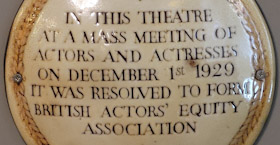
The plaque, which I noticed whilst waiting to enter the auditorium was put on the wall of the bar to celebrate that on the 1st of December 1929, a mass meeting of actors and actresses was held in the theatre. Those assembled resolved to form the ‘British Actors Equity Association’. Above this plaque, there is a framed document with many signatures below the words: “We the undersigned, hereby pledge ourselves that we will not enter into any engagements with Theatre Managers on conditions which would deny our right to refuse to work with non-members of Equity.”
Amongst the signatures on this undated document, I was able to read those of Flora Robson, Hermine Baddeley, Violet and Irene Vanburgh, Marie Burke, Reginald Backs, Robert Donat, Sybil Thorndyke, Leslie Henson, Godfrey Searle, and many others.
This document marked the birth of the actors’ union known as Equity. As the document suggested, and like many other British trade unions, Equity adopted the closed-shop policy. When this was made illegal by Margaret Thatcher’s government in the 1980s, joining the union required evidence of having experience of a sufficient amount of paid professional work.
I must admit that I am not sure whether seeing the memorial to the foundation of Equity was not more exciting for me than watching the play I had come to see.
DURING JULY AND early August (2022), we visited theatres three times. First was a performance of Shakespeare’s “King Lear” at the Shakespeare Globe Theatre by the Thames near Southwark Bridge. The seats were far from comfortable, and the production was not among the best I have seen. Next, we watched a play (in comfortable seats) at the Young Vic in Waterloo. Neither the play, “Chasing Hares”, nor the acting was up to the usual high standard that we have enjoyed in the past at that theatre. After these two disappointments, it was with some trepidation that we made our way to the Bridge Theatre, which is next to Tower Bridge and faces the Tower of London across the Thames.
At the Bridge Theatre
The Bridge Theatre, housed in a 21st century building, was opened in October 2017. It was developed by Nick Starr and Nicholas Hytner, who is both a theatre and film director. His productions at the National Theatre, where he was artistic director for several years, were wonderful. With comfortable seats and good sightlines from every seat (even those designated as ‘restricted view’), the Bridge is an excellently designed theatre. Not only are its stage and auditorium optimal, but also is the spacious foyer, from which there are good views across the Thames towards the Tower and the new skyscrapers in the City of London.
The play we saw at the Bridge on the 4th of August was “The Southbury Child” by Alex Jennings. Filled with humour, this work raises several serious questions. One of them is whether the Church of England should be authoritarian or whether it should be a democratic organisation responsive to the needs and wishes of its congregation. To avoid giving away its excellent plot, all I will say is that the play is highly enjoyable.
We have now seen 5 plays at the Bridge and not one of them was disappointing. In fact, they were all above average in quality. So maybe it was not a case of ‘third time lucky’ when after two poor performances elsewhere recently, we went to the Bridge.
MUSEUMS OFTEN CONTAIN interesting surprises for visitors. The small museum in Burnham on Crouch (in Essex) is no exception. It amused me to see that amongst the exhibits there were several early examples of so-called pocket calculators – too large to fit most pockets. I was given one of these (made by Casio) in about 1974, and at the time this was a wonderful gift as well as being a useful tool. I was able to replace my slide-rule with my Casio. These calculators, along with other things that were regarded as being ‘the latest thing’ in the 1960’s and ‘70s, were not what surprised me most at the museum. Hanging on the wall of one side of a staircase, there was a huge piece of cloth with advertisements printed on it. It is part of the fire safety curtain that was used in the local cinema, The Rio (see: https://adam-yamey-writes.com/2021/11/13/a-small-cinematic-survivor/) , in the 1930s.
Fire curtains are usually made of metal or heavy materials containing asbestos (or some other fire retardant). They are designed to be lowered (often automatically) should a fire break out on the stage of a theatre or cinema in order to prevent the fire spreading to the auditorium. In 1613, a cannon misfired on the stage of Shakespeare’s Globe Theatre, causing the thatch on the building’s roof to catch fire; the theatre was destroyed. There were no fire curtains in those days.
The first fire curtain (it was made of iron) to be installed in the UK was in 1794 at the Theatre Royal Drury Lane in London. A large fire at the Theatre Royal in Exeter in 1887 led to the wider use fire curtains in British theatres, and later in cinemas. However, these safety devices were not infallible. A fire that began on the stage of the Iroquois Theatre in Chicago (USA) led to the deaths of about 575 people when the fire safety curtain snagged and could not be fully lowered. This led to the invention of an improved automatic fire curtain by John Clancy a year later in 1904.
Fire curtains, which must be lowered at least once during every performance in the UK can be plain or decorated. Plain fire curtains, when lowered, can serve as screens on to which advertisements are projected. The example at the museum in Burnham has advertisements printed or painted on it. Local businesses paid the cinema to have their adverts printed on the curtain that hung in the Rio during the 1930s. The Treasurer of the museum explained that of the many Burnham firms, who placed adverts on the fire curtain, only one of them is still in business. Thus, the old fire curtain (or at least the half of it that is in the museum) not only protected Burnham’s cinemagoers from burning but also serves as a valuable record of the town as it was almost 100 years ago.
THE BYRON RESTAURANT chain, which specialises in serving burgers, has a branch next to the Adelphi Theatre on London’s Strand. I have not eaten there but I did peer through its street door. What I saw is quite amazing. The ground floor dining room’s walls have giant mirrors separated by marble pilasters. The ceiling beams look like marble , although it is unlikely that they are made of that material. The grand dining room has a decadent fin-de-siècle appearance, providing your eyes are averted from the banquettes upholstered with red leather, or perhaps plastic, which are quite appropriate for a burger joint.
The large façade of the restaurant has pink granite pillars on both sides. On one of these, there is a commemorative plaque that reads:
“Site of the Adelphi Theatre Restaurant owned by the Swiss-Italian Gatti family, restaurateurs, music hall, theatre and electricity supply entrepreneurs. Sir John Gatti served as Lord Mayor of Westminster, 1911-12.”
The Adelphi Theatre is still in business, but its neighbour, the Adelphi Theatre Restaurant, is now the Byron outlet. Carlo Agostino Gatti (1841-1897) and his brother Stefano Gatti (1844-1906), father of Sir John, ran the Adelphi Theatre, the Adelphi Theatre Restaurant and the Vaudeville Theatre all in the Strand (www.londonremembers.com/subjects/gatti-family). Carlo and Stefano came from Ticino Canton in Switzerland. Another Gatti, Gaspare Antonio Pietro Gatti, known as ‘Luigi’, came to London from Montalto Pavese in Italy, where he was born in 1875. He is supposed to have managed the restaurant at The Ritz Hotel, as well its concessions on two ships, one of which was the ill-fated Titanic. Whether Luigi was related to the brothers is uncertain.





 yamey
yamey 