Sunflowers on the walls in London’s Mayfair

SINCE TIME IMMEMORIAL artists have been influenced and inspired by creators who preceded them. In the case of the German artist Anselm Kiefer (born 1945), he has been both influenced and inspired by Vincent Van Gogh (1853-1890), who was born almost a century before him. Both artists have broken boundaries, and explored new ways of expressing themselves in painting. At two Mayfair galleries, White Cube (Mason Yard; until 16 August 2025) and Thaddeus Ropac (in Dover Street), you can see some of Kiefer’s paintings that illustrate his response to Van Gogh, and in particular the Dutch artist’s depictions of sunflowers and wheat fields.

By Anselm Kiefer

At the age of 18, Anselm Kiefer made a journey following in the footsteps of Van Gogh. The White Cube’s website revealed the route he took:

“… from the Netherlands to Belgium, Paris, and finally to Arles, where, in the final years of his life, Van Gogh created many of his most iconic works.”

It is those works painted in Arles that are reflected in Kiefer’s creations that are on display in both galleries as well as in a temporary exhibition in London’s Royal Academy in Piccadilly. Almost all of Kiefer’s images at White Cube and Thaddeus Ropac contain sunflowers and/or depictions of fields of agricultural crops. Unlike Van Gogh’s paintings, there are no human figures depicted in Kiefer’s artworks. In one of them, there is a flock of menacing looking black birds with wings outstretched. Kiefer’s crops made by sticking materials onto his canvases look much more sinister than the often-vivid depictions of agricultural landscapes created by Van Gogh. In their own ways, both Van Gogh and Kiefer portray the world as a disturbed place. In the case of the Dutch artist, this might have been due to his psychologically disturbed state of mind when he was in Arles. In Kiefer’s case, one must remember that he was born at the end of WW2 in a country devastated by conflict and the horrendous dictatorship that preceded it.

Although I am often less than convinced by pairing and comparing two artists in exhibitions such as that at the Royal Academy, but putting Vincent and Anselm side-by-side is both intriguing and appropriate. Having viewed the Kiefer works at the two Mayfair galleries, I now look forward to seeing how the Royal Academy’s curators have dealt with the relationship between the two artists.

The imagination of an artist and artificial intelligence (AI)

DAVID SALLE WAS born in 1952 in Oklahoma (USA). Between 1970 and 1975, he studied at the California Institute of the Arts. A painter, he lives and works in Brooklyn, New York. There is an exhibition of his strange, colourful paintings at the Thaddeus Ropac Gallery in London’s Dover Street until 8 June 2025. 

The paintings on display are strange compositions in which everything seems to be in the wrong place, perspective is confused, and the laws of gravity seem to have been forgotten. Yet the objects and people in the paintings have been depicted in a straightforward way, without distortion or abstraction. What was going on in the artist’s mind?

Salle, an innovative artist interested in developing new techniques, has employed artificial intelligence (‘AI’) to help him compose these images. Let me explain. Between 1999 and 2001, Salle produced a series of paintings inspired by a nineteenth century opera backdrop. He scanned these images into a machine with AI capabilities, and then, without providing any text prompts or instructions, he got the machine to use its AI to warp the scenes on his paintings to create new images that contain and reconfigure all the elements in his original pictures. In this way, he obtained new compositions, on which he has based his new paintings – those on display at Thaddeus Ropac. Regarding Salle’s innovation, the gallery’s press release noted:

“Painting is a technology in its own right, one that, as the history of art attests, has advanced over millennia through relentless modification and reinvention. For Salle, it is incumbent on the artist to make use of the tools available in their time, whether egg tempera, oil paint or photography. AI is useful ‘since it doesn’t know what it’s doing,’ he says. ‘It can violate all the rules of depiction without a pang of conscience.’ Like the human eye, it rapidly scans, processes and distils an endless stream of visual information … Avoiding the pitfalls of ‘generic’ digital imagery, the result is a highly concentrated visual vocabulary, which is enriched and intensified by further layers of overpainting. In concert with the reverberations of his past pictorial invention, Salle stages what curator Nancy Spector describes as a ‘duet for one’.”

This exhibition show how AI can be used intelligently and imaginatively by those working in the arts. Even if one had no inkling that Salle had created the paintings with the help of AI, what can be seen of his work at Thaddeus Ropac is both attractive and intriguing.

Dwarfed by dogs in Mayfair’s Dover Street

SOME SAY SMALL is beautiful. But can colossal also be beautiful? This is something that can be explored at the Thaddeus Ropac Gallery in London’s Dover Street until 2 April 2025, where three much larger than life realistic looking sculptures of dogs are on display. These dogs, each about 10 feet high, have been created by the artist Ron Mueck, who was born in Australia in 1958. He now works in the UK.

As the gallery’s website explained:

“Over a career spanning three decades, Mueck is celebrated for exploring the physiological implications of scale. Whether miniaturised or enlarged, his use of scale heightens our awareness of the relative spaces our own bodies occupy, as he charts the full spectrum of human experience with striking perceptiveness.”

The three dogs on display in the exhibition ought to feel menacing, but I did not experience this sensation. I was more amused than over-awed.

Repetitions of an image need not necessarily be monotonous

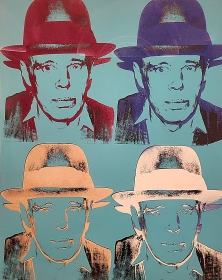
IF I WERE to tell you that I have just seen an exhibition of well over fifty photographic portraits of one person, all reproduced from the same original print, and enjoyed it, you might begin to wonder about me and my sense of aesthetics. Well, I really did enjoy this exhibition at the Thaddeus Ropac gallery in London’s Mayfair. If you wish to share the experience, you will have to hurry, because the show ends on the 9th of February 2024.

On or soon after the 30th of October 1979, the German artist and political activist (e.g., a co-founder of the German Green Party) Joseph Beuys (1921-1986), who was in New York City for the installation of a retrospective exhibition of his works at the Guggenheim Museum, was taken to meet the American Pop artist Andy Warhol (1928-1987). During that encounter, Warhol used his Polaroid camera to make a portrait of Beuys wearing his characteristic felt hat. It was not the first time that Warhol had photographed Beuys. He had also used his Polaroid when he first met Beuys earlier in 1979 at the Hans Mayer gallery in Düsseldorf (Germany). This meeting has been recorded on film (see https://youtu.be/PRrC8EJ3KxI?si=DM4RoR9nDrX_cJbX).

Between 1980 and 1986, Warhol used his Polaroid photograph of Beuys as the source image for a series of screen-printed portraits. As the Press Release on the website of the Thaddeus Ropac Gallery explained:

Repeating Beuys’s arresting gaze on different scales and in different formats, Warhol exercised his characteristically experimental approach to materials in the portraits. Amongst the paintings, unique Trial Proofs, line drawings, and unique and editioned works on paper, are examples of some of the artist’s earliest uses of diamond dust in portraits. These sit alongside images that have had their tonal values inverted to give the effect of photographic negatives. Belonging to the Reversal Series in which Warhol reproduced key subjects from across his wide-reaching body of work – including his iconic portraits of Marilyn Monroe, the Mona Lisa and Mao …”

In the 1940s, Warhol began his working life in commercial and advertising art. By the 1950s, he had discovered the secret of repeating images making small changes to produce variations on a theme. In 1952, he had his first solo exhibition in an art gallery (in NYC). Although it was not well received, it was not long before he became recognised as an artist of note. In 1962, he learned screen-printing techniques, and became one of the first artists to use this process for creating artworks. These include most of  the images on display at Thaddeus Ropac.

The results, which we were able to see at the gallery were far from monotonous, despite being repetitions of the same photograph. By modifying the sizes, colouration, and many other aspects of the photographic portrait, Warhol managed to bring a considerable degree of liveliness to this image. As I saw the various diverse presentations of the single image of Beuys, the German artist began to feel oddly familiar. It was almost as if I was meeting an old friend.

Before seeing the exhibition, I had my doubts about viewing what I had heard were multiple reproductions of the same photograph. My worries were dispelled within a few seconds of looking at the exhibition. I was fascinated how one image could be altered in so many different ways and the effect that seeing the results had on me, There are now less than 24 hours left before the show ends. So, if you can, hurry up and view it.

Art appealing to eye and brain: two exhibitions near Piccadilly

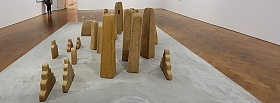
THADDEUS ROPAC GALLERY, in a most elegant building on central London’s Dover Street is four minutes’ walk from Waddington Custot Gallery on Cork Street. We visited both today (the 13th of September 2022). At Thaddeus Ropac, we saw an exhibition, “City of Silence” by Wolfgang Laib (born in Germany in 1950), and at Waddington Custot, we saw “In the Studio”, a collection of works by March Avery (born 1932 in New York City).

Works in beeswax by Wolfgang Laib

Laib’s works, the best of which is a collection of objects made in beeswax that resemble towers and ziggurats, were not particularly visually appealing at first sight. Neither were his numerous minimalistic works on paper or even a set of identical model boats made in brass. It was only after reading some of the explanatory material provided by the gallery that these artworks began to become interesting. They did not become more appealing to the eye, but they began to make some kind of sense to me. For example, the beeswax towers and other objects alongside them are supposed to evoke thoughts of dwellings in the Middle East and the Towers of Silence where Zoroastrians leave corpses to be devoured by vultures. To some extent, these objects achieve the artist’s mental vision of the structures, which inspired them. However, without the explanations, Laib’s exhibition would have ‘left me cold’.

Immediately on entering Waddington Custot, Avery’s colourful, mostly figurative paintings appealed to my eyes and provided feelings of visceral satisfaction. Although it is highly likely that the paintings are manifestations of the artist’s thoughts and ideas, the viewer can get enjoyment from the artworks without knowing anything about what was going through Avery’s mind while she was creating them.   

We left Avery’s exhibition both visually and intellectually satisfied. In contrast, we felt that Laib’s works on their own without explanation were far less fulfilling than Avery’s.

Oscar Wilde, a bishop, and an art dealer

DOVER STREET RUNS north from Piccadilly, not far from The Royal Academy. It is a thoroughfare we often visit because it contains several commercial art galleries that frequently put on interesting exhibitions. One of these is the London gallery of Thaddeus Ropac. Not only does this international art dealer have good exhibitions, but the house in which the works of art are displayed, 37 Dover Street, is an artwork itsef, an architectural treasure.

The architectural historian, Nikolaus Pevsner (1908-1983), whose writing I enjoy greatly, is a little dismissive of the buildings in Dover Street with one exception. In his “London Volume 1”, which was co-authored by Bridget Cherry, he wrote of this street:

“The only house which needs special attention is Ely House (No. 37)”

This is the building that is now home to Thaddeus Ropac. Ely House was built in the 1770s by the then Bishop of Ely, Edmund Keene (1714-1781), who was appointed to that post in January 1771. According to The Dictionary of National Biography (1885-1900 edition), Keene:

“… obtained in 1772 an act of parliament for alienating from the see, in consideration of the payment of 6,500l. [i.e., £6,500] and an annuity of 200l., the ancient palace in Holborn, and for purchasing, at a cost of 5,800l., the freehold of a house in Dover Street, Piccadilly, London. The present house on that site was built by him about 1776.”

Clearly, the bishop was not short of cash; he was married to Mary (née Andrews), daughter and sole heiress of Andrews of Edmonton, once a successful linen draper in Cheapside.

The architect of Ely House was Sir Robert Taylor (1714-1788). The building remained the London residence of the Bishops of Ely until the beginning of the 20th century. In 1909, the interior of Ely House was greatly modified by the Arts & Crafts architectural firm Smith and Brewer (https://ropac.net/news/245-galerie-thaddaeus-ropac-ely-house-london/), and it became the home of The Albermarle Club. This private members’ club, founded in 1874, was open to both men and women, and was first housed at 13 Albermarle Street. Known for its liberal views on women’s rights, it was in 1895 the site of an incident that led to the first trial of one of its members, the writer Oscar Wilde (www.back2stonewall.com/2021/02/gay-lgbt-history-feb-18-oscar-wilde-accused-sodomite.html). Because of the club’s connection with proceedings that led to Wilde’s downfall, it moved to 37 Dover Street to distance itself from Albermarle Street where these unfortunate events had occurred.

During WW2, Ely House became used by The American Red Cross Interstate Club. Later, it housed a private bank. When Pevsner and Cherry published their book in 1973, the house was being used by Oxford University Press. In Spring 2017, Thaddeus Ropac announced that they would open their London gallery in Ely House.

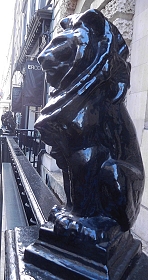
The exterior of Ely House might not have changed much since it was constructed. A medallion on the façade depicts a bishop’s mitre. The magnificent wrought iron railings topped with several models of lions was a 19th century addition based on the lions designed for The British Museum by the sculptor Alfred Stevens (1817-1875). The interior of Ely House would now be unrecognisable to Bishop Edmund Keene apart from a few decorative features that have been preserved. Furthermore, the artworks that are so beautifully displayed in the lovely, whitewashed rooms of the former Ely House would have seemed totally alien to the long-since departed bishop. Rarely, if ever, do the artworks displayed superbly in the gallery lack in visual interest and originality. What drew us to the gallery on the 9th of November 2021 was a small, intriguing collection of creations by Marcel Duchamp (1887-1968) in one room, and several rooms containing disturbingly lifelike, but not always life-sized, sculptures by Ron Mueck, an artist born in Australia in 1958, son of German-born toymakers.

Dover Street is part of a network of Mayfair thoroughfares containing commercial art galleries. Amongst them Thaddeus Ropac has the most beautiful premises and is worth seeing not only for its artworks but also as a fine example of London’s architectural heritage.