
A steep climb to the memorial to a poet

ALFRED LORD TENNYSON (1809-1892), the famous Victorian poet, had his home, Farringford House, at Freshwater Bay on the Isle of Wight. First, he rented the house in 1853, and then bought it in 1856. Because he was pestered by so many tourists, he moved to Aldworth in West Sussex in 1869. However, he kept Farringford, and spent most winters there. In 1860, his friend, the creative photographer Julia Margaret Cameron (1815-1879), bought a house, Dimbola, which was very close to Farringford.
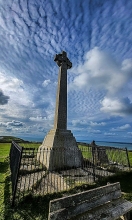
In 1897, a memorial to the poet was erected on Tennyson Down, a clifftop high above Farringford and Dimbola. Designed by JL Pearson, it is a tall stone Celtic cross mounted on a stepped base. A gently sloped footpath leads from Dimbola to the memorial, but we did not use this. Instead, my friend Martin and I laboriously climbed a steeper path closer to it.  The cross is impressive and dramatic against the wide-open sky – almost Wagnerian. The views from the clifftop were magnificent on the clear day we visited it.

Our descent from the clifftop was somewhat adventurous. This was not intentional. Because we could not remember the place the path (and staircase), which we ascended, began, we had to create our own route down the steep, almost vertiginous, wooded slopes. We had to be careful not to trip over the numerous tree roots and fallen branches that were hidden under fallen leaves that lay all over the place. I was quite relieved when we reached the car park without having fallen or strained our ankles. Next time I visit the poet’s memorial, I will use the lengthier but safer footpath.

You can read more about Tennyson and Julia Margaret Cameron, “Between Two Islands. Julia Margaret Cameron and her Circle”, available from Amazon sites such as:
A female pioneer of artistic photography

Many people will have heard of at least one of the following: Alfred Lord Tennyson, Charles Darwin, Anthony Trollope, Charles Dodgson (Lewis Carroll), Edward Lear, Henry Wadsworth Longfellow, Virginia Woolf, Vanessa Bell, and William Dalrymple.

Fewer might be familiar with George Frederic Watts, Valentine Prinsep, Julia Stephen, and Dejazmatch Alamayou Tewodros.

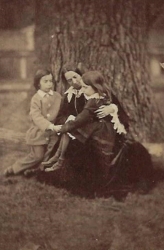
One thing that all of the people listed above share is that they were in diverse ways connected with a Victorian pioneer of artistic photography – Julia Margaret Cameron (1815-1879).

To discover about this fascinating woman and how her story involves all of the above-mentioned, please read “BETWEEN TWO ISLANDS: JULIA MARGARET CAMERON AND HER CIRCLE” by Adam Yamey. It is available both as a paperback and as an e-book from Amazon:

A thatched church and Alfred Lord Tennyson

THE POET ALFRED TENNYSON made his home in the village of Freshwater Bay on the Isle of Wight (‘IOW’) from 1853 until his death. His presence there attracted many Victorian cultural figures to the village either as residents or as his visitors. In 1907, fifteen years after Tennyson died, the Bishop of Winchester visited Freshwater and decided that the village needed a better church than the rather primitive one being used at the time. The Reverend AJ Robertson, who was Rector of Freshwater in 1907, made a watercolour painting of the type of church he hoped would be built. It included a thatched roof. Such a church as he had envisaged was designed by the architect Isaac Jones of Herne Hill in London, and constructed on land donated by Tennyson’s eldest son Hallam, Lord Tennyson (1852-1928). It was Hallam’s wife Lady Emily (1853-1931; née Prinsep), who gifted the new church’s porch and suggested that the church be dedicated to St Agnes.

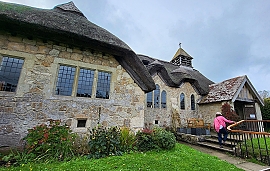
St Agnes is the only church on the IOW to have a thatched roof. Much of the building was built using stones from what had once been the home of the scientist Robert Hooke (1635-1703). The use of old stones makes some people believe that the church is older than it really is. One of the old stones has the date 1694 inscribed on it, a reminder of the origin of the stonework. The interior of the building is well lit by natural light through its many windows. The timber framed ceiling is fine as is the beautifully carved chancel screen. The screen with delicate bas-relief carvings of plants was created by the Reverend Thomas Gardner Devitt, who was curate of St Agnes between 1942 and 1946.

In brief, this thatched church is charming. In appearance, it manages to combine a feeling of mediaeval antiquity with the aesthetics of the Arts and Crafts Movement, which was in its heyday when St Agnes was built. Seeing it was one of many delightful experiences we enjoyed whilst spending a week on the IOW.