
The German artist Gunter Demnig was born two years after the last year of WW2. He is best known for his Stolperstein project, which he started in 1992. A Stolperstein (plural: Stolpersteine, which means ‘a stumbling block’, is a 4-inch concrete cube topped with a brass plate. The metal plate is inscribed with the name and other biographical details of a person, who was murdered by the Nazis. The Stolpersteine are embedded in the pavement outside the last place that they chose freely to reside, work or study, before they were killed by the Nazis and their collaborators. Most of these memorials, upon which passersby will step, commemorate Jewish victims, but others have been placed, as Wikipedia (https://en.wikipedia.org/wiki/Stolperstein) noted, to remember victims including:
“Sinti and Romani people, Poles, homosexuals, the physically or mentally disabled, Jehovah’s Witnesses, black people, members of the Communist Party, the Social Democratic Party, and the anti-Nazi Resistance, the Christian opposition (both Protestants and Catholics), and Freemasons, Spanish Republicans along with International Brigades soldiers in the Spanish Civil War, military deserters, conscientious objectors, escape helpers, capitulators, ‘habitual criminals’, looters, and others charged with treason, military disobedience, or undermining the Nazi military, as well as Allied soldiers.”
During a recent visit to northern Italy and Budapest in Hungary, we spotted several Stolpersteine. Amongst those were a group on the pavement of Budapest’s Andrassy Utca. They were in a row outside the front of the city’s beautiful Hungarian State Opera House, which was designed by Miklos Ybl, and opened in 1875.
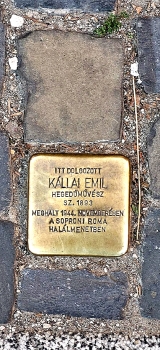
It was just before 7 pm when I spotted the memorials. Elegantly dressed operagoers were swarming across the memorial studded pavement to the front steps of the opera house, where a performance was about to begin. I photographed several of the Stolpersteine, and was dismayed to discover who was being commemorated on them. Here is a list of some of the victims whose memorials I photographed:
- Emil Kallai worked here [in the Opera House]. Violinist. Born 1893. Died November 1944 in a Roma death march at Sopron.
- Frigyes Gyorgy Keleti worked here. Bassoon player. Born 1912. Died 1944 as a slave labourer.
- Roza Kohlberg worked here. Opera singer. Deported to Theresienstadt 1942. Killed at Auschwitz 17 May 1944.
- Leo Jotischky worked here. Viola player. Born 1905. Killed as a slave labourer at Gunskirchen 22 April 1944.
- Pal Hütter worked here. Cellist. Born 1907. Deported 1943. Killed at Bor labour
camp [in Serbia]
And the other Stolpersteiner placed in front of the opera house record similar tragic stories.
I suspect that all those people commemorated in front of the opera house had at many occasions played music by the great German composers such as Mozart, Bach, Beethoven, Wagner, Weber, and so on. Many of them must have admired the Germans for their undoubtedly invaluable contributions to the richness of European culture. I wonder what went through their minds when suddenly they were faced with the brutality and cruelties inspired by Nazi Germany. How could members of a nation that produced highly regarded cultural figures such as composers, philosophers, and writers have lowered their standards to have been able to commit the atrocities that characterised the Nazi era?
I cannot neither answer this question nor begin to guess what these people who had worked in the opera house thought when they were forcibly deported from Budapest, but I can relate a story about a friend who miraculously survived the Holocaust.
‘K’ was born in Poland of Jewish parents. Although he spoke Polish, his family spoke to each other and their social circle in German. For they regarded German as the language of high ‘culture’. In 1939, young K was separated from his parents, whom he never saw again. From that date until the end of WW2, he lived in concentration camps including Auschwitz. Somehow, he survived. After the war, a Jewish organisation moved him to London, where he completed his education, and later became one of my father’s academic colleagues at the London School of Economics. He and his wife married in the garden of our family home.
I met K often. The numbers tattooed in blue on his forearm fascinated me. The sevens in his tattoo were of the European variety with a horizontal line through the vertical arm of the numeral. When I used to visit K and his wife for dinner, I saw that K could not bear to see food thrown away, so great was his memory of hunger in the camps. Although he never discussed it with me, K must have had a horrendous time in the camps. Yet, despite this, I had the strong impression that even after all he had been through including losing his parents, he never stopped admiring German culture. And he enjoyed speaking German.
Returning to those commemorated outside Budapest’s opera house, another question entered my mind. I had read that at some of the Nazi concentration camps, inmates with musical talent were ordered to play in the camp’s orchestra, both for their captors and as the prisoners marched past them on their way to forced labour projects. I wondered how many of those remembered outside the opera house were forced to join these orchestras.
There are Stolpersteine outside many buildings in Budapest. Each one records a human tragedy, the result of fellow man’s inhumanity and the insane ideas of an Austrian who became Chancellor of Germany in 1932.
Since 1914, Budapest has witnessed many horrendous events including: WW1, the Commumist regime of Bela Kun and its aftermath, WW2 and the invasion by Germany, purges during the early years of the post-war Communist regime, and the 1956 Uprising with its brutal suppression. Although much of the city has been tidied up, it is not hard to discover – particularly in Pest – the scars of its recent turbulent history including buildings whose walls are still damaged after having been hit by ammunition fired by both Hungarians and Russians during the 1956 Uprising.
I have visited many cities with dramatic histories, but in Budapest I felt the ghosts of its recent past were ever present. I felt very much in touch with history. However, since my first visits to Budapest in the early 1980s – and especially after 1991 – the city has regained the vibrancy it must have had prior to WW2, and it is a joy to be there.

