
Stepping down to the water in the well

WATER STORAGE TANKS and wells are subject to changes in the water level. In small wells such as are commonly found in England, a bucket and winch system allows the water gatherer to reach the water in the well. In India  where water tanks and wells can be quite large, occupying a substantial area of ground, another system is used to allow users to get to whatever level the water has reached. The walls of the sides of the tank/reservoir/well are lined with a series of staircases, which are used to reach the water. Often the sets of steps lining the walls of the so-called stepwells are arranged in attractive geometric patterns.


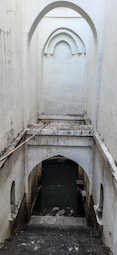
At the Toorji stepwell

Since first seeing a (disused) beautiful stepwell in the ruins of the medieval city of Vijayanagara at Hampi in Karnataka thirty years ago, I have been fascinated by stepwells. I have seen many while travelling around Gujarat,  and was pleased to find one near our guest house in Jodhpur (Rajasthan). It’s name is Toorji ka Jhalra Bavdi.


The Toorji stepwell was built in about 1740. Its construction was ordered by the Queen Consort of Maharaja Abhay Singh. Back in those days, ladies of the royal family often commissioned the building of  water tanks and wells. The Toorji stepwell was used mostly by women, who traditionally did household chores including the fetching and carrying of water.


Toorji stepwell is constructed with the rose red sandstone of Jodhpur.  It is decorated with carvings of various sizes. Nowadays, as with so many interesting places all over the world,  it is a popular location for taking ‘selfies’ and for posing for photographs. Despite this, it is a stepwell worth seeing and is a remarkably tranquil spot surrounded by a maze of narrow, busy streets and lanes.
Temple bells and a stepwell in Surat (Gujarat)

NOBODY KNOWS WHEN the Bahucharaji stepwell was constructed. Legend has it that this well, located in Surat’s Vishal Nagar area, was built by Vanjara people, who came from outside Surat. These people used to visit the city, and set up camp there. This stepwell is said to have been dug by them to provide a supply of water.

The Vanjaras (Banjaras) are descendants of nomadic traders. Found in many parts of India, they used to have an important role in the economy of the Subcontinent. Wikipedia related that:
“… the Banjaras had a monopoly on the movement of salt prior to the arrival of the East India Company. More generally, they also traded in cattle, moving the beasts around the country’s bazaars, and they rented out their carts. Although some older sources have suggested that they did not use credit, Habib’s analysis of historic sources suggests that they did and that some were reliant on it.”

A Hindu goddess called Mataji appeared in the dream of a Vanjara and inspired the construction of the stepwell. After the vav (stepwell) was constructed, a temple was built within it. This is dedicated to Mataji.

The entrance to the stepwell is within a temple compound, in which footwear must be removed. We visited the place on a Sunday morning in December 2023. A steady stream of worshippers of all ages entered the stepwell’s ground level entrance. As they descended the steps towards the water in the bottom of the vav, they sounded the temple bells suspended above the staircase. Before reaching the water, the steps pass two shrines each containing effigies of Hindu deities. At one of them, a lady in a beautiful sari was involved in a lengthy puja conducted by a priest. She was accompanied by a large-ish group of people. I noticed that some of them were holding on to her sari.

We squeezed past the group and descended further into the vav until we reached a railing from which we had a clear view of the water far below us. Several tortoises were resting on the step closest to the water in the well.

After admiring the beautifully maintained vav, we left the temple compound. Outside it, we spotted some beautiful cockerels wandering around. A few days earlier in Surat when we were visiting another temple dedicated to Mataji, we saw cockerels and were told that the goddess favoured these creatures. Above the entrance to the Bahucharaji Stepwell compound, there is a bas-relief depicting Mataji astride a cockerel.

As for Mataji, I will not try to explain her because, for me trying to explain anything about Hinduism is nearly impossible. All I can say is that for Hindus, it seems that their beliefs and rituals are simply a part of the rhythm of daily life, rather than something compartmentalised as is often the case for Europeans.

Faith healing in a well in Baroda

ACROSS THE MAIN ROAD from the 16th century Hazira Maqbara – a mausoleum – there is a small stepwell – the Hazira Vav. We have visited it before but never saw it in use.

A flight of tiled steps leads down to the water in the stepwell. To put it mildly, the water looks filthy and completely uninviting.

At the top of the stairs, there is a small Hindu shrine. The small courtyard surrounding the top of the staircase is decorated with coloured images depicting various Hindu deities. A few coconuts hang between them. These nuts are considered auspicious by Hindus. At our Hindu wedding in 1994, coconuts were included on the complex ceremony, which lasted several hours.

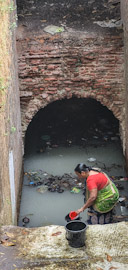
While we were looking at the well, a lady in a sari and her husband arrived. The woman descended the steps to the waters edge. Her husband explained to us that she was suffering from itchiness and that the curative waters of the well might help cure her condition.

The lady picked up one of the bucket on the step beside the water, and filled it from the well. Then, she began dowsing herself with the water. Fully dressed, she poured several buckets of the unwholesome looking water over her whole body.

Having watched this, we felt that it was unlikely that the water itself would heal her, but more likely, it was her faith in its curative properties that might have helped. Having seen the water, my thought was that if one bathed in the well, it is likely that you would end up less healthy than before you entered it.