
A saint and a surveyor

SAINT THOMAS MOUNT in Chennai is best known for being the place where St Thomas was martyred (by whom I have no idea). A friend in Bangalore, John Fernando, told me that apart from the much-revered saint, another notable person is commemorated on the summit of the Mount. His bust can be found near the east end of the church almost hidden away between a couple of banyan trees. The bust is a depiction of the British Colonel, William Lambton (1753-1834).

It is appropriate that the soldier Lambton is commemorated on the summit of the Mount. For, it was from this lofty place that in 1800 he commenced his trigonometric fieldwork for his project, a great trigonometric survey of India.

To quote Wikipedia, Lambton’s:
“… initial survey was to measure the length of a degree of an arc of the meridian so as to establish the shape of the Earth and support a larger scale trigonometrical survey across the width of the peninsula of India between Madras and Mangalore. After triangulating across the peninsula, he continued surveys northwards for more than twenty years. He died during the course of the surveys in central India and is buried at Hinganghat in Wardha district of Maharashtra.”
Lambton’s assistant was George Everest (1790-1866), who succeeded him as Surveyor General of India. Everest is associated with a famous Peak in the Himalayas. However, it was not him but two others, Andrew Scott Waugh and Radhanath Sikdar, who ascertained the mountain’s height.

I am grateful to John for mentioning Lambton’s memorial to me. Even without seeing this bust, a visit to Saint Thomas Mount is worthwhile as there is much of interest to see there including an old church built by the Portuguese, gravestones and paintings with Armenian script on them, and the vibrant nature of Indian Christianity.
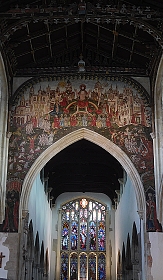
Doom painting

UNDOUBTEDLY THE CATHEDRAL in Salisbury (Wiltshire) is the city’s ‘star’ attraction and is worthy of many visits. However, the city has other things that should not be missed. One of these is the Parish Church of St Thomas (and St Edmund), about 370 yards north of the cathedral.

The Doom Painting

The present church was built from the 15th century onwards. Its detailed history can be found on the church’s website (https://stthomassalisbury.org.uk/wp-content/uploads/2021/06/BriefHistory.pdf). On entering the church from its western end, one cannot avoid seeing the colourful wall painting above the chancel arch. This is the Doom Painting, which depicts The Last Judgement. Images such as these used to be common in Christian Europe but are rare today. ‘Doom’ means ‘judgement’ in Anglo-Saxon. The painting in St Thomas is thought to have been created in about 1470 in the Flemish style by an English painter.

During the Reformation, the painting was covered over with whitewash in 1593. It remained hidden until 1819 when faint traces of colour began to appear when the wall was being cleaned. The painting was carefully uncovered in 1881, and then it was restored. In 1953, the image was cleaned again and retouched. Since then, it has remained untouched. Although it has been restored, it gives a good idea of how this superb fresco looked when it was first created.

While looking up at the Doom Painting, you should also examine the decorated timber ceilings above the nave and other parts of the church. These contain almost 100 wood carvings of angels. Also of interest, is a wooden panel on the wall of the south aisle. This bas-relief wood carving depicts Abraham sacrificing his son Isaac and Jacob’s Dream. It was created in about 1660 by the master Joiner Humphry Beckham (1589-1671).

There are plenty of other interesting items to see in the church, which deserves a visit. Had there not been a famous cathedral in Salisbury, this smaller church would have become one of the place’s main attractions.