
Created by an arrow: Bombay’s longest occupied settlement

LEGEND HAS IT that when Rama was searching for Sita, who had been kidnapped,  he stopped at a spot in what is now Walkeshwar in Bombay. Thirsty, Rama asked his brother, Lakshmana, to get hom water. Thereupon, Lakshmana shot an arrow (‘baan’) into the ground, and where it landed, a stream began to flow. Although1000 miles away from the Ganges, it was considered to be a tributary of the holy river. This stream has been named the Bānganga, and its water is stored in a large rectangular stepped tank.
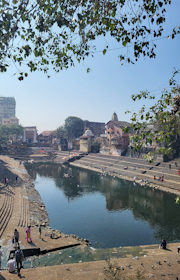
 

Bānganga Tank

The tank, the Bānganga Tank, was constructed in 1127 AD by by Lakshman Prabhu, a minister in the court of Silhara kings of Thane. It was restored in 1715. The area in which the tank is located, Bānganga,  is Bombay’s oldest inhabited district.


We have visited Bāngang often and it is always a treat. Located close to the Arabian Sea, the area around the tank is a complete contrast to the rest of Bombay. The tank is surrounded by small houses and, being a sacred spot, plenty of Hindu temples. The place is more like a quaint village than part of one of the world’s biggest cities.


Between the tank and the rocky sea shore, there is a large colony of ramshackle structures mostly made with sheets of corrugated iron. The inhabitants of this slum have an enviable view of the sea. One day, I  suppose, some developer will clear away these poor people’s dwellings, and replace them with swanky apartments or hotels. But developers should be wary because, so we were told, during the monsoon seasons, large areas of the slopes between the tank and the sea become inundated.


We made our most recent visit to Bāngang on the first day of 2026, and found it to be as delightful as ever. However,  we noticed that in addition to the pigeons and abundant waterfowl in the tank and on its steps, there was no lack of rubbish.


Since our last visit to Bānganga about two years ago,  the RPG Foundation has put up signs that identify various temples and provide some history of each place.  Despite these, there seemed ti be few tourists around the tank.

A local working-class heroine

COLVILLE SQUARE GARDEN in North Kensington is seventy-two yards east of a section of Portobello Road, where stalls with various foods do business most days of the week. The square was laid out in the1870s by the local developer George Frederick John Tippett (1828 – 1899). By the 1950s, the area around Colville had a large proportion of the local ‘black’ community, numbering about 7,000 (https://citylivinglocallife.files.wordpress.com/2017/04/colville-community-history-newsletter-issue-18.pdf), living there.  Conditions in the locality became particularly bad not least because of the activities (www.rbkc.gov.uk/vmpeople/infamous/peterrachman.asp) of the notoriously unscrupulous local Polish-born landlord Peter Rachman (1919-1962). Unfortunately, in addition t0 Rachman’s poor behaviour with his mostly impecunious tenants, the area became seedy and crime ridden. Since those days, things have looked up and the area has become a far more pleasant place to live and visit.

Colville Square Gardens is a typical London square surrounded by residential buildings. Long and thin. it runs parallel to Portobello Road between Colville Terrace and Talbot Road. Much of the garden is used for recreational activity and includes a play area for young children. At the south-eastern corner of the square, there is a decorative iron gate leading to a nursery and pre-school. The gates bear the words:

“In memory of Pat McDonald”, and her dates:

“1940 – 1986”

A small, rather indistinct plaque next to the gate records:

“Pat McDonald. Working-class heroine. Lived and worked in North Kensington from the 1960s until her death in 1986. She was the driving force behind the campaigns for better housing, more play-space, and new nurseries. May her fighting spirit live on.”

There is no mention of who placed this memorial.

Pat’s endeavours to improve the care of children under the age of five began in about 1967 when she:

“… and a mothers group ‘commandeered’ a local vicar and started a playgroup in the vestry of a local church … The booklet to commemorate Pat McDonald’s life tells through reminiscences how this became Powis Playgroup in All Saints Church Hall, which gained a grant for equipment from the Pre-school Playgroups Association.” (www.academia.edu/28663809/Activism_and_organisation_Creating_a_community_nursery_in_1970s_Notting_Hill).

And this is almost all that I have managed to discover about North Kensington’s local heroine. It seems that the poor lady’s life ended tragically. Two websites allude to her tragic, premature end. From one of them (www.theundergroundmap.com/article.html?id=34069), we learn:

“The Colville Nursery Pat McDonald gates are dedicated to the People’s Association community activist play worker, who was murdered by her husband.”

The association was most likely the ‘Notting Hill People’s Association’, which was set up in 1966 to:

“… to widen access topeople with grievances and problems and to resolve them with legal advice – to resolve the individual problems but also to campaign on more general issues.” (www.unionhistory.info/britainatwork/emuweb/objects/common/webmedia.php%3Firn%3D1618+&cd=8&hl=en&ct=clnk&gl=uk).

Once again, whilst walking along a street which I have used hundreds of times, I came across something I had never noticed before. This time it was the quite conspicuous gate in memory of a social reformer and the far less conspicuous memorial plaque close to it. I pride myself on being reasonably observant, but clearly, I have not been nearly as aware of my surroundings as I believed.