ALTHOUGH THE MAIN attraction of Dulwich Picture Gallery is the collection of works of art by famous painters, there is a small but fascinating feature that should not be missed. And that is the mausoleum. This small chamber houses the sarcophagi containing the remains of the gallery’s founders, Sir Peter Francis Bourgeois, Noel Desenfans, and his wife Margaret.
Like the rest of the gallery, the mausoleum was designed by Sir John Soane (1753-1837). Working in an age before electric lighting was available, he was a master of maximising the use of natural illumination to get light into his buildings. The galleries at Dulwich are provided with clear glass ceilings that are sufficient to provide adequate lighting of the artworks. However, this is now supplemented with electric lighting. Light enters the mausoleum through glass windows at the top of it. Instead of plain glass, he used amber coloured glass. The light passing through this gives the mausoleum a warm glow, making it feel a spiritual place.
The mausoleum was badly damaged during an air raid in WW2. However, it was restored and is said to look exactly as it did before the war. Although it was designed as a final resting place, it is occasionally used to house art installations and films about temporary exhibitions being held in the galleries.
WIMPOLE HALL IN Cambridgeshire is according to the architectural historian Nikolaus Pevsner:
“Without doubt the most spectacular country mansion in Cambridgeshire…”
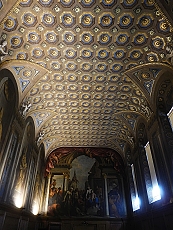
Chapel at Wimpole Hall, Cambridgeshire
Much of the mainly red brick building dates from the 17th century, although more was built in the 1740s. It contains many splendid rooms including a large library; a chapel decorated in 1724 by the painter James Thornhill (c1675-1734), who decorated the Painted Hall in Greenwich; and a large ‘salon’ created by Sir John Soane. These are a few of the wonders that can be viewed within the house, now maintained by the National Trust. The grounds of Wimpole are also superb and include a magnificent walled garden and a ‘Gothick’ folly.
Despite the visual attractions of Wimpole Hall, I was fascinated by its last owners: George and Elsie Bambridge. George Louis St Clair Bambridge (1892-1943) was a British diplomat and a soldier. In October 1924, he married Elsie Kipling (1896-1976), the second daughter of the famous writer Rudyard Kipling (1865-1936).
After living in several places outside the UK, George and Elsie came to London. Between 1933 and 1937, they lived in Hampstead. Their home in that lovely district of north London was the elegant Burgh House, which was built in 1704. In an epilogue to a biography of her father by Charles Carrington, Elsie wrote of Burgh House:
“In 1933 we returned to England, and our life in the delightful old house which we rented in Hampstead was a source of happiness to him to the end of his life.”
The person to which she was referring (i.e,, “him”) was her father, Rudyard Kipling.
On the 12th of January 1936, Rudyard and his wife (Carrie) visited George Bambridge, who was in bed at Burgh House, suffering from bronchitis. It was to be Rudyard’s last outing because on the following day he was admitted to Middlesex Hospital where he underwent hazardous surgery for a haemorrhage. He died in hospital on the 18th of January.
The Bambridges moved from Hampstead to Cambridgeshire in 1937. They rented Wimpole Hall between 1937 and 1942, when they purchased to property. George died in 1943, and his widow, Elsie, continued living in Wimpole Hall until her death. When they moved in, the place was empty of contents. They bought pictures and furniture, much of which can be seen today. After her husband’s death, Elsie used the substantial royalties from her father’s books to refurbish the house. On her death, she bequeathed the house and its vast estate to the National Trust. It is well worth visiting if you are anywhere near Royston or Cambridge and it is no more than one hour’s drive from central London.


 yamey
yamey 