
History revealed at a shop in London’s Kensington

SHOPS IN LONDON’S High Street Kensington are forever changing hands. And each time a new lessee takes over a shop, he or she brings in builders to alter the shop’s appearance. Today (in July 2025), I passed a currently empty shop undergoing a change in the appearance of its façade. The front of the shop had been stripped down, and as a result the name of one of the businesses that had formerly used the premises had been revealed. The old shop sign at number 13 High Street Kensington read “Blooms (1920) Ltd.”.

When I tried looking this up on Google, by entering various combinations of search words, I was shown a list of flower shops, none of which are at 13 High Street Kensington. And, sadly, nothing came up that revealed any information about Blooms Ltd, which had once occupied the premises. So, if anyone knows anything about the business conducted by Blooms (1920) Ltd, do please let me know.  
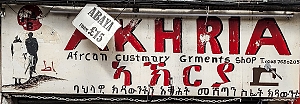
A sign with missing vowels in Shepherds Bush

IN SHEPHERDS BUSH Market, I noticed a shop sign written in Arabic, Ethiopian and Latin scripts. The Latin script read as follows:

“Afrcan custmory grments shop”.

Was this bad spelling of English words or maybe something else? It might have been the latter as I will try to explain using two examples.

When I was a dental surgeon, I worked for a while with a wonderful assistant from Uganda. Her English was very good, but when she saw me eating potato crisps at lunch time, she used to ask me whether I was enjoying my “crisips”.  The other example concerned a couple of Italian friends who had been living together since they were both 18 years old. Just after their 40th birthdays, they married suddenly. When we asked them why, the lady said in English:

“For physical regions.”

We were surprised. It turned out that what she was trying to say in her Italian accented English was that they had married for FISCAL reasons.

Both my Ugandan assistant and our Italian friend had inserted vowels between two consecutive consonants where they did not exist in the properly pronounced versions of ‘crisps’ and ‘fiscal’. Remembering this, I wonder whether whomever had written the shop sign in Shepherd Bush Market had thought it unnecessary to put in various vowels where they should have been because they believed that readers of their sign would automatically add vowel sounds between some pairs of consonants. This kind of reader would probably read the misspelt signs as follows:

“African customary garments shop”

If this is not the case, then the signwriter needs to improve his or her spelling of English words.