WE USUALLY PASS this place early on Sunday mornings. As it opens at 12 noon, we had never been able to enter it until a few days ago. Situated on the riverside in Hammersmith with its entrance in a narrow passage that is the east end of Upper Mall, it is The Dove pub. As it looks so quaint and ‘olde worlde’, we have long planned to visit it during its opening hours.
The Dove pub has been in existence since the early 18th century, or maybe the century before. Its north facing façade was created in the early 19th century. It is said that King Charles II (reigned 1660-1685) might have entertained his mistress Nell Gwynne here. Although there is no certainty about that, there is evidence that the Scottish poet James Thomson (1700-1748) spent time in The Dove. In 1740, he composed the poem “Rule, Britannia!”, which was later set to music by the composer Thomas Arne (1710-1778). He is said to have written the poem in The Dove, where there is a memorial commemorating the birth of this famous British patriotic song. Later regular visitors to the pub included Ernest Hemingway, Dylan Thomas, and William Morris (who lived a few yards away).
We decided to visit the pub after a late afternoon performance of an enjoyable film, “Taste of Things”, at the nearby Riverside Studios. On entering The Dove, there is a bar to the right and a small seating area to the left. The bar is one of the shortest in the UK – it is only 7 feet long. To comply with legal requirements, a second bar had to be built. This is reached by climbing a few steps into a larger middle room, which was heated by a real coal fire and lined with pictures. We took a table in this cosy dining area, and enjoyed acceptably good food. Another flight of steps leads down into a third seating area with windows overlooking the Thames. Beyond this, there is an open terrace with views of the river.
The Dove is wonderfully old-fashioned. Even though it is in the heart of west London, it feels just like a traditional country pub in the middle of nowhere. Most of the clientele in the pub on the Monday evening we visited it were local people. I suspect that during weekends and public holidays, the locals become outnumbered by visitors who are not local.
Having ‘broken the ice’ and entered the pub, I am sure that we will become regular visitors there, but it is unlikely that we will compose a song that can rival “Rule, Britannia!”- however much we drink.
NOW THAT THE GRAND FINALE of Brexit is nail-bitingly close, maybe our thoughts will turn to patriotism as it is hoped by many, but certainly not all, that Britannia will once again rule the waves, or, at least, the fish that surround our ‘sceptred isle’. Some hope, if you ask me!
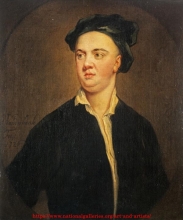
James Thomson
Yesterday, the 16th of December 2020, we joined our friends on a walk from their home in Richmond to Kew Gardens. On the way, we walked along a quiet back street, Kew Foot Road, and passed a former, now disused, hospital, ‘The Royal Hospital’, which opened in 1868 (https://ezitis.myzen.co.uk/royalrichmond.html) and closed recently. In its last reincarnation, it served as a psychiatric day hospital and a mental health resource centre. A plaque on one of its buildings facing Kew Foot Road commemorates that James Thomson (1700-1748) lived and died here. Observant readers will note that his residence in this location antedates the establishment of the former hospital. The hospital was opened as ‘The Richmond Infirmary’ in the pre-existing Rosedale House on Kew Foot Road. According to James Thorne in “Handbook to the Environs of London” published in 1876, this was the building in which Thomson lived.
Thorne wrote of Rosedale House:
“The present house is a large brick house of three floors, – a centre with a small portico reached by a flight of steps, and two irregular wings. The house Thomson occupied was a mere cottage of two rooms on the ground floor, which now, united by an arch, form a sort of entrance hall… It has since suffered many changes, and is by now (1876) the Richmond Infirmary. The garden has suffered as much as the house. Thomson was fond of his garden, added largely to it, and spent as much time in improving it as his indolent temperament allowed.”
Thomson’s cottage became incorporated into the building that served as the first part of what was to become the Royal Hospital.
One room was where Thomson died on the 22nd of August 1748. The other room was where he wrote his last published poem, “The Castle of Indolence” (text available at : http://spenserians.cath.vt.edu/TextRecord.php?textsid=34286) during the last year of his life. This poem, written in Spencerian stanzas, had a great influence on the poetry written by Byron, William Wordsworth, and John Keats. This kind of stanza, employed by Edmund Spencer (1552-1599) in his poem “Faerie Queen”, consists of nine lines, eight of which are iambic pentameters and the remaining an iambic hexameter, with the ABABBCBCC rhyming scheme (https://en.wikipedia.org/wiki/Spenserian_stanza).
Thomson was, as you might begin to realise, a poet. Born in Scotland, and educated at The College Edinburgh, he was planning to become a Presbyterian cleric. At Edinburgh, he joined the Grotesque Club, a literary group. He made friends with a fellow member, the Scottish poet and dramatist David Mallett (c1705-1765) and followed him to London in early 1725. Thomson had a busy life in London, tutoring, teaching in a school, and writing.
In 1740, Thomson collaborated with Mallett on the masque “Alfred”, which was first performed that year at Cliveden, the country home of Frederick, Prince of Wales (1707-1751), father of King George III. Five years later, the British composer Thomas Arne (1710-1778) modified their work to create an oratorio and then a few years later an opera. The finale of this work by Arne uses Thomson’s words in the now well-known patriotic song “Rule Britannia”.
Thomson wrote the words to “Rule Britannia” whilst living at Rosedale in Kew Foot Road. He moved to the area from his room above the Lancaster Coffee House at Lancaster Court in London’s Strand in 1836, but not immediately to Rosedale. It was in 1839 that he moved along the road to Rosedale (www.richmond.gov.uk/james_thomson).
In August 1748, Thomson took a boat trip from Hammersmith to Kew. During that excursion, he caught a chill. The great Samuel Johnson (1709-1784) describes Thomson’s this excursion in his “Lives of the English Poets” as follows (http://spenserians.cath.vt.edu/BiographyRecord.php?action=GET&bioid=33843):
“The last piece that he lived to publish was The Castle of Indolence, which was many years under his hand, but was at last finished with great accuracy. The first canto opens a scene of lazy luxury, that fills the imagination.
He was now at ease, but was not long to enjoy it; for, by taking cold on the water between London and Kew, he caught a disorder, which, with some careless exasperation, ended in a fever that put an end to his life.”
Thomson was buried in St Mary Magdalene, Richmond, near the font.
I had no idea when we set out for our walk that I would walk past the former home of the creator of the patriotic song, “Rule Britannia” on our way to Kew Gardens, which we entered via the Lion Gate and enjoyed greatly. Each time I visit these fine botanical gardens, my enjoyment of this place increases.


 yamey
yamey 