
A merchant’s house near the River Thames

THE FIRST DENTAL practice in which I worked was in the village of Rainham in north Kent. Although I practised there from 1982 until about 1994 and knew that there is another place called Rainham in east London, I never ever visited it. It was only in August 2022 that we drove to Rainham, formerly in Essex, and now in the London Borough of Havering. Situated between Dagenham and Tilbury, the former Essex village contains a few reminders of its past: several cottages; a fine old parish church; and Rainham Hall. It was to see the latter that we travelled through the industrial areas of east London to reach Rainham.

Rainham Hall, now beautifully maintained by the National Trust (‘NT’), was built in about 1729 by John Harle (1688-1742), who was buried in the nearby parish church. Son of a successful mariner of South Shields, who had made his fortune shipping coal from South Shields to London, John became a prosperous businessman in London. Harle came to Rainham (Essex) in 1728, and built the fine brick house, which we see today. As the NT’s guidebook pointed out:

“By aristocratic standards, the Hall is a modest house … The Hall is a rare survivor and a wonderful example of early 18th-century architecture. It was designed as a home, not for the super-rich, but for the ‘middling sort’ of successful marine merchant.”

Between Harle’s death and WW2, the Hall became the property of a series of different people, and occupied by many owners and tenants. During WW2 and until 1954, the Hall was requisitioned by Essex County Council, who used it for various purposes including as a nursery for the children of working women. The Hall was offered to the NT in 1945 and the organisation adopted it 4 years later.

Until the 1990s, the Hall had a series of tenants. Each of them had interests in arts and design. First, the place was leased to the architectural historian Walter Ison (died 1997) and his wife, the artist and architect Leonora Payne. In 1962, they left, and the Hall became home to Anthony Denney (1913-1990). Denney, who trained at the Royal College of Art in London was already an established fashionable fashion photographer and collector of modern art by the time he came to live in the Hall. He helped restore the house. After Denney left the house in 1969, it became home to the architect Adrian Sansom and his wife Marilyn, a cellist. In the 1980s, the Hall’s tenants were the viola player Paul Silverthorne and his wife Mary. They encouraged local residents to use the Hall’s extensive gardens and also did restoration work. Stefan Roman, the film-set designer and his family followed the Silverthornes, and the last tenants were the painter David Atack and his family.

The visitor to Rainham Hall can wander through rooms on the ground, first, and second floors. The various inhabitants of this large but intimate family dwelling have all made modifications to the building, but mostly in keeping with the age and character of the Hall. When we went around recently, many of the rooms were being used to house exhibits relating to the life and work of Anthony Denney. We entered the garden, which was in a sad state because of the lack of rain and the heatwaves affecting most of England. The recently restored stable block will be discussed in a future essay. I am glad that we visited Rainham in Havering. Although it cannot be described as being one of England’s most picturesque places, it is certainly more pleasing to the eye, and has more redeeming features, than Rainham in Kent.
Royal remains

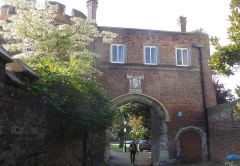
WE VISIT RICHMOND regularly to see a couple of friends, with whom we almost always take a stroll, usually somewhere reasonably near their home. They know that I love seeing places that I have never visited before and almost always they take us to see something that they feel might interest us. On our most recent walk with them, taken in October 2021, we began by walking across Richmond Green, taking a path that was new to us. At the western edge of the green, we crossed a road and immediately reached a Tudor gateway that leads into an open space surrounded by buildings. The open space is on the site of a now mostly demolished royal residence that was particularly liked by Queen Elizabeth I.

The royal residence was Richmond Palace. It was built by King Henry VII, when the 14th century Shene Palace, which used to stand on the site, was destroyed by fire in December 1497.  Henry VII built a new palace on the same ground plan of Shene Palace. Richmond Palace, as the new building was named, was used continuously a royal residence until the execution of King Charles I in January 1649.

On a wall facing a pathway leading from the old gatehouse to the River Thames, there is a commemorative plaque with the following carved on it:

“On this site extending eastwards to cloisters of the ancient friary of Shene formerly stood the river frontage of the Royal Palace first occupied by Henry I in 1125…”

It adds that Edward III, Henry VII, and Elizabeth I all died in the palaces that stood on this riverside site in Richmond.

After Charles I lost his head, the palace, like many other parts of the royal estate, was sold by the Commonwealth Parliament led by Oliver Cromwell. Much of its masonry was sold. According to an informative source (www.richmond.gov.uk/media/6334/local_history_richmond_palace.pdf):

“While the brick buildings of the outer ranges survived, the stone buildings of the Chapel, Hall and Privy Lodgings were demolished and the stones sold off. By the restoration of Charles II in 1660, only the brick buildings and the Middle Gate were left.”

The same source relates that after being owned by the Duke of York, who became King James II, and after he was deposed:

“The remains of the palace were leased out to various people and, in the early years of the 18th century new houses replaced many of the crumbling brick buildings. ‘Tudor Place’ had been built in the open tennis court as early as the 1650s, but now ‘Trumpeters’ House’ was built in 1702-3 to replace the Middle Gate, followed by ‘Old Court House’ and ‘Wentworth House’ (originally a matching pair) in 1705-7. The Wardrobe building had been joined up to the Gate House in 1688-9 and its garden front was rebuilt about 1710. The front facing the court still shows Tudor brickwork as does the Gate House. ‘Maids of Honour Row’ replaced most of the range of buildings facing the Green in 1724-5 and most of the house now called ‘Old Palace’ was rebuilt about 1740.”

During our recent perambulation with our friends, we saw most of the buildings listed in the quote above but not the Maids of Honour Row. They also pointed out that Richmond Green, across which we walked, was used for jousting tournaments in mediaeval times. Today, this pleasant green space close to Richmond’s main shopping street is used for more peaceful purposes including walking, both human beings and their canine companions.

Once again, a visit to our friends in Richmond has resulted in opening our eyes to new places of great interest, and for that we are most grateful.