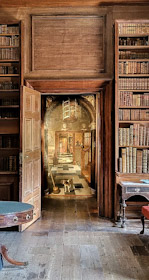
THERE IS A LONG corridor in Dyrham Park house near Bath. It seems to be extremely long when seen from one end of it, but this is an illusion. The extreme length has been created by putting a troupe l’oeil painting at one end of the corridor. This painting is a work of the Dutch artist Samuel van Hoogstraten (1637-1678), who was one of Rembrandt’s most successful students.
In addition to this trompe l’oeil by Hoogstraten, there is another one placed above a grand staircase at Dyrham House. These two paintings are not the only ones at Dyrham. One of the former owners of the house, William Blathwayt (1649-1717), was a collector of paintings by Dutch masters. Not only did he purchase Dyrham Park, but also, amongst many other achievements, he established the War Office as part of the British Government.
“Perhaps the original Mughal miniatures arrived from the Dutch trading post in India. It’s also possible that he encountered the paintings in the collections of wealthy traders and various Dutch East India Company officials, who were his friends and often his clients.”
Shrey added:
“These drawings are remarkable for they allow us to understand the incredible global network established by trade ships which allowed an exchange of cultures to take place on a global scale.”
Recently, we visited an excellent exhibition at the MK Gallery in Milton Keynes: “Beyond the Page. South Asian Miniatures and Britain 1600 to now.” Amongst the many beautiful and intriguing exhibits, there were a few that illustrated the influence of Mughal painting on Western European artists. Although none of the above-mentioned Rembrandt drawings were on display, what I saw interested me greatly. I have been long aware of the influence of western artistic trends on the works of artists from the Subcontinent, but not the other way around.
An artist, Willem Schellinks (1623-1678), one of Rembrandt’s contemporaries is represented in the MK Gallery’s exhibition. He, like Rembrandt, is believed to have studied an album of Mughal paintings, which was thought to have been in the possession of the English art collector Alethea Howard (1585-1654), Countess of Arundel, who lived in Amsterdam from 1641 until her death. Incidentally, her portrait was painted by Peter Paul Rubens (1577-1640). In addition to sketches, Schellinks is known to have painted at least six paintings that contain Indian imagery (see the detail above). One of these and a sketch are on display at the MK Gallery.
In the same room as the Schellincks works, there is a painting by William Rothenstein (1872-1945). Drawing inspiration from traditional Mughal miniature paintings in the India Office Collection (in London), he created his “Sir Thomas Roe’s embassy to the court of Jahangir”, which was completed in 1924.
Before seeing the exhibition at Milton Keynes, I knew that Rothenstein had an interest in Indian culture. For example, he helped Rabindranath Tagore (1861-1941) to find accommodation in Hampstead’s Vale of Health in 1911-1912, but the well-produced exhibition catalogue provided me with information that was new to me. For example, Rothenstein had visited India and was a collector of Rajput paintings and drawings. In addition, in 1910 he was a co-founder of the India Society of London, whose aim was to bring Indian Art, in its many forms, to the attention of audiences in Britain and the world. So, it is maybe unsurprising that he chose to paint his picture of Sir Thomas Roe (c1581-1644) meeting with Emperor Jahangir (1569-1627) in a style that was influenced by the painters who would have around at the time of that historic rendezvous, sometime between 1616 and 1619.
Close to Rothenstein’s painting, there is an image by Abanindranath Tagore (1871-1951), who was a nephew of Rabindranath Tagore. This chromolithograph, “The Last Moments of Shah Jahan”, was created in 1903 in the style of traditional Mughal miniature painting. It is interesting to note that Abanindranath had never encountered Mughal paintings until he was in his twenties. He was introduced to them by another of the founders of the India Society, the art historian Ernest Binfield Havell (1861-1934). Havell had served the Madras School of Art as Superintendent for a decade from 1884, and in 1896 became Superintendent of the the Government School of Art in Calcutta. According to Wikipedia:
“Havell worked with Abanindranath Tagore to redefine Indian art education. He established the Indian Society of Oriental Art, which sought to adapt British art education in India so as to reject the previous emphasis placed on European traditions in favour of revivals of native Indian styles of art, in particular the Mughal miniature tradition.”
The works by Schellincks, Rothenstein, and Abinindranath Tagore, all on display at the MK Gallery, vividly demonstrate the cross-cultural fertilization that began when Europeans first set foot on Indian soil with intentions that were far from being cultural. I have written about only a few of the wonderful exhibits in the show, but all of the others on display are not only beautiful but are filled with a wide variety of deep meanings. Of the many exhibitions I have seen this year, the one showing at the MK Gallery until the 28th of January 2024 is by far the best.
KENWOOD HOUSE IS NEAR both Hampstead and Highgate in north London. It offers the visitor the chance to view not only its lovely grounds and fine interiors designed by the architect Robert Adam (1728-1792), but also a fabulous collection of paintings, many by world famous artists including, to mention but a few, Rembrandt, Frans Hals, Van Dyck, Vermeer, Reynolds, and Gainsborough.
Merlin (painted by Gainsborough) and the invalid cahir he invented
One of the paintings by Thomas Gainsborough (1727-1788) is a portrait of the inventor John Joseph Merlin (1735-1803). The latter was born in Huy (Belgium), and as a young man, he worked in Paris making clocks and mathematical instruments. In 1760, he moved to England to work as a technical advisor to the then new Spanish Ambassador to London. By 1766, he was working with the London jeweller James Cox. Then, he was creating mechanical toys including the Silver Swan, an automaton, still working, that can be seen at the Bowes Museum in Barnard Castle (Durham).
In addition to these ‘toys’, Merlin invented some useful items. These included roller skates; various clocks including one that was powered by changes in atmospheric pressure; improvements to keyboard musical instruments; playing cards for blind people; prosthetic devices; and a self-propelled wheelchair known as ‘the Gouty Chair’. There is an example of this ingenious wheelchair on display beneath Merlin’s portrait in Kenwood House. In my book about Hampstead and its environs, I described it as follows: “Two handles at the ends of its armrests are connected by rods and cogwheels to some wheels on the floor below the chair. The occupant of this chair could rotate the handles, and thereby propel this early form of wheelchair around the room.”
In the same room as the invalid’s chair, there is another of Merlin’s creations: a skeleton clock made by him in 1776. This kind of timepiece is one, whose working parts are not concealed by casing or any other features that usually hide them.
The portrait of Merlin, painted in 1781 by his friend Gainsborough, shows him in a red jacket, holding a small beam balance in his left hand. Apparently, this was one of his creations. This precision instrument is the only clue that the subject of the painting had anything to do with jewellery or instrument making. His right hand is tucked into his jacket:
The painting hangs in Kenwood House because it, like many of the others on display there, were part of the collection of the philanthropist and brewer (of the Guinness beverage) Edward Cecil Guinness, 1st Earl of Iveagh (1847-1927), who bought the house in 1927, and bequeathed it and his collection of paintings housed within it to the nation. You can discover more about Kenwood and nearby Highgate village in my book “Beneath a Wide Sky: Hampstead and its Environs” (https://www.amazon.co.uk/dp/B09R2WRK92 OR https://www.bookdepository.com/BENEATH-WIDE-SKY-HAMPSTEAD-ITS-ENVIRONS-2022-Adam-Yamey/9798407539520 )
IN CASE YOU ARE WONDERING, this piece is not all about me, Adam Robert Yamey. My father, a well-known economist, was all for calling me ‘Adam Smith Yamey’, in honour of the famous Scottish economist and author of “The Wealth of Nations”, Adam Smith (1723-1790), but my mother was against this. My ‘Robert’ might have been chosen because my mother had a brother called Robert, but maybe they chose the name because they knew about a more celebrated Robert, the Scottish architect and Adam Smith’s contemporary, Robert Adam (1728-1792). Lately, we have visited two buildings whose appearances owe much to Adam the architect. One is Osterley House, west of London, and the other Kenwood House in north London.
Ceiling of Etruscan Room at Osterley
According to a mine of information, “Handbook to the Environs of London” by James Thorne (published in 1876), the manor of ‘Osterlee’ belonged to John de Osterlee in the reign of Edward I (lived 1239-1307). Through the years it moved through the hands of men such as John Somerseth (died 1454), Henry Marquis of Exeter (1498-1538), Edward Seymour (Protector Somerset 1500-1552), Augustin Thaier, and then Sir Thomas Gresham (1519-1579).
Gresham was, according to Thorne, was “… the prince of merchants”. An able financier, he worked on behalf of King Edward VI, Queen Mary I, and Queen Elizabeth I, and was also the founder of the Royal Exchange in London. In 1857, the economist Henry Dunning Macleod, used Thomas’s surname to name a law of economics, namely ‘bad money drives out good’. By 1577, Gresham enclosed Osterley Park and constructed a magnificent mansion. Although there are no surviving images of this building, its architectural style can be imagined by looking at the Tudor stable block (c1560) that stands next to the present Osterley House.
After Gresham’s death, the building began to decline even while his widow, Anne (née Ferneley), continued to dwell in it. After her death in 1596 at the age of 75, Osterley House and its grounds were owned by a series of people until about 1713, when the banker Sir Francis Child (1642-1713) bought the property.
Sir Francis left the place to his sons Robert (1674-1721), Francis (1684-1740), and Samuel (1693- 1752). It was the latter’s son, the third Francis Child (1735-1763), who engaged the fashionable architect Robert Adam to make improvements to Osterley House. His was employed in the 1760s to modernise Gresham’s house. The most obvious of Adam’s works can be seen before you enter the house, the neo-classical portico supported by two rows of six Ionic columns that evokes memories of the Propylaeum of the Parthenon in Athens, which Adam might well have known about after his Grand Tour of Europe undertaken between 1755 and 1757, which, incidentally, included a visit to the ruins at Split (now in Croatia). The portico joins two wings of the building that Child inherited.
In addition to the magnificent portico that contrasts with the Tudor brickwork of the rest of the building, Adam redesigned the entire interior of the building, creating a series of beautifully decorated rooms, most of which have eye-catching ornate ceilings. One room, which does not have a decorated ceiling is the Long Gallery which was used to house some of the large collection of paintings that used to hang in the Child’s London home, which they sold in 1767. Most of these artworks were removed from the house when Lord Jersey gifted the house to the National Trust in 1949, and then lost in a fire. They have been replaced by other fine paintings. Many of the chairs and sofas and other furnishings in the Long Gallery (and other rooms) were designed by Robert Adam, who took great interest in every detail of what he created. The absence of ceiling decorations, it was explained to us, was intentional; the ceiling was left unadorned so that viewers of the paintings were not distracted by decorative features above them. In the other rooms, the ceilings rival other aspects for the viewer’s attention. From the grand entrance hall onwards, the visitor is faced with a series of rooms that compete for his or her admiration. Amongst these marvels of interior decoration, I was particularly impressed by the Drawing Room that drew inspiration from the Temple of the Sun at Palmyra (destroyed by ISIS in 2009), the Tapestry Room, and the delicately decorated Etruscan Dressing Room. I have singled out these rooms, but the others are also magnificent. Adam’s creations make a visit to Osterley Park a breath-takingly exciting visual experience.
As the crow flies, Kenwood House is ten miles northeast of Osterley House, or about 15 miles by road. Osterley House was completely remodelled by Robert Adam. Beneath his modifications, its structure is basically the Tudor mansion that the Child family purchased. The situation is different at Kenwood.
In 1755, the lawyer and politician William Murray (1705-1793), who was to become First Earl of Mansfield, bought Kenwood House. In 1764, he commissioned Robert Adam to remodel the house, giving him freedom to do it however he wished. Adam did the following (as quoted in www.english-heritage.org.uk/visit/places/kenwood/history-stories-kenwood/history/):
“… addition of a new entrance on the north front in 1764, which created the existing full-height giant pedimented portico … modernised the existing interiors, notably the entrance hall (1773), Great Stairs and antechamber, and built a new ‘Great Room’ or library (1767–9) for entertaining. The ground-floor rooms on the south front all received Adam’s new decorative schemes. These social spaces for the family included a drawing room, parlour and ‘My Lord’s Dressing Room’ … designed the south front elevation in 1764, but changed it in 1768 in order to insert attic-storey bedrooms.”
So, he added to the existing building rather than working within its original ‘footprint’. The ‘pièce de résistance’ of Adam’s work at Kenwood is without doubt the Library. It must be seen to be believed. Reluctantly, because I was really impressed by his creations at Osterley, this library exceeds the splendour of all the rooms at Osterley. The South façade of Kenwood is also a successful modification of the building, more effective aesthetically than the portico added to the north side of the house.
Seeing Adam’s Library at Kenwood House is just one of the good reasons to visit the place. The other attractions include the wonderful gardens and the collection of masterpieces of British and European painters that are on display. Including works by Vermeer, Rembrandt, Bols, Turner, Guardi, Reynolds, and many more celebrated artists, the paintings are part of the collection of the Irish businessman and philanthropist, Edward Cecil Guinness, 1st Earl of Iveagh (1847-1927), which he left to the nation following his death.
Those enamoured by the works of Robert Adam must visit the two houses already described, which are open to the public. There is another place in London, Home House in Portman Square, once the home of Sir Anthony Blunt and the Courtauld Institute and now a private members’ club (Home House Club), whose Adam interiors, which I have seen, are also spectacular examples of his creative powers. If you are not fortunate enough to know a member of this club, you will have to satisfy yourself by visiting Kenwood and Osterley Houses, but you will not be disappointed.



 yamey
yamey 