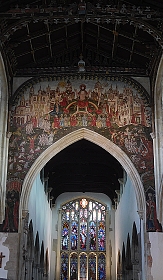
Mediaeval paintings on a wall in a church in Kent

ON OUR WAY to visiting friends, who live in Tonbridge (Kent), we stopped to look at the Church of St Thomas à Becket in the village of Capel. The saint lived from c1120 until his murder in 1170. An old tree in the churchyard at Capel is fenced off and alongside it, there is a label that informs the reader that the saint was:

“… supposed to have preached beneath this lovely old yew tree.”

Given that it is now the year 2025, the very latest that he could have preached beneath this tree would have been 855 years ago. As some yew trees can remain alive for several thousand years (https://fortingall-graveyard.org.uk/yew-tree), it is quite possible that the venerable yew at Capel was around when St Thomas à Becket was active.

The interior of the church offers visitors a wonderful surprise. The north wall of the church has many sizeable fragments of wall paintings that were uncovered in 1927. They had been covered with whitewash (paint) during the Reformation (sixteenth century) during which church decorations were largely removed, destroyed, or hidden. Experts believe that these paintings were executed in two periods: in about 1200 and then about 50 years later. The subject matter of these wall paintings was religious, designed to convey bible stories to those parishioners who could not read, and who did not understand Latin, then the language used during church services.

Amongst many other fascinating things in this small church, the communion rail caught my attention. Carved in the seventeenth century, it bears the date 1682 and the name “Michael Davis”. According to an informative leaflet in the church, in the 1630s Archbishop Laud (1573-1645) recommended installing such rails to prevent dogs from entering and defiling the sanctuary that contains the high altar. The simple stone altar was made in 1979 to replace a seventeenth century communion table that had been stolen. Like mediaeval stone altars, the modern one at Capel is inscribed with five crosses, which symbolise the five wounds made in the crucified Christ.

Although still consecrated, the church is not used often. It is now cared for by The Churches Conservation Trust and left open during the day for visitors to enter. For those interested in seeing mediaeval wall paintings in Kent, apart from at Capel there are fine examples at: Chiddingstone, Newington-next-Sittingbourne, Stone, and Barfreston.
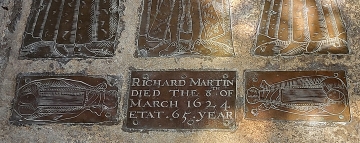
Monumental brasses lost from a church in Suffolk

IT IS NOT UNCOMMON to see gravestones with inlaid engraved brass images in English churches. Known as ‘monumental brasses’, they began to be used in the 13th century instead of three-dimensional effigies and images throughout Europe to commemorate the dead. These often-elaborate brasses are set in depressions carved in the tombstones where they are placed.

During a recent visit to the Suffolk village of Long Melford, we wandered around inside its enormous 15th century Holy Trinity Church. The long side aisles of this edifice are paved with tombstones, many of which have empty depressions where once there had been monumental brasses. A person looking after the church explained to us that long ago, the brasses had been prised out of the gravestones. This had been done both during the Reformation in the reign of Henry VIII and later by the puritans. Later, when the church had run low on funds, it sold some to a local blacksmith for what was then a huge amount – about £8 and 10 shillings.

So much for the lost brasses. Fortunately, at the eastern end of the church, several monumental brasses have remained in place – some of them intact, and others damaged. To the south of the high altar, there is a set of intact 17th century brasses commemorating members of the large Martyn family. Included amongst these brasses are two of particular interest – they are Chrism brasses (see photograph above), which commemorate children who died before their mother was “churched” (that is before the mother has gone to church to give thanks to God for the birth of a child). The Chrism brasses depict babies in swaddling clothes. In addition to these brasses, there is another one depicts a brother and sister. The girl is holding a skull, which means that she died before her parents.

Churches in England, and especially that at Long Melford, offer many fascinating insights into how people lived in the distant past. The brasses – those which have gone and those which remain – are fine examples of history on display.

RARE SURVIVALS IN A MEDIAEVAL PARISH CHURCH IN SUFFOLK

DURING THE REIGN of King Henry VIII, many English churches were vandalised because of the monarch’s divorcing the country from the Roman Catholic Church. Many artefacts were destroyed in churches to erase their connection with the Church in Rome. These included carvings and stained-glass windows. Holy Trinity Church in the wool town of Long Melford in Suffolk was no exception. Above the south entrance to the church, you can see empty stone frames that once contained stone effigies of saints. Much of the 15th century church’s mediaeval stained-glass was also destroyed.

Luckily for us, some of the stained-glass survived. This is because it used to be located in the windows of the clerestory high above the long nave – out of reach of the people sent to destroy it. In recent times, the surviving windows have been restored and placed in the windows lining the north wall of the church. These windows are much lower than those in the clerestory, and are easily viewed from the ground. The windows depict both dignitaries and religious subjects, which were the main targets of the vandals who were destroying religious images.

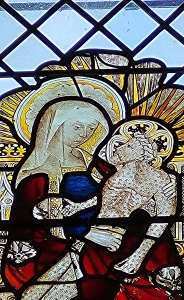
One of the windows is particularly interesting because it shows the Virgin Mary holding the dead body of Christ soon after it had been removed from the Cross. In other words, it is what is known as a Pietà. This subject matter was, and still is, extremely important in Roman Catholic imagery, and had they been able to reach it, those who attacked the church would have certainly wanted to destroy this.  A knowledgeable gentleman, who was helping in the church, told us that the pre-Reformation Pietà in the church was an extremely rare survival from the time before Henry decided to break with Rome. What is more is that unlike many images of the Pietà, the dead Christ is shown with his eyes wide open.

The Pietà image in the surviving mediaeval stained-glass is just one of many interesting things that can be seen in the magnificent, large parish church at Long Melford. As the Michelin Guidebooks often say, the place is “worth a detour”.

A faceless baptismal font in a small town in Hertfordshire

HITCHIN IS A SMALL, attractive town in Hertfordshire. When we first visited it in 2020, despite an easing of the covid19 lockdown rules, we were unable to enter the town’s 14th to 15th century church of St Mary’s. On the 26th of August 2023, we spent a couple of hours in Hitchin and were able to enter the church. It contains many items of interest including a large painting created in the studio of Ruben’s.

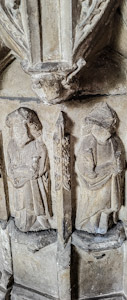
It was the 15th century carved stone font that particularly interested me. The column supporting the bowl, which contains water with which children are baptised, has twelve carved figures. These depict the 12 apostles. Looking at these closely, you will see that they are all mutilated. Their faces have been chipped away, leaving the figures faceless.

The very helpful and informative gentleman who was looking after the church was not sure whether the faces were obliterated by Thomas Cromwell during the Reformation of Henry VIII or during the time of that other iconoclast Oliver Cromwell.

Luckily the carved angels that adorn the ceiling of the Chapel of St Andrew and a finely carved 15th century wooden screen escaped the attention of the iconoclasts. In one or two Suffolk churches we have visited, angels such as these were destroyed as part of the attempts to ‘purify’ the English Church.

Apart from what I have described, there are plenty of other things that make a visit to Hitchin’s church worthwhile. And if you enjoy ‘Olde Worlde’ British buildings, the town centre is rich in them.

When religious art was frowned upon

WE OFTEN VISIT the Tate Britain art gallery on London’s Millbank, usually to see special temporary exhibitions. Rarely, if ever, do we spend time looking at the Tate’s permanent collection. However, today, the 6th of July 2023, we met some friends who wanted to see the recently re-hung paintings in the permanent collection. The paintings are arranged in rooms in chronological order. Each artwork has an interestingly informative label, which describes the social conditions of the era in which it was created and other points about it.

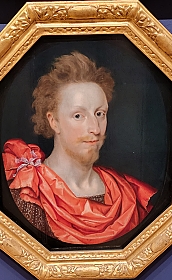
The first room of the series of galleries is dedicated to works created just before, during, and after the (Protestant) Reformation in 16th century England. I found it to be most interesting.  The radical rejection of Roman Catholic religious practices involved, amongst many other things, a profound disapproval of the artistic portrayal of religious subjects. A consequence of this was that artists switched from painting religious scenes to portraiture. Just as people love being portrayed in photographs today, those who could afford it in the 16th century were pleased to have themselves immortalised in well-executed paintings. What I had never realised before was that the Reformation unwittingly gave birth to the long tradition of British portrait painting. Maybe, most people know this already, but it was news to me.

The gallery dedicated to the Reformation era has many fine portraits, by artists both known and unknown. However, one of the paintings hanging amongst the portraits is a religious scene, “An Allegory of Man”, by an unknown artist. Painted in about 1596, it would have been a highly controversial subject given the Protestant aesthetics prevailing at that time.

Although the temporary exhibitions at the Tate Britain are usually well worth viewing, the permanent collection deserves many a visit, as we discovered today.

Survivors in Suffolk

IN 1975 I WENT to the town of Prizren in Kosovo, which was then part of the former Yugoslavia. I visited an old church in the town. Once, its internal walls had been covered with frescos. However, they had been badly defaced up to a certain height above ground level. Above that height and on the ceiling, they were intact. When the Ottoman soldiers arrived in Prizren, they used their spears to destroy the frescos, but only did so as far as they could reach. Being lazy, they did not use ladders to reach the higher parts of the church. So, the frescos beyond their reach survived.

In England, both the Dissolution of the Catholic religious establishments by Henry VIII, and later the defacement of churches by Oliver Cromwell and his followers, resulted in the destruction of many fine works of religious art. During a recent visit to Suffolk, we saw a few fine artefacts, which like the frescos in Prizren, have survived.

Bardwell

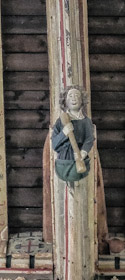
In accordance with Cromwell’s decree, many of the 15th century carved wooden angels that overlooked the nave of the parish church in Bardwell were destroyed. But, a few were left intact. Why was that? Did the workmen lose interest, or were they not paid enough? Who can say? And why was some of the 14th century stained glass left intact? Again, nobody can remember.

Over in the sleepy little town of Eye, the Parish Church contains a wooden rood screen containing beautifully painted panels that should surely have been destroyed by Cromwell’s iconoclastic vandals. Were they covered up with, say, wood panelling before the wreckers arrived, or were they removed and hidden? Luckily for us, these wonderful mediaeval paintings have survived.

Near Eye, there is a tiny church with a thatched roof in the village of Thornham Parva. It contains a rectangular wooden frame containing several mediaeval paintings that were created the 14th century. It was once the retable of an altar. Most likely, it was originally part of an altar in the Dominican Thetford Priory, which was dissolved during the reign of Henry VIII.

It is most probable that when the priory was dissolved, the retable was rescued by a Catholic family who put it in their private chapel. It passed through two other families before it was donated to the church at Thornham Parva in 1927. It is a rare surviving example of 14th century British religious painting. Interestingly, there is another series of painted panels in the Musée Cluny in Paris that resembles the Thornham Parva retable. Comparison of detailed aspects of these two sets of paintings suggests that they were both painted by the same team of artists, and were originally designed for the same location – most probably Thetford Priory.

In the space of three hours, we visited the churches at Bardwell, Eye, and Thornham Parva. All three contain artefacts of great interest and beauty which survived the religious upheavals orchestrated by Henry VIII and later by Cromwell. Once again, touring around in England has opened our eyes to its treasure house of history.

Benjamin Franklin and Saint Bartholomew

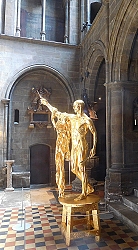
ONE OF LONDON’S FEW remaining pre-1666 (Fire of London) buildings is the church of St Bartholomew the Great close to Smithfield Market. Founded in the 12th century, the building has many Norman (Romanesque) features. It also contains some contemporary artefacts including “Colloquy” (a work made from glass) by Sophie Arkette, and “St Bartholomew. Exquisite Pain” (a work in gilded bronze) by Damien Hirst.

By Damien Hirst

Beyond the chancel at the east end of the church there is the spacious Lady Chapel. During the Reformation (after about 1529), this part of the church was closed off from the rest of it, and used as commercial premises. In the 18th century, it was used as a printer’s workshop owned by Mr Palmer. Benjamin Franklin (1706-1790), one of the founding fathers of the USA, worked as an apprentice in this printing works in 1725. Then, he was lodging nearby in Little Britain. While he was working in the converted Lady Chapel, he wrote his philosophical pamphlet, “A Dissertation on Liberty and Necessity, Pleasure and Pain.” Franklin wrote:

“At Palmer’s I was employed in composing for the second edition of Wollaston’s “Religion of Nature.” Some of his reasonings not appearing to me well founded, I wrote a little metaphysical piece in which I made remarks on them. It was entitled “A Dissertation on Liberty and Necessity, Pleasure and Pain.” I inscribed it to my friend Ralph; I printed a small number. It occasion’d my being more consider’d by Mr. Palmer as a young man of some ingenuity, tho’ he seriously expostulated with me upon the principles of my pamphlet, which to him appear’d abominable.”

The workshop was purchased by the church and restored as a Lady Chapel in 1897. An information panel next to it provides its history and connection with the young Franklin. It was by pure chance that I came across this London link with the American Revolution on the 4th of July.

Doom painting

UNDOUBTEDLY THE CATHEDRAL in Salisbury (Wiltshire) is the city’s ‘star’ attraction and is worthy of many visits. However, the city has other things that should not be missed. One of these is the Parish Church of St Thomas (and St Edmund), about 370 yards north of the cathedral.

The Doom Painting

The present church was built from the 15th century onwards. Its detailed history can be found on the church’s website (https://stthomassalisbury.org.uk/wp-content/uploads/2021/06/BriefHistory.pdf). On entering the church from its western end, one cannot avoid seeing the colourful wall painting above the chancel arch. This is the Doom Painting, which depicts The Last Judgement. Images such as these used to be common in Christian Europe but are rare today. ‘Doom’ means ‘judgement’ in Anglo-Saxon. The painting in St Thomas is thought to have been created in about 1470 in the Flemish style by an English painter.

During the Reformation, the painting was covered over with whitewash in 1593. It remained hidden until 1819 when faint traces of colour began to appear when the wall was being cleaned. The painting was carefully uncovered in 1881, and then it was restored. In 1953, the image was cleaned again and retouched. Since then, it has remained untouched. Although it has been restored, it gives a good idea of how this superb fresco looked when it was first created.

While looking up at the Doom Painting, you should also examine the decorated timber ceilings above the nave and other parts of the church. These contain almost 100 wood carvings of angels. Also of interest, is a wooden panel on the wall of the south aisle. This bas-relief wood carving depicts Abraham sacrificing his son Isaac and Jacob’s Dream. It was created in about 1660 by the master Joiner Humphry Beckham (1589-1671).

There are plenty of other interesting items to see in the church, which deserves a visit. Had there not been a famous cathedral in Salisbury, this smaller church would have become one of the place’s main attractions.

Look, no hands

WE VISITED TWO churches in Suffolk, and inside them we spotted three things that particularly interested us. The first church is in Cavendish, The Parish Church of St Mary the Virgin. Standing on a hill above the village, its construction dates from 1300 and was largely completed by 1485. Some restoration work was carried out in the 19th century. One of the two things that fascinated us in this church is affixed to the inside of the north wall. It is a bas-relief depicting the Crucifixion. It is a reredos of Flemmish make, created in the 16th century. It is framed in a Victorian surround designed by Ninian Comper (1864-1960) in 1895. The sculpted reredos was brought to the church from the private chapel of the hymn writer Athelstan Riley (1858-1945) in London, following his death.

Cavendish church

The other curiosity in this church, which has memorials to the philanthropists and local parishioners Baroness Sue Ryder and Baron Leonard Cheshire, is on a wall just behind the 19th century wooden pulpit within arm’s reach of the preacher. It is an hourglass, looking like a large egg-timer, which the priest could use to time his sermon. I had never seen such a thing in a church. Less curious but also fairly unusual are the 13 wooden crucifixes on the interior walls of the bell tower. These were made from wood salvaged from the Western Front during WW1 and each one commemorates one of the men from Cavendish who were killed in the conflict.

The other church we visited on our recent trip to Suffolk was St Mary in Stoke by Nayland, which was sometimes painted by John Constable (1776-1837), who was born nearby in East Bergholt. Built in Perpendicular Gothic style between 1300 and 1481 it is very majestic, like a small cathedral. The church is full of interesting monuments including many fine brasses. It was one of the funerary monuments that particularly intrigued us: the Lady Anne Windsor monument. Anne lived from about 1568 until 1615. A stone carving depicts her lying with her head on a pillow. At her feet, there is a carving of a kneeling man, Anne’s son. By her head, two carvings depict a pair of kneeling women, Anne’s daughters. Look closely at this pair and you will notice that their hands have been broken off. Their arms are merely amputated stumps. What is going on here?

Stoke by Nayland church

The answer is that in 1643, Parliamentary Commissioners visited the church in Stoke by Nayland and destroyed 100 religious images and 7 funerary items. Part of this over-zealous iconoclastic behaviour was the removal of the four hands of the two women on Lady Anne’s monument, as well as those of the recumbent figure of the deceased. All the hands of females on the monument were removed but those of the kneeling male figure were left untouched. Apparently, the female hands were removed because the Commissioners considered them to have been in “a superstitious attitude of prayer”, whatever that meant during the Reformation.

The three items I have described are but a few of the things worth seeing in the two churches. I have chosen to describe them because I have not seen such things in the many other parish churches I have visited in England.

Praying above the flowing water

ALMOST OPPOSITE THE modern and magnificent Hepworth Wakefield art gallery, completed in 2011, there is a nine arched bridge, built between 1342 and 1356, crossing the River Calder. Midway across the bridge, there is a small gothic chapel. It is the oldest one of only four surviving bridge chapels in England. Between the mid-14th century, when it was built and the Reformation in the 16th century, the Chantry Chapel of St Mary the Virgin served as a place of worship for travellers crossing the bridge on their way from Wakefield to Leeds.

The purpose of a chantry chapel was:

“…to provide for a priest to say mass for the souls of the dead to reduce their time in purgatory.” (www.wakefieldcathedral.org.uk/visit-us/the-chantry/a-history-of-the-chantry-chapel)

Two acts passed during the reigns of King Henry VIII and his successor the young and fanatically Protestant Edward VI resulted in the closure of the well over 2300 chantry chapels in their kingdom. The chapel on the bridge at Wakefield was one of them. Whereas many chantry chapels were demolished or otherwise rendered unrecognizable, that on the bridge at Wakefield survived because it is an integral part of the structure of the bridge (https://en.wikipedia.org/wiki/Chantry_Chapel_of_St_Mary_the_Virgin,_Wakefield).

The former chapel on the bridge was used for various purposes between 1547, when its religious use was terminated, and 1842, when it was restored. It was used at different times to house a warehouse, a library, an office, and a cheese shop.

In 1842, the formerly Roman Catholic chapel was transferred to the Church of England and it was restored by the Yorkshire Architectural Society, which was influenced in its philosophy by the Oxford Movement, a group of High Church members of the Church of England who wanted to reinstate older Christian traditions, which had been abolished during the Reformation, and incorporate them into Anglican theological practice. The architect George Gilbert Scott (1811-1878) was involved in the restoration of the edifice.  By 1848, the bridge on the chapel was once again being used as a place of worship. For a while it became a parish church, and then after a new parish church was built in 1854, it became used for occasional rather than regular services, and peopled prayed whilst water flowed below them.

Currently, the chapel is under the care of the Friends of Wakefield Chantry Chapel, which was founded in 1991. The chapel is usually kept closed but is opened on certain days (see: www.chantrychapelwakefield.org/open-days.html). As luck would have it, we walked across the bridge on a sunny day that the chapel was open. The small chapel is on two floors. The upper chapel is well-lit both by electric lamps and light flooding through its five sets of stained-glass windows. A narrow spiral staircase leads down to a lower, poorly lit, rather dusty chamber, somewhat devoid of interest.

The decorative ancient gothic chapel on the bridge makes an interesting contrast to the elegant but puritanically unadorned exterior of the Hepworth Wakefield gallery almost opposite it. Both buildings are definitely well worth exploring.