
Residences close to the railway tracks in north London

LIVING NEAR BUSY railway lines can be a noisy experience. The American-born architect Neave Brown (1929-2018), who worked for the London Borough of Camden, understood this when he designed a housing estate that is situated beside a curve of the railway between Kilburn High Road and South Hampstead stations. Six parallel tracks carry trains regulatly past this site. So, living alongside these tracks could be far from peaceful.

Side of the block facing the railway tracks

Neave Brown designed a public housing estate next to this curve. Called the Alexandra and Ainsworth estate, it was designed in the Brutalist style of architecture, but in such a way that the buildings themselves muffle the sounds coming from the railway tracks. How he did this is well explained in a Wikipedia article:

“The higher, eight-story block directly adjacent to the railway line is organised in the form of a ziggurat, and acts as a noise barrier that blocks the noise of the trains from reaching the interior portion of the site, and its foundations rest on rubber pads that eliminate vibration.”

This step-like construction is both impressive and sculptural. Far from being inhuman as many Brutalist constructions can be, the estate, which is rich in vegetation, looks like a pleasant place to live. This contrasts with the pairs of tower blocks that stand on the other side of the tracks. As one of its residents, the architect Lefkos Kyriacou wrote (http://alexandraandainsworth.org/history/):

“… Alexandra Road still retains its cinematic wonder but having suffered the problems that have blighted much of Britain’s post-war social housing it is emerging from the shadows, not only as a valuable part of our national heritage but as a viable example of how mass housing can succeed.”

What is more, and this is a measure of its success, I have read that Neave Brown’s estate has suffered far less from vandalism than almost all of Camden’s other residential estates.

A not so peaceful garden of peace

TODAY, OUR FRIEND took us to see a part of Hampstead, which I never knew existed. Called The World Peace Garden, it is located on a sliver of sloping ground bounded to the south by Hampstead Heath Overground station and to its north by a short stretch of the western end of the road called South Hill Park. Its dimensions are approximately 95 feet in length with a maximum width of about 29 feet. It is entered by a discrete opening on South Hill Park. Some steps lead downward to a couple of paths that wind their way through the dense vegetation and past small ponds to a tiny seating area at the garden’s eastern end. The miniscule park is rich in flowers, bushes, and trees. It is a lovely place.

The World Peace Garden began to be created in about 2014 on waste land between South Hill Park and the railway station. Inspired by a local estate agent, Jonathan Bergman, the garden was designed by  Tony Panayiotou and Michael Wardle, and created by gardeners Keiko, Hugh, Laurence, Miki, and Mer. In 2016, it was awarded the ‘Time Out Love London Award for Local Culture in Hampstead’. Today, it is still delightful, although slightly overgrown. During our midday visit, we saw several people enjoying lunch in shady nooks.

Although the garden is to celebrate the idea of world peace, it is not exactly a peaceful place. Every few minutes, the peace of the garden is disturbed by noises coming from trains passing through the station beneath it. Despite speaking to many people about Hampstead, until today nobody has mentioned the Peace Garden to me.

Water music

I BELIEVE THAT SOUND travels well over water. I do not know if that is scientifically proven, but I like to think that it is the case.

BLOG KENWOOD 2

Yesterday, we visited Kenwood in north London. The neo-classical mansion, remodelled by Robert Adam (1728-1792) and completed in about 1780, contains a superb collection of fine art (the Iveagh Bequest), mostly paintings. Because of the Coronavirus pandemic, Kenwood House was closed, but its extensive grounds were open. Although the official car park was fully occupied, there was no sense of crowding in the grounds.

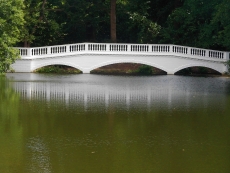
A wide terrace at the rear of the mansion overlooks a sweeping panorama including a lake at the bottom of the grassy slope that falls away from the terrace. From this vantage point, the viewer can see what looks like a fine bridge with balustrades and three arches at the eastern end of the body of water. However, what meets the eye is not a bridge, but a sham, a trompe-l’oeil, made in wood to produce a picturesque view. It was designed by Robert Adam and constructed in about 1767 and fully restored in the late 20th century.

The bridge has survived the progression of time, but another structure that was a notable feature on the side of the lake furthest from the House has not.  This was an edifice shaped like the quarter of a sphere. Within this shelter, a whole symphony orchestra could be comfortably seated with their instruments. On summer evenings, orchestras used to play music that travelled across the lake to huge audieces seated on the grassy slope leading down to the water.

I used to attend these concerts occasionally during my younger days. They were, as I can recall, often on Saturday evenings. Two kinds of tickets were available. The costlier ones allowed a person to sit on one of the deckchairs arranged in rows on the part of the slope closest to the lake. The cheaper ones permitted holders to sit on the grass above the rows of deckchairs. Many people, who sat on the grass, brought rugs and picnics, which they enjoyed whilst listening to the music. I have never liked sitting on the floor and always preferred to experience the concert in a comfortable deckchair.

It was delightful sitting outside hearing well-performed music whilst the sun set slowly, and the twilight enveloped us all. The acoustics were good, but the first halves of many concerts were subject to the frequent the competition from noisy aeroplanes passing overhead. Usually, by the second half of the performance, there were few interruptions by ‘planes.

When we returned to Kenwood yesterday, the orchestra ‘dome’ was not visible. Where it had been has been replaced by bushes and trees. There is not a trace of it left. It looks as if it had never existed and I worried that maybe my memory had played a trick on me. We stopped a couple of elderly women and asked them about the concerts. They remembered them well and told us that they had been stopped a few years ago because, incredibly, local residents had complained about being disturbed by the noise (and increased traffic) during the few events that occurred each summer.

The lakeside concerts were held every year between 1951 and 2006, the year the English Heritage was forced to put an end to what had been a lovely annual event and an important money-spinner for them. I remember those concerts with fondness and hope that the wealthy inhabitants who live around the area, quite distant from the lake, will one day relent to allow music lovers to enjoy fine music wafting across the water. Well, as often is the case, money has more clout than culture.