
Tasty molluscs from an island off the coast of Essex

SOME PEOPLE SAY that the Ancient Romans in Rome enjoyed consuming oysters that had been harvested along the coast of Essex. It is said that these tasty molluscs were transported live from Essex to ancient Rome. A website (www.bbc.co.uk/news/uk-england-humber-69051462) noted:

“Oysters were highly prized by the Romans with some reports suggesting they played a key part in Julius Caesar’s decision to invade the British Isles. Many of the oysters were exported to Italy with Roman Emperors reportedly paying for them by their weight in gold.”

This quote refers to finding a Roman oyster processing site on the Humber estuary. Other places where oysters are cultivated include parts of the coast of Essex. These places are famous for the quality of their oysters. One of them is West Mersea on the island of Mersea, a few miles south of the city of Colchester. Today, this place is an important source of oysters. The gardens of houses in West Mersea are full of discarded oyster shells, both for decorative purposes and as a ground covering.

An oyster pit and the Packing Shed (in the distance)

Oysters are ideally cultivated in the brackish saline waters of estuaries. They feed by siphoning a large amount of seawater through their bodies, extracting nutrients from it. Sometimes, they collect sand and other impurities as the water passes through them.  West Mersea sits at the mouth of the Blackwater River, and oysters have been grown and harvested there since Roman times. When oysters are mature enough to be harvested, they are placed in tanks filled with clean water which passes through them as they filter the water. This ensures that by the time they are sent to market, impurities such as sand have been removed from their digestive systems. Today, this purification process is carried out in sophisticated mechanised tanks, some of which irradiate the water with ultra-violet light to kill microbes. In the past, after being sorted for size, they were placed in wood-lined tanks filled with clean water. The remains of some of these now disused oyster pits can be seen rotting along the coastline at West Mersea.

In about 1890, a shed, now known as the ‘Packing Shed’, was constructed on an islet close to West Mersea. This building was built to be used for cleaning and sorting oysters before they were sent to destinations all over the world. Soon after it was built, it was blown away in a storm. In 1897, it was replaced by a new building, which remained in use until the 1950s. After that, it was hardly used and began to rot. Despite this, it survived the great storm of 1987. It became a picturesque ruin until 1992, when it was fully restored. Owned by the Tollesbury & Mersea Native Oyster Fishery Company, it is rented to the Packing Shed Trust, which uses it for a variety of purposes (including bird watching, weddings, art classes, parties, and celebrating special occasions). You can see this long, low building from many points on the seashore of West Mersea. On the day we were in West Mersea, we saw groups of young school pupils going on an excursion to visit the Packing Shed.

Several companies dealing in oyster cultivation and sales have sheds in West Mersea. There are plenty of eateries where you can sample these highly prized delicacies. We used to enjoy consuming them in the past before one of us had an extremely unpleasant reaction after eating some oysters at a good restaurant in London’s Kensington. The reaction was so bad that hospitalization was necessary. After that, both of us have, reluctantly, decided not to eat oysters again. Regardless of that, West Mersea is a delightfully peaceful place to visit – providing it is during school term time. We were told that during school holidays, Mersea Island becomes overcrowded and far from relaxing.
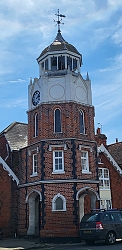
The oyster merchant’s clock tower

BURNHAM-ON-CROUCH in Essex is a picturesque port on the River Crouch. Currently, it is a leisure resort and a centre for ship maintenance and boating. It was once famed for what grew in great numbers on the muddy bed under the water of the Crouch: oysters. For several centuries before the river became polluted in the 19th century, the oyster beds in the Crouch (and a few other places in Essex) were very profitable, providing much employment.  

“On the shores of England the principal nurseries of oysters, not only for the English markets, but also for the foreign, are those on the coast of Essex and the estuaries adjoining: those taken there are called ‘ Natives/ Mr. Sweeting claims the name as peculiarly applicable to his fishery, as within his memory no strange oysters have ever been introduced…”

Men were required both to dredge the oyster beds and process the molluscs as well as to protect the precious creatures from thieves based in other places on the Essex coast.

Today (11th of July 2022), we visited the small but excellent museum in Burnham-on-Crouch. On the ground floor, we saw a retired mechanised oyster grading machine (made in France and capable of sorting 7000 oysters per hour) amongst the exhibits. On the upper floor of the museum, which is housed in a former boat repair building, we met the museum’s treasurer, who is a mine of interesting local history. He told us several things about Burnham’s oyster heydays. I hope that what I am about to tell you is a reasonably accurate summary of what he told us. If it is not totally accurate, I hope that he and you, dear reader, will forgive me.

For 10 years, I used to live in north Kent and often visited Whitstable to enjoy eating oysters for which this Kentish seaport is famous. The treasurer in Burnham told us that many of what are described as ‘Whitstable oysters’ were born in the mud beneath the river in Burnham-on-Crouch. From what I can recall, the young oysters, which grow in the mud beneath the Crouch, are dredged and then placed on boards to which they attach themselves. Keeping them submerged in seawater, the boards to which the young oysters are attached, were transported to Whitstable where they matured in its waters. The Burnham oysters were ‘native’, meaning that they began their lives there; they were not imported, as Thomas Campbell Eyton described in “A history of the oyster and the oyster fisheries” (published in 1858):

“On the shores of England the principal nurseries of oysters, not only for the English markets, but also for the foreign, are those on the coast of Essex and the estuaries adjoining: those taken there are called ‘Natives’. Mr. Sweeting claims the name as peculiarly applicable to his fishery, as within his memory no strange oysters have ever been introduced.”

One of the exhibits in the museum is a large model of the octagonal Victorian clock tower that dominates Burnham-on-Crouch’s High Street. The tower stands next to the building that used to house the former St Mary’s School. It was erected in 1877 to honour the local philanthropist Laban Sweeting (1793-1876). So, what, you might ask, and what has he got to with what I have been writing about?

Laban Sweeting, mentioned in the quoted from Eyton’s book, was a philanthropist; a member of The Burnham River Company; and he was one of the town’s oyster merchants. The museum has amongst its exhibits a small barrow, which used to be wheeled around Burnham by a member of the Sweeting family. It would have carried baskets of oysters ready for sale to the town’s populace.

We had visited Burnham once before, and although I was impressed by the clock tower, I knew nothing of its history. Neither did I know about the town’s association with oysters, which were poor people’s food in the 19th century, when chicken was a luxury. How times have changed.