IT IS CURIOUS how some things, heard once long ago, stick in one’s memory. When I was a little boy, I remember my father telling me that there was a product called Klim. I thought he must be joking because Klim is ‘milk’ spelled backwards and my father did have a sense of humour. For example, when we used to visit Italy, he used to say “a penne for your sauce” (instead of ‘ a penny for your thoughts’).
A few years ago, some friends were clearing out some books and gave me a few of them. One of them was “Cookery Book of Malaya”. It was published in 1951 by the YWCA of Malaya and Singapore. Remember that Malaya only became known as ‘Malaysia’ in 1963.
It was only today (1st of September 2023) that I decided to have a look at this book. Edited by Mrs AE Llewellyn, the volume is packed with information about nutrition and recipes. The recipes include many western dishes as well as a selection of “Malay”, “Javanese”, “Chinese”, “Indo-Malayan”, and Indian, recipes. Most of the book is written in English but the section on “Methods of Cooking” is bilingual: English and Malay. I suppose this was so that the British housewives could instruct their Malay cooks.
The book has several pages of advertisements. Four of these are for milk – mainly the powdered variety. To my great delight, one of them is for Klim. The advert says:
“Take pure water, add Klim, stir, and you have safe, pure milk.”
Another part of the same advert says:
“Keep KLIM handy in your cupboard. Remember – it stays fresh – without refrigeration.”
Klim has been around a long time. According to Wikipedia:
“In 1920 Klim was a product of Merrell-Soule Company of Syracuse, New York which in 1907 had improved the spray-drying method patented by Robert Stauf in 1901 by starting with condensed milk instead of regular milk. In 1927 Borden acquired Merrell-Soule gaining the Klim brand and None Such Mincemeat, both already made popular worldwide.”
The Nestlé company acquired Klim from Borden in 1998. Although I have never noticed it in any of the many shops I have visited, it is still sold worldwide.
I am pleased that I finally got around to opening the old cookbook because it contained the advertisement that confirmed that by mentioning Klim my father was not simply pulling my leg.
UNTIL I WAS ABOUT 18, I drank a pint of chilled milk in the morning and another when I came home from school. I did not drink all the varieties of milk that were supplied by the milkmen who worked for the Express Dairy Company, but chose the ‘homogenised’ variety, which did not have cream at the top of the bottle. Never once whilst drinking this refreshing slightly watery liquid did I ever imagine that I would one day visit an exhibition about milk. Today, the 29th of July 2023, I viewed an exhibition called “Milk”, which is being shown at the Wellcome Collection in London’s Euston Road until the 10th of September 2023. Amongst the numerous exhibits displayed in this beautifully curated show, the following particularly interest me.
There was a collection of decorated porcelain cream jugs. Each one was shaped like a cow. Cream used to be poured into the hollow cow via a hole in its back. Then, a lid was placed to cover that orifice. To use the cream jugs, the cows were tilted so that the cream could flow out of another hole through creatures’ mouths.
There was a terracotta model of a mule carrying two trays laden with cheeses. This Ancient Roman artefact dating back to the 3rd or 2nd century BC was found by archaeologists in Southern Italy. In times long before refrigeration, making cheese was one way of preserving milk for future use.
I saw a metal lactometer, which was used to determine the amount of water in milk. My wife said that when she was a child in India, milk used to be delivered to the door. To check whether the milkman had watered it down, her mother used a lactometer just like the one on display at the exhibition.
Our daughter spotted an 18th century etching depicting St Bernard of Clairvaux kneeling before the Virgin holding the Christ Child. As the saint knelt before the Virgin, he received a squirt of her milk from her breast. This was supposed to grant him wisdom and eloquence. When she was studying History of Art, our daughter wrote a thesis about this curious episode – The Lactation of St Bernard’.
A rather uninteresting looking exhibit proved to be most fascinating. It consisted of two milk testing forms, which had to be completed after a farmer’s batch of milk had been tested for diseases, bacteria, fat content, and protein content. The forms on display related to milk produced by cattle on the Dartington Hall Estate in Devon. The Estate was founded to research the merits of various scientific farming methods. One of the founders of the Estate was the agronomist Leonard Elmhirst (1893-1974). What made him special in my mind was that after meeting the great Rabindrath Tagore (1861-1941) in the USA in 1913, he later (in 1922) set up for Tagore an Institute of Rural Reconstruction near Tagore’s university at Shantiniketan (now in West Bengal). After marrying Dorothy Straight, Elmhirst and his wife established the Estate at Dartington in 1925. It was modelled on what he had founded near Shantiniketan.
There were plenty of other exhibits that were both visually interesting and thought provoking. A theme that I felt pervaded the exhibition is related to the colour of milk – white. Because milk is often perceived as being healthy, pure, and virtuous, it may also nourish the malevolent ideas of white racists. One of the exhibits showed a video of Trump supporters cavorting around, each one of them waving large bottles of white milk whilst shouting racist and anti-Semitic slogans. Yet, the ancestors of racists like these were perfectly happy to snatch the newborn babies of black slaves away from their mothers, so that these unfortunate women could be forced to breast-feed the babies of the white women of the families who owned them. Their milk was white, but not their skin colour. To compensate for these and other harsh reminders that all is still not well in the racial tolerance scene, the exhibition includes a satirical film from You Tube ( https://youtu.be/cevXg_SlT-Q ), which makes fun of people with racist tendencies.
Well, it never occurred to me that milk and racism might be considered in the same brackets until I visited the splendid show at the Wellcome Collection. It is well worth seeing not only because of its historical and scientific aspects, but also for its artistic and sociological content.
WALKING HAS ALWAYS been my favourite and almost only form of exercise. I do not enjoy games, gyms, or swimming, or any other sport, but I love to stroll through towns, villages, and rustic landscapes, exercising my body and especially my eyes. I always carry a camera to record anything I consider of interest or picturesque or curious. With the current (January 2021) restrictions on moving far afield from home to take exercise, I must confine myself to wandering around within a short distance of home. Luckily, the borough, within which I live, and its neighbours are full of fascinating places to see, photograph, and investigate. One of these is Justice Walk, a short (77 yards) passageway leading from Chelsea’s Old Church Street to Lawrence Street.
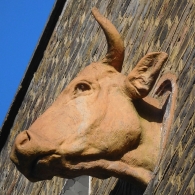
But first, let me tell you about number 46 Old Church Street close to the beginning of Justice Walk. This building has a sculpture of a cow’s head attached to its façade as well as two pictures made with coloured tiling. One of them, with the words ‘An early mower’, depicts a man holding a scythe and taking a drink from a small barrel. The other shows a milkmaid carrying a wooden pail on her head. An alleyway on the north side of the building leads to a modern gateway. On the north wall of the house there is a name plate that reads ‘The Old Dairy Chelsea’ and near this there is another tiled painting showing a milkmaid watching cattle standing in a stream with ducks and ducklings. Behind the gates, there is a larger brick building with a pediment bearing a cow’s head as well as the date ‘1908’ and ‘estd. 1796’.
“The dairy was one of the first in Chelsea and was erected on Cook’s Grounds (the site of Glebe’s Place today) in 1796. Around 50 cows and two goats grazed nearby, providing milk for the dairy … A frequent visitor to the dairy was Scottish philosopher and writer Thomas Carlyle (1795-1881), who lived a few minutes walk away on Cheyne Row … The Old Dairy was forced to move slightly west due to rapid redevelopment in the late 1800s, with Cook’s Ground and the nearby kitchen gardens of the Chelsea Rectory being swallowed up by housing. Wright’s Dairy set up their headquarters and a shop at 38-48 Church Street (now Old Church Street). The fields behind the dairy were used for the grazing cows.”
The cow’s head on the former dairy looks out at pictures of pigs across the road. These adorn a pub with the name ‘The Chelsea Pig’. Originally called ‘The Black Lion’, the establishment is said to date back to the 17th century.
Justice Walk is extremely picturesque. It is dominated by a large brick building, whose appearance is suggestive of authority, topped with a triangular pediment. This was formerly a Wesleyan chapel, which was built in 1841. It was used as a chapel and a Sunday school between 1843 and 1903 (https://chelseasociety.org.uk/wp-content/uploads/2013/11/1997-Annual-Report-1.pdf). Many estate agents have misrepresented this building as a former courthouse, glamourising with words such as these (www.russellsimpson.co.uk/stylist-the-court-house/):
“A historic courthouse and jail that once held highway robbers and thieves before they were transported to the British penal colonies in the 18th Century has been transformed into a luxury £14.5 million home.
The Court House, on the aptly-named Justice Walk in Chelsea, is one of London’s last surviving courthouses and gaols and has been dubbed “Britain’s most expensive prison cell” after undergoing a designer restoration and makeover. Built in the early 18th Century, the majestic house of justice tried hundreds of criminals with highway robbery, drunken behaviour and petty theft – of a kind similar to legendary highwayman Dick Turpin (who was executed in 1739 for horse theft).”
So much for Dick Turpin and other exciting misinformation. Opposite the former chapel, there is a house whose front door is surmounted by a scallop shell and other ornate decoration. The door bears the name ‘Judge’s House’. Given what I have learnt about the so-called courtroom, which was really a chapel, I wonder whether a judge ever lived in the house. My doubt is increased when I read (in “The London Encyclopaedia, edited by B Weinreb and C Hibbert) that Justice Walk is most probably named after John Gregory, a Justice of the Peace, who owned property in nearby Gregory Place and in Kensington Church Street.
Several houses at the corner of Justice Walk and Lawrence Street stand where there was a factory and showrooms for the renowned Chelsea china. The china establishment was demolished at the end of the 18th century (www.british-history.ac.uk/old-new-london/vol5/pp84-100). Although the china works are long gone, the Cross Keys pub still exists, though closed during the ‘lockdown’. Established in 1708, it is Chelsea’s oldest pub. Its customers have included JMW Turner, John Singer Sargent, and James McNeill Whistler, painters; Dylan Thomas, poet; Bob Marley, musician; and Agatha Christie, novelist.
Seeing all that I have described took about fifteen minutes, but you could easily miss it all if you walked past in a hurry. Although I did not perform much exercise looking at this tiny part of London, seeing it provided plenty of food for thought. After exploring this area, my wife and I walked out of Lawrence Street and began a vigorous stroll along the Thames embankment which provided lovely vistas in the hazy winter sunshine.
MY LATE MOTHER trained at the Michaelis Art School in Cape Town. She became a commercial artist. After she married my father in London in early 1948, she became a more creative artist, a painter and then a sculptor. Her interest in art was shared by my father, who became deeply interested in the history of art. Most of our family holidays were connected with my parents’ enthusiasm for art both old and new. I used to be quite envious of my friends whose parents took them to the seaside, but now that I am older I appreciate the special nature of our family holidays.
One of the places my parents enjoyed visiting was Bruges (Brugge) in Belgium. We used to stay in the city’s Hotel Portinari. Once every visit, we did something that I found more enjoyable than visiting churches and museums. We took a boat ride along the city’s canals. These tours involved travelling in a small low boat powered by an outboard motor. The most exciting part of this voyage was when we passed beneath a particularly low road bridge. The tour guide would tell us all to duck our heads. My mother, who saw danger around every corner, always emphasised how important it was to lower our heads as much as possible to avoid them being smashed to a pulp by the metal struts under which we were passing. In retrospect, considering the potential for experiencing this awful injury (possibly leading to death), I am amazed that my mother sanctioned these boat trips every time we visited Bruges.
My mother passed away, I married and in 1995 our daughter was born. Six weeks after her birth, we crossed the English Channel and we took our daughter with us. We were driving to Rotterdam in Holland to meet my wife’s parents, who were disembarking there after a cruise on the River Rhine.
We wanted to spend a night in Bruges on our way to Holland, but were unable to find accommodation in a hotel that we could afford. Instead, we booked a hotel at nearby Damme, which was said to be picturesque.
We arrived at our hotel in Damme on a Saturday afternoon. I remember that we had trouble getting hot water to flow in our shower. However much the hot tap was turned, the water remained icy cold. The problem was solved when a member of the hotel staff explained that the taps had been labelled wrongly: hot water flowed when the cold tap was opened.
In the evening, the three of us went to a restaurant in Damme. The dining room was a long rectangle in plan. A long central ‘aisle’ ran between two lines of tables. Each table was occupied by late middle-aged couples sitting with their backs to the walls and facing the diners seated opposite them across the aisle. Not one of these people looked as if they were enjoying their night out, or even being alive. They were a miserable looking bunch.
We were shown to the one remaining empty table. Within minutes of sitting down, our daughter decided that she needed a drink, not of Belgian beer but something that only wife could supply.
My wife asked the maitre d’hôtel whether there was somewhere that she could breastfeed our daughter discreetly. He pointed at a door. My wife stood up and walked towards it. Before she reached it, the hitherto seemingly moribund diners sprang to life. They told us that they did not mind if our daughter suckled in the dining room. They did not want mother and child to be exiled, or even self-exiled.
For the rest of the evening, our fellow diners remained animated, exclaiming how sweet our daughter was and offering much advice. Our arrival and our daughter, in particular, had made that Saturday evening a huge success for these ageing members of Damme’s bourgeoisie.
Picture of the Minnewater in Bruges, taken in the early 1960s
Once, long before ‘political correctness’ became fashionable, when my wife was an undergraduate student, she asked two Nigerian students whether they preferred their tea “black or white “. They looked at her indignantlybefore answering aggresively: “with milk“.
When I was a child, I drank tea without milk. That was the way my parents preferred it. That is what I became accustomed to. If I sipped even a little tea with milk, I felt nauseous. Tea with milk, as served in England, is made by adding brewed tea to milk or vice versa depending on your preference.
My prejudice against tea with milk persisted until I began visiting India in 1994. At first, I was suspicious of the “white” tea on offer, but soon began to enjoy it. I think that this is because it is made differently from that which is served in the UK.
In India, tea leaves are boiled vigorously with milk. Often additives such as sugar, crushed ginger, cardamom, mint, and lemon grass are added to the hot bubbling mixture. After a while, the boiled milky tea is passed through a strainer, often cloth, and served in cups. The resulting drink is a harmonious blend of the flavour of tea and the additives. In my opinion, it tastes quite different from, and much better than what is served in England.
I have visited India many, many times since 1994. Apart from developing a great fondness for the country and its people, my tastes in food have changed for the better as a result of my exposure to life in India.





 yamey
yamey 