In a library on an island off the coast of Essex

MERSEA ISLAND IS south of Colchester in the mouth of the Blackwater River, which flows through the south of Essex. Connected to the mainland by a cuseway, which gets submerged twice a day when  it is high tide, Mersea Island feels like it is many hundreds of miles away from London, even though it is about 60 miles from Trafalgar Square and only a few miles from Chelmsford and Colchester. The island has two settlements: West Mersea and the much smaller East Mersea.

Although there are some working people on the island, many of its residents are retired. We did spot a few (less than five) people, who did not look as if their heritage was white British, but the island cannot be described as having a multi-ethnic population. The island is an outpost of the Anglo-Saxon heartland. It seems to be a friendly community. People with whom we spoke were very amicable. Having said this, a surprise greeted us when, out of curiosity, we stepped inside West Mersea public library, which is run by Essex County Council.

The library is a modern structure with a simple but pleasant, spacious reading room. Immediately after entering, we spotted a bookshelf with a notice above it. This had the words “Author of the Month”. The author whose books were prominently displayed on the shelves were by Vaseem Khan. He was born in east London in 1973, and studied at the London School of Economics. Then, he worked for ten years in India. His experience of India led him to begin writing detective novels set in India. My wife, Lopa, has read and enjoyed many of his books.

I am not sure why we were so surprised to see Vaseem Khan’s books given pride of place in the library in West Mersea. Maybe, it was because our experience of the island is that its population is far from being cosmopolitan.  Lopa spoke to the librarian, saying how pleased she was that Vaseem Khan had been highlighted, and then began mentioning other British Indian authors such as Abir Mukherjee and Imran Mahmood. The librarian had read books by all these authors and spoke knowledgeably about them. She had chosen Vaseem Khan to be the author of the month because she had met him at a literary festival, and then invited him to speak in her library. We left the library having been highly impressed by what she had discussed with us.

One thing we forgot to ask her was how often Vaseem’s books were borrowed in comparison with other fiction writers’ volumes on the shelves. I would liked to have discovered whether her display of Vaseem’s books attracted much attention from the local, seemingly Anglo-centric, users of the library.
When nature challenges the flow of traffic.

THE ISLAND OF MERSEA is connected to the mainland of Essex by a causeway,  which was originally constructed before the medieval era. It is the only way that vehicles, motorised or otherwise,  can travel between Mersea and the rest of Essex.

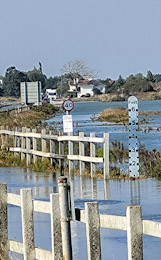
Twice a day, the tide rises. When it does, not only do the mudflats close to the island become submerged beneath the sea but also the causeway.

The flooded causeway

After visiting East Mersey, we drove to the causeway and had to stop in a long queue of traffic. It was high tide, and the water had not only covered the causeway but also about 200 yards of the roadway approaching it. It was interesting to see how even in the 21st century,  a simple thing such as high tide can bring life to a standstill.

Tasty molluscs from an island off the coast of Essex

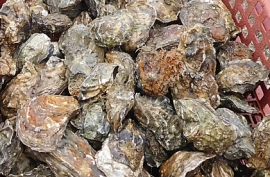
SOME PEOPLE SAY that the Ancient Romans in Rome enjoyed consuming oysters that had been harvested along the coast of Essex. It is said that these tasty molluscs were transported live from Essex to ancient Rome. A website (www.bbc.co.uk/news/uk-england-humber-69051462) noted:

“Oysters were highly prized by the Romans with some reports suggesting they played a key part in Julius Caesar’s decision to invade the British Isles. Many of the oysters were exported to Italy with Roman Emperors reportedly paying for them by their weight in gold.”

This quote refers to finding a Roman oyster processing site on the Humber estuary. Other places where oysters are cultivated include parts of the coast of Essex. These places are famous for the quality of their oysters. One of them is West Mersea on the island of Mersea, a few miles south of the city of Colchester. Today, this place is an important source of oysters. The gardens of houses in West Mersea are full of discarded oyster shells, both for decorative purposes and as a ground covering.

An oyster pit and the Packing Shed (in the distance)

Oysters are ideally cultivated in the brackish saline waters of estuaries. They feed by siphoning a large amount of seawater through their bodies, extracting nutrients from it. Sometimes, they collect sand and other impurities as the water passes through them.  West Mersea sits at the mouth of the Blackwater River, and oysters have been grown and harvested there since Roman times. When oysters are mature enough to be harvested, they are placed in tanks filled with clean water which passes through them as they filter the water. This ensures that by the time they are sent to market, impurities such as sand have been removed from their digestive systems. Today, this purification process is carried out in sophisticated mechanised tanks, some of which irradiate the water with ultra-violet light to kill microbes. In the past, after being sorted for size, they were placed in wood-lined tanks filled with clean water. The remains of some of these now disused oyster pits can be seen rotting along the coastline at West Mersea.

In about 1890, a shed, now known as the ‘Packing Shed’, was constructed on an islet close to West Mersea. This building was built to be used for cleaning and sorting oysters before they were sent to destinations all over the world. Soon after it was built, it was blown away in a storm. In 1897, it was replaced by a new building, which remained in use until the 1950s. After that, it was hardly used and began to rot. Despite this, it survived the great storm of 1987. It became a picturesque ruin until 1992, when it was fully restored. Owned by the Tollesbury & Mersea Native Oyster Fishery Company, it is rented to the Packing Shed Trust, which uses it for a variety of purposes (including bird watching, weddings, art classes, parties, and celebrating special occasions). You can see this long, low building from many points on the seashore of West Mersea. On the day we were in West Mersea, we saw groups of young school pupils going on an excursion to visit the Packing Shed.

Several companies dealing in oyster cultivation and sales have sheds in West Mersea. There are plenty of eateries where you can sample these highly prized delicacies. We used to enjoy consuming them in the past before one of us had an extremely unpleasant reaction after eating some oysters at a good restaurant in London’s Kensington. The reaction was so bad that hospitalization was necessary. After that, both of us have, reluctantly, decided not to eat oysters again. Regardless of that, West Mersea is a delightfully peaceful place to visit – providing it is during school term time. We were told that during school holidays, Mersea Island becomes overcrowded and far from relaxing.