
Two in one

THE GOVERNMENT MUSEUM in Chennai has a magnificent collection of mostly early medieval Hindu and Buddhist bronze sculptures. One of these wonderful religious artworks was exceptionally interesting. At first sight, it seems like a sculpture of a human figure, but soon you will notice many odd things about it.

The figure has two right arms and one left arm. It’s left breast is female in form. The right is male. The right side of the torso has male characteristics, but the left side has sensuous female curves. As for tthe shapes of the buttocks, the right one is different from the larger left one. The right leg is largely unclothed, but the left is covered with a depiction of a cloth covering.
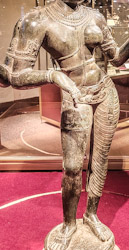
The statue I gave been describing is half male and half female. According to an information panel nearby, this sculpture is an 11th century depiction of Artanarishvara. It is a composite of Shiva (right half) and Parvati (left half). It represents the belief that the Godhead, Shiva, and his consort, Parvati, cannot exist without each other. It also shows that without the coexistence of male and female, human life cannot be propagated and continued. No doubt, there is much more meaning encompassed in this interesting sculpture, but I am not competent to discuss this further. Suffice it to say, seeing this unusual sculpture gave me food for thought.

Until today, I had never seen an Artanarishvara. This beautifully crafted work was one of many lovely pieces in the bronze collection of Chennai’s version of the British Museum.

Mistress

A man might have one ‘mistress’ or even several. However, there is no male version of this word in English. The word ‘mistress’ sometimes carries negative connotations, but it also suggests a more formal or longterm relationship than a casual one. In any case, having a mistress implies a relationship with a woman, who is not married to the man.

So given that there is no male version of a mistress , how does a woman refer to a man with whom she is having a relationship out of wedlock?

The word ‘partner’ is sometimes used. So, is ‘boyfriend’, ‘lover’, ‘guy’, ‘common law husband’, or even ‘paramour’. None of these words carry exactly the same interpretations as ‘mistress’.

To me, boyfriend suggests young love. When I was practising as a dentist, some quite elderly women used to mention their ‘boyfriends’, who were often at least as old as they were. To my ears, ‘boyfriend’ sounded wrong in these cases. ‘Partner’ seemed a better choice of word.

Years ago, a friend of my father, the late Cyril Sofer, used to refer to girls’ close male friends as their ‘chaps’. Although I like this term, it is still not a male version of the word ‘mistress’ with all of its implications.

Keep your hair on

Mr T was a regular attender at my dental surgery. Bald, he had a high pitched voice. For some years he made appointments on Saturday mornings because he commuted during the weekdays. He retired and then began coming to see me on weekdays.

One Thursday just before Mr T was due to enter my surgery, our receptionist rushed in and said : “Don’t be surprised when you see Mr T.”

A few moments later, a woman in fairly dowdy, quite unfashionable clothes walked in and sat in my dental chair. When this person with a good crop of hair greeted me, I recognised Mr T’s voice and his familiar face was framed by his unfamiliar hair. I looked at my dental nurse, and she looked back at me, astonished.

As I always did, I asked the patient whether he/she had any medical problems lately, or had to see the doctor lately. The transformed Mr T said “not at all.”

Puzzled, I performed the dental check up, and discovered that there was a tooth that required extracting. T consented to this and we arranged for him to return a week later. He/she left the room.

In those days, early in my career, whenever I performed a tooth removal I asked the nurse to support the patient’s head gently during the procedure.

As soon as T left the room, my nurse said to me: “Don’t expect me to support his head next week. What if his wig were to come off in my hand?”

A week later, dressed as before in dowdy women’s clothing and with a full head if hair, the previously bald and previously male-attired T turned up for his extraction.

Before commencing, T asked me in his high-pitched voice which was now in complete harmony with his female appearance: “Will this take long?”

I said: “Only a few minutes. Are you in a hurry?”

“Slightly,” T replied, “I am going shopping with my wife in a quarter of an hour.”

I suspect that throughout his working life, T had yearned to appear female, but only in retirement was he able to make his fantasy into reality. His wife must have been a very understanding woman.