While researching for an essay about STEVE BIKO, I consulted the diary I kept when I visited South Africa in August 2003. We spent a night in an old-fashioned hotel in the heart of the bleak Karoo. Here is what I wrote about it:
After the village of De Doorns, the Karoo begins: the countryside becomes emptier and emptier, trees become scarce, the ground is covered patchily with small round bushes. The country is desert-like, wild and also hilly.
After about an hour of driving through this empty, though very beautiful, landscape, we spotted the tiny settlement called Matjiesfontein.
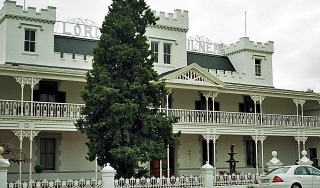
This place, in the middle of nowhere, consists of one street, a 19th century grand hotel, the “Lord Milner”, a few cottages, other buildings, and a railway station on the main line from Cape Town to Jo’burg. When we arrived, we were fortunate to be there whilst the famous, luxury “Blue Train” was making a halt. It stops there for a couple of hours three times a week. To travel on this train, a sort of luxury liner on rails, one needs to part with R10, 000 (£880, about) per person. The train takes 3 days and 2 nights to get from Cape Town to Pretoria.
A building along the platform at Matjiesfontein station contains the Rawden Museum that contains a jumble of assorted items extending back to Victorian times. This includes a good selection of bedpans as well as a portable field toilet, housed in a mahogany case, complete with porcelain bowl and a flushing mechanism – an essential item for winning a war (i.e. the Anglo-Boer War). A particularly intriguing item was a portable chapel: it was like a suitcase, which opened up to reveal a folding crucifix, a lectern and a special space to keep a Bible. There were also a great number of Victorian clothes in various states of disintegration.
Near the Hotel there is a “Museum of Transport”, containing a collection of cars, some of which I remember as being new models in the 1960s. There is also some old railway rolling stock that can be entered by visitors.
We ate dinner in the Hotel’s dining room for which the dress code rule is ‘smart casual’. I took this to mean that a blazer would be required, Far from it, in South Africa, smart casual simply means: no shorts or sandals. In fact as the temperature was so low (near freezing point outside) many of the diners ate without removing their outer coats. The food, for which the hotel used to be well known, was indifferent but the wine was good.
After dinner we were shown around the private rooms, filled with antique furniture, of Lord Logan, who founded the Hotel. We slept in a cottage, which was, we were told, where the writer Olive Schreiner(1855-1920) used to stay when she visited Matjiesfontein.

