
Next to London Bridge

THE PRESENT FISHMONGERS Hall at the northern end of London Bridge was constructed in 1827, following the completion of the London Bridge, which now stands in Lake Havasu City in Arizona (USA). Built in a neo-classical style, the Hall, which faces the Thames and King William Street, was designed by Henry Roberts (1803-1876), assisted by a young architect who would later be known as Sir George Gilbert-Scott (1811-1878).
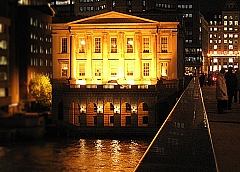
Recently, the Hall was associated with a horrific act perpetrated by a terrorist Usman Khan (1991-2019). Khan, whom it was believed to have been reformed and rehabilitated from his terrorist leanings, was attending a conference on prisoner rehabilitation arranged by the University of Cambridge at Fishmonger’s Hall on the 29th of November 2019. During the conference, he put on what turned out to be a fake suicide vest. He threatened to blow up the Hall. He did not do that, but instead fatally stabbed two of the other conference delegates (both in their twenties): Saskia Jones and Jack Merrett. The latter had studied at the University of Cambridge. As Khan fled across London Bridge, he was tackled by members of the public before being shot dead by a policeman. What had been intended to be a well-intentioned project, ended up as a national tragedy. It illustrated that although a person’s mind can be programmed to become a fanatic, undoing this programming is far more difficult than most people, even experts, imagine.
Me Here Now

UNTIL RECENTLY, LONDON Bridge railway station, overshadowed by the glass-clad Shard skyscraper, was not visually appealing. It was a place that you lingered no longer than necessary either whilst waiting for a train or having just disembarked.

Today, the station has been transformed into a place where you might want to linger and explore. It has been cleaned up and tastefully remodelled. The station and the tracks leading from it have always been above ground, supported by innumerable brickwork arches. A few years ago before the improvement works were carried out, many of these archways led to passages beneath the station, most of them dark and unwelcoming.

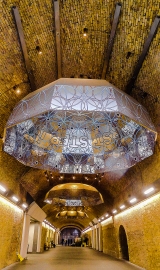
One of these was the Stainer Street Walkway that links St Thomas Street and Tooley Street and passes through the station’s foyer from which stairways lead up to platforms. This wide passageway lined with ochre coloured brickwork is now well-lit and apart from being a bit chilly, quite pleasant. But look up, and you will see three enormous, reflective, decorative umbrellas suspended from the ceiling. Each umbrella is decorated with geometric symbols and lettering. The lettering forms sets of words that are supposed to be meaningful for those who bother to read them.

Together, these umbrellas comprise an artwork, “.Me. Here. Now” by Mark Titchner , which were put in place in mid-2019. With the decrease in passenger numbers since the start of the covid19 pandemic, this lovely set of artefacts have been seen by far fewer people than were anticipated by the commissioners of this creation, Network Rail.