
THE AINA MAHAL (‘Palace of Mirrors) in Bhuj (Kutch, Gujarat) was constructed in about 1750, and badly damaged during the terrible earthquake of 2001. Luckily, some of the palace survived, and several rooms containing an intriguing variety of objects can be visited by the public. Above these, there is another floor, which is not accessible to the public. A prominent member of the royal family of Kutch, with whom we have become friendly, kindly showed us around these rooms, which include the old Durbar Hall where the ruler, the Maharao, used to hold audiences. After 1868, when a new palace, the gothic revival style Pragmahal, was built, the rulers of Kutch used its larger durbar.
The old durbar Hall in the Aina Mahal contains fine painted portraits of some of the previous Maharaos. One of these depicts Maharao Desarji II, who ruled from 1819 to 1860. Amongst his many achievements he encouraged the study of mathematics, geography, and astronomy. He developed schools and hospitals. And he also put an end to slave trading in Kutch. In addition, he put an end to the practice of sati (‘self’-immolation of widows during their husbands’ cremations).
His son Pragmalji II, who ruled from 1860 to 1875, not only had the Pragmahal place built but also encouraged education. It was during his reign that the Alfred School was built. It was named in honour of Queen Victoria’s son Prince Alfred, who visited India in 1869/70.
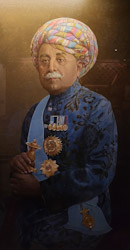
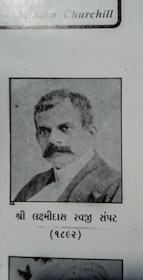
My wife’ great great grandfather, Laxmidas Ravji Sapat, was the 11th headmaster of the Alfred High School between 1888 and 1892. This was during the reign of Maharao Khengarji III, who ruled Kutch from 1876 to 1942. He loved wildlife and took an interest in education. Amongst the many things he did was establishing the Museum of Kutch and the Jubilee Hospital – both in Bhuj. He also helped Laxmidas Ravji Sapat.
After being headmaster of the Alfred School, Laxmidas and his son-in-law went to London to study law, Mr Thacker, at Middle Temple. Going to London to study was expensive. As both Laxmidas and his son-in-law, Mr Thacker (my wife’s great grandfather) were bright, their community, the Kutchi Bhatias, clubbed together to help finance the education of these two promising men. Additional money was donated by the Maharao (Khengarji III), who, as already mentioned, was keen on promoting education.
I am grateful that we were privileged to have been shown around a part of the Aina Mahal not open to the public. Apart from seeing something new and having a member of the royal family to explain things, we managed to see portraits of his ancestors, each of which was accompanied by labels that summarised their achievements.
 yamey
yamey 