
THE SIKH RELIGION was founded by Guru Nanak (1469-1539). During his lifetime, he made pilgrimages to Mecca. On two of these, he travelled through the port of Lakhpat in Kutch (Kachchh, Gujarat). In his lifetime, Lakhpat was a thriving port, but now it is a ghost town.
Lakhpat contains a fully functioning gurdwara (Sikh place of worship), the Lakhpat Gurdwara Sahib. It was established by the descendants of the Sikhs who hosted Guru Nanak during his two stays in Lakhpat. The sanctuary of the gurdwara contains relics that were used by Guru Nanak while he spent time in Lakhpat.
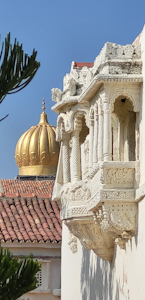
The sanctuary is housed in a large compound in which one must walk barefoot and with one’s head covered. The place is very clean.
As with all gurdwaras, pilgrims and other visitors are offered (free of charge) vegetarian food and drinks (eg tea) in the ‘langar’ (=kiitchen) hall. We drank tea from metal cups and saw others, seated on the floor, eating food from metal thalis. After finishing ones food and drinks, visitors must was the metal vessels with soap and water so that they are ready for use by others.
Although the sanctuary building is nineteenth century or older, the rest of the gurdwara is newer. We entered a huge new meeting hall to which builders were completing finishing touches. We were told that it was being got ready because there was about to be a great gathering of Sikh pilgrims at a festival.
Lakhpat and its gurdwar are close to India’s border with Sindh in Pakistan. The whole area around the erstwhile port is full of military personnel and camps. Many Indian regiments contain Sikh members. Some of these regiments have donated things to the gurdwara at Lakhpat. As one walks around, one can see plaques put up by, and to commemorate these regiments.
I enjoyed visiting the gurdwara, and we were happy to make a donation. Whatever the size of the donation, the donor receives a receipt that states the reason for making the gift. We wrote that our money was in gratitude for the refreshment offered to us in the langar hall.
By visiting the gurdwara at Lakhpat, we can truly say that we were following in the footsteps of Guru Nanak, even though our journey was most probably more comfortable than his.
 IN DECEMBER 2005, we spent a Saturday night at a bed and breakfast in a remote spot near Winchelsea in East Sussex. In those days we still had our own car and could stop where we wanted on or even off the route.One of our stopping places was Redhill in Surrey. We wanted to visit its contemporary Roman Catholic church of St Joseph and St Paul’s, but not for religious reasons. The architects, who had designed it, knew that my late uncle WS Rindl, an accomplished structural engineer, was a keen amateur sculptor. They asked him to make some decorative features and a crucifix to adorn the exterior of the church. In addition to the concrete crucifix, my uncle designed and constructed concrete gargoyles to run off rainwater from the roof. Each of these gargoyles is decorated in bas-relief with castings of the tools used by builders and engineers. On one of these drainage spouts there is a representation of what looks as if it were an early rather bulky model of a pocket calculator. The church, completed in 1984, is a lovely example of imaginative 20th century architecture, well worth a detour to see.The rurally located bed and breakfast was housed in a building that was at least 300 years old if not older. The accommodation was comfortable but the breakfast was disappointing. The fried eggs served seemed as if they had been made long before breakfast and kept warm; they were not as fresh as the frost that had coated the surrounding countryside overnight. We made a brief visit to Winchelsea, a place that has always fascinated me. Founded as ‘New Winchelsea’ by King Edward the First in the 13th century, the town was a coastal port, complete with city walls. By the 1520s, what had been a thriving centre of trade declined rapidly because of shifting of the coastline resulting from silting up of its harbour. Apart from some of the town’s mediaeval gateways and the large church of St Thomas the Martyr, it is difficult to imagine that Winchelsea was once a bustling metropolis. The decline of Winchelsea is one of many examples all over the world of how environmental changes can affect the ability of civilisations to thrive. In January 2020, we visited Lakhpat in Kutch, a part of Gujarat in western India. This huge walled city, far greater in size than Winchelsea, was a thriving seaport until the early 19th century when an earthquake caused the sea inlet on which it stood to become transformed into a salty desert. Today, the seven kilometres of intact city walls contain not a city but only a few widely separated dwellings and a Sikh Gurdwara. The church, which dates back to the 13th century, looks large. However, what can be seen today is all that is left of what had once been a far larger cathedral-like building.On the Sunday morning when we entered the church, a service was being held. There was the priest and his congregation of less than eight people, looking a little lost in the huge church. Seeing the three of us entering, he welcomed us, and said in a pleading voice:
 yamey
yamey 