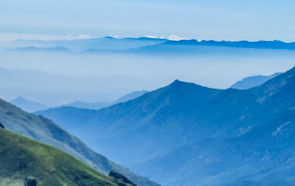
Once a railway station in Kerala  but now a viewpoint for tourists

TOP STATION IS about 20 miles from Munnar (in Kerala) and 5500 feet above sea level.  Today, it is a popular tourist attraction, providing visitors with magnificent views of several ranges of hills. The place gets its name because it was the highest station on a railway that no longer exists.


View from Top Station

Between 1902 and 1908, a monorail system used for transporting locally harvested tea was built to connect Munnar with Top Station. In 1908, this was replaced by a narrow-gauge railway  the Kundala Valley Railway. Tea was transported to Top Station, where it was loaded onto a ropeway that carried it down 3 miles to a village, Kottagudi, in Tamil Nadu.  From there, it was transported to other parts of India. Sadly, the railway was washed away during a severe flood in 1924, and was never replaced.


Top Station was not only important as a railway Terminus, but also as a place on a road that was improved by the British  in 1942, when it was feared that Chennai, which had been bombed, might be invaded by the Japanese.


Following the bombing, which caused little damage, people fled from Chennai, the wealthy to hill station,  and the less well-known off to villages and towns far from the east coast. Meanwhile,  the British built what became known as the Escape Road, which ran across the high mountains between Kodaikanal and Munnar. This 50 mile road linked roads from Madras with roads from Munnar to Kochi (Cochin), from where troops could leave India if necessary.


The Escape Road, which reaches 8140 feet was the highest road in India South of the Himalayas.  The road remained in use until 1990. After this date, it fell into disused because neither Tamil Nadu nor Kerala were prepared to pay for its upkeep.


As a result of the closing of the former Escape Road,  travellers between Munnar and Kodaikanal have to travel on other roads. The present road route is 105 miles instead of  50 miles taken by the disused road.

  Top Station is well worth visiting. The views from over the precipice are amazing. To see them, one needs to elbow aside the numerous people posing for photographs or taking ‘selfies’. Unfortunately,  the viewpoint itself is covered with litter left by tourists.

Thrown out of a library

When she was about two years old, our daughter dressed in a unisex romper outfit, rushed into the Men’s Bar at the Bangalore Club. An elderly gentleman conducted her back to the entrance of the bar, saying: “You can’t come in here yet, young man. You’ll have to wait until you’re twenty one.”

My wife explained that our child is a girl. The gentleman replied: “In that case, my dear, you will never be able to enter the Men’s Bar.”

The Bangalore Club was founded by British officers in 1868 at the time when Mahatma Gandhi was born in faraway Gujarat. Until after about 1945, women were not allowed into the main Club House. There was a separate annexe reserved for women. And until 1947, with the exception of servants and a very few high ranking military officers, no Indians were permitted to enter any part of the Club.

The Bangalore Club and many other similar still existing colonial era clubs in India maintain many of the old-fashioned rules that applied in elite clubs in the UK. For many years, men could only enter the Club House at the Bangalore Club wearing ‘proper’ shoes, not sports shoes or sandals. Now, sandals are allowed providing they have a back strap around the ankle.

Once, I stayed at the Kodaikanal Club deep in the southern Indian state of Tamil Nadu. Dress code seemed to be non-existent there until I stepped into the club’s small library. Within a few seconds, a member of the library staff escorted me out of the library. I was wearing sandals. I was told that one could only enter the library if formal leather shoes were being worn.

Well, if you join a club, you should respect its rules however idiotic they might seem. Vide the UK and the EU.

As time moves on, rules change. A couple of years ago , for reasons best not explored here and they were nothing to do with gender equality, women were permitted to enter and use the Men’s Bar at the Bangalore Club. Since that date, the formerly masculine sanctuary has been renamed “The Bar”.

The old gentlemen who evicted our daughter from the Men’s Bar is probably no longer alive. I wonder what he would have thought when his prediction proved to be wrong. Let’s finish by raising a glass to his memory.