
A cook from Kutch in Norway

THE SHARAD BAUG HOMESTAY is in the extensive, luxuriant, verdant grounds of the Sharad Baug Palace. Badly damaged in the 2001 earthquake, the palace is a short walk from the excellent homestay. This accommodation is owned and run by members of the royal family of the former Kingdom of Kutch.

Close to the homestay in the middle of a field, there is another ruined edifice. This was formerly used as a guesthouse by important guests of the ruler, the Maharao. For some time, the poet Dara Shiko (1615-1659) hid from his brother (the future emperor Aurangzeb) in this building.

Near the ruined palace, there is a building, which was the last Maharao of Kutch’s sitting room and dining hall. Now, the building houses a small museum filled with exhibits relating to the royal Jadeja family. Amongst these, there are several items connected with the last ruler of independent Kutch when he spent some time in Norway.

After Kutch had joined India soon after 1947, its last Maharao, Madansinhji (1909-1991), was appointed India’s ambassador to Norway. There are photographs relating to his stay in Norway in the museum. There is also a Christmas card in Norwegian and a certificate issued by the Oslo Tennis Club. He served in Norway between 1957 and 1960.

While in Norway, Madansinhji was served by his chef from Bhuj, a member of the Yadav family. For many generations, the Yadavs have been chefs, specialising in non-veg food.
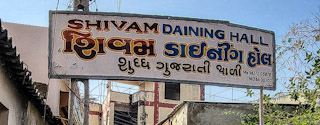
When we first visited Bhuj, in 2018, we were recommended to eat in a simple, small restaurant in the bazaar of Bhuj. Named Shivam Daining (sic), it serves very tasty pure vegetarian food. We returned to eat there several times during our recent (January 2023) stay in Bhuj. While chatting with its chef and his relatives, we learned that the man who produces the excellent food is a grandson of the Mr Yadav, who cooked for Madansinhji in Norway. Although the family have a tradition of cooking meat and fish, they do not offer it at Shivams because they rightly feel that there is little demand for non-veg food in the mainly vegetarian city of Bhuj.

Without knowing it when I booked the Sharad Baug homestay, it turned out that it and one of our favourite restaurants in Bhuj had at least one common connection, and that is Norway.
An illustrious ancestor

QUEEN VICTORIA’S SON Prince Alfred (1844-1900) visited India in December 1869. In his honour several schools in India were founded in his name. In the present State of Gujarat, there are at least 3 still in existence. One is in Rajkot, another in Bhavnagar, and one in Bhuj (formerly the capital of the Princely State of Kutch).

Alfred High School in Bhuj

In Bhuj, we have a friend, Pramod Jethi, who is a historian of Kutch. Some of what I am about to relate is based on information kindly provided by him. Much of the rest is gleaned from what my wife’s family have told me.

My wife’s mother’s great grandfather was one Laxmidas Ravji Sapat (aka Sampat), who was born in the mid-19th century, or a bit earlier. Along with Gokaldas Parekh, Laxmidas was one of the first teachers in the Alfred High School in Bhuj (founded by Rao of Cutch, Pragmalji II in 1870). It is likely that he was its headmaster for a time. I have yet to see it, but his portrait hangs in the school. One of my wife’s relatives, also a descendant of Laxmidas, arranged to have it restored a few years ago.

In 1890, Laxmidas left the school. Later, along with his son-in-law, Cullyanji Murarji Thacker, he went to London (UK) to become a barrister. He studied for the Bar at Middle Temple and was called to the Bar on the 27th of June 1900, along with his son-in-law. Mr Thacker, who was my wife’s mother’s grandfather. The two men received financial help for their studies from the Kutch Royal family.
Both men were members of the Bhatia community in Kutch. Back at the end of the 19th and the early 20th it would have been unusual for a man and his son-in-law to travel out of India together to study.

Laxmidas, after leaving the Alfred School, became appointed as police chief of Bhuj, then diwan (Prime Minister) of Jaisalmer, and after that Chief Justice of Jodhpur. Apparently, he was very successful in reducing dacoitry in the Kingdom of Kutch and also Jaisalmer.

Recognising that the dacoits robbed because they were impoverished and starving, he helped make arrangements that reduced these poor peoples’ need to steal. It was this success that attracted other rulers of Princely States to offer him employment.

Regarding Jaisalmer, I discovered this quote:
“On his retirement, one Laxmi Das Raoji Sapat, who had lately served as Police Commissioner in the Kutch State, was appointed as Dewan of Jaisalmer”
This was in 1903.

As for Mr Thacker, he was successful enough to have owned a large house with two separate kitchens (one veg, the other for meat), and to have employed an English governess for my wife’s maternal grandmother, Benabhai, who married the surgeon Haridas Bhatia FRCS (died of septicaemia whilst on duty in 1926).

Incidentally, Benabhai was sent to London to study at the former Bedford College at the same time as her husband was studying for his FRCS. This contrasts with Mahatma Gandhi, who went to study in London, leaving his wife behind in India.

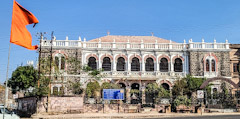
In January 2023, whilst spending a short time in Bhuj, we took a look at the elegant exterior of the city’s Alfred High School, which adjoins the Bhuj Museum. Badly damaged in the earthquake of 2001, the school building has been well restored. A less attractive, newer building was built to enlarge the school. On a future and lengthier visit to Bhuj, we hope to be able to view the portrait of Laxmidas that hangs inside the school.