IT IS NOT UNUSUAL to find a swing (‘hichko’ in Hindi) in an Indian home. Often, they consist of a seat suspended from a frame by ropes or chains. The museum in the fort at Jodhpur in Rajasthan has a fine collection of hichkos that were once used by the former royal family.
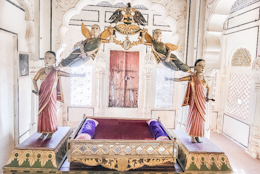
Hichko presented by the PWD
One of the swings in the collection caught my eye both because it was quite different in design from the others in the collection and because it bore an interesting label, which had been attached by its maker(s). The wording on the label reads:
“With profound loyalty of Jodhpur PWD Employees Union”
(PWD: Public Works Department)
This hichko which is decorated with the royal crest of Jodhpur and almost lifesize models depicting two women in saris is not dated. The union still exists, but since 1947, the royal family has lost the power which it once possessed.
MY WIFE AND I CAN tolerate and enjoy spicy Indian food. Yet, once in a while, a dish can have such an excess of hot chillies that eating it is less than pleasurable.
Last night (4th of December 2024), our autorickshaw driver, ‘M’, recommended that we try a Muslim restaurant that is popular with ‘local people’ in Jodhpur. On arriving at the place, Beli Chicken, we were directed to one of its several rooms. It was the one where men accompanied by women plus or minus children could dine together. It was the Family Room. Another room, the restaurant’s largest, was reserved for men only.
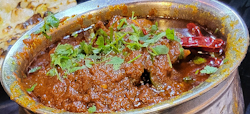
Lal maas
We ordered the restaurant’s speciality, fried chicken, and Mutton lal maas (a red meat curry, a speciality of Rajasthan). The chicken was perfect. It was some of the best fried chicken I have ever eaten. The lal maas had a good flavour but contained an excessive amount of fiery red chillies. The meat was easy to enjoy, but the sauce was almost painful to eat. By mopping it up with a paratha, it became more enjoyable. When we had eaten most of the meat we asked the waiter to have the left overs packed up. We thought that M or his family might appreciate it.
As we set off from the restaurant, M said he needed to make a short detour to see an “uncle” (an elderly acquaintance, rather than a blood relative). This uncle turned out to be a poor old man squatting on a low concrete divider in the middle of a busy road. In front of him, there were a few remains of kebabs and other scraps of food. We stopped next to him, and M handed the old man our packed food. The uncle put his hand to his heart to express his gratitude.
I was touched by the charitable action of our kind autorickshaw driver.
MANDOR IS A FEW MILES out of Jodhpur. It was the capital of Marwar kingdom until the founding of the city of Jodhpur in the mid-15th century AD. After that, Mandor remained the place where members of the royal house of Jodhpur were cremated. It was also where the cenotaphs commemorating the rulers of Marwar were erected. These beautiful, intricately designed, red sandstone structures are now part of a well-manicured park known as Mandore Garden.
Part of a cenotaph
High above the group of cenotaphs, there are the ruins of Mandore’s fort. And near to these memorials, there is an important Hindu temple and a lovely octagonal tower: the Ek Thamba Mahal. This structure with latticed window apertures might have been where ladies could watch ceremonies without contravening the conventions of purdah.
A morning in Mandore Park, the abode of many monkeys, is well worthwhile. At 7 pm, the monuments are lit up, and this is a highly recommended sight, so we were told.
PS a cenotaph is a monument to someone whose remains are buried or disposed of elsewhere
THE MEHRANGARH FORTRESS rests on massive rock overlooking the city of Jodhpur in Rajasthan. At night the walls of the fort are brightly illuminated and can be seen from many places in the city. The older districts of Jodhpur cling to the lower slopes of the rock upon which the fort rests. To take advantage of the splendid views of the fort, many restaurants in the old parts of the city are located high above street level on rooftops. Some of these eateries are as much as five storeys above street level, and none of them have lifts to reach them.
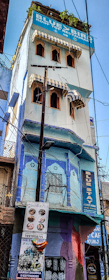
A restaurant is at the TOP
One rooftop restaurant, which we have visited twice, is on the second floor of an old building. Called Indigo, we have eaten excellent Rajasthani meat dishes there, and were looking forward to visiting it a third time today (the 3rd of December 2024).
At about 4 am. on the 3rd of December, I awoke briefly and noticed that there was no electricity in the hotel and the alley next to it. By 7 a.m., the electrical supply had been restored. At breakfast, which is always served on the fourth floor rooftop of our guest house, Mr Manu, the owner of the place, told us that there had been a fire in the kitchen of the Indigo restaurant, which we had begun to enjoy. Burn marks were clearly visible from our guest house’s rooftop.
The reason the power had failed early in the morning was that the Indigo restaurant is located close to an electricity transformer, and the authorities were concerned that the fire might spread ⁷to it. Luckily, it did not.
After breakfast, we decided to walk to Indigo to offer our sympathy to its charming owner. When we arrived, we found his wife and a few other women seated in the restaurant’s ground floor courtyard. Each of them had very sad expressions on their faces. I felt that it was like visiting the bereaved soon after a loved one had passed away. They asked us to sit with them, and soon after that, the owner arrived. We told him how sorry we were about the disaster which had befallen him and his family. I believe that he appreciated our brief visit.
Had the fire not happened, we would have eaten all the rest of our evening meals at Indigo during the remaining few days of our stay in Jodhpur. I hope that Indigo will recover soon and that anyone who happens to read this and is visiting Jodhpur will eat at this excellent restaurant.
WATER STORAGE TANKS and wells are subject to changes in the water level. In small wells such as are commonly found in England, a bucket and winch system allows the water gatherer to reach the water in the well. In India where water tanks and wells can be quite large, occupying a substantial area of ground, another system is used to allow users to get to whatever level the water has reached. The walls of the sides of the tank/reservoir/well are lined with a series of staircases, which are used to reach the water. Often the sets of steps lining the walls of the so-called stepwells are arranged in attractive geometric patterns.
At the Toorji stepwell
Since first seeing a (disused) beautiful stepwell in the ruins of the medieval city of Vijayanagara at Hampi in Karnataka thirty years ago, I have been fascinated by stepwells. I have seen many while travelling around Gujarat, and was pleased to find one near our guest house in Jodhpur (Rajasthan). It’s name is Toorji ka Jhalra Bavdi.
The Toorji stepwell was built in about 1740. Its construction was ordered by the Queen Consort of Maharaja Abhay Singh. Back in those days, ladies of the royal family often commissioned the building of water tanks and wells. The Toorji stepwell was used mostly by women, who traditionally did household chores including the fetching and carrying of water.
Toorji stepwell is constructed with the rose red sandstone of Jodhpur. It is decorated with carvings of various sizes. Nowadays, as with so many interesting places all over the world, it is a popular location for taking ‘selfies’ and for posing for photographs. Despite this, it is a stepwell worth seeing and is a remarkably tranquil spot surrounded by a maze of narrow, busy streets and lanes.
QUEEN VICTORIA’S SON Prince Alfred (1844-1900) visited India in December 1869. In his honour several schools in India were founded in his name. In the present State of Gujarat, there are at least 3 still in existence. One is in Rajkot, another in Bhavnagar, and one in Bhuj (formerly the capital of the Princely State of Kutch).
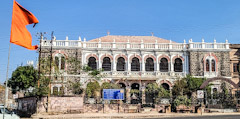
Alfred High School in Bhuj
In Bhuj, we have a friend, Pramod Jethi, who is a historian of Kutch. Some of what I am about to relate is based on information kindly provided by him. Much of the rest is gleaned from what my wife’s family have told me.
My wife’s mother’s great grandfather was one Laxmidas Ravji Sapat (aka Sampat), who was born in the mid-19th century, or a bit earlier. Along with Gokaldas Parekh, Laxmidas was one of the first teachers in the Alfred High School in Bhuj (founded by Rao of Cutch, Pragmalji II in 1870). It is likely that he was its headmaster for a time. I have yet to see it, but his portrait hangs in the school. One of my wife’s relatives, also a descendant of Laxmidas, arranged to have it restored a few years ago.
In 1890, Laxmidas left the school. Later, along with his son-in-law, Cullyanji Murarji Thacker, he went to London (UK) to become a barrister. He studied for the Bar at Middle Temple and was called to the Bar on the 27th of June 1900, along with his son-in-law. Mr Thacker, who was my wife’s mother’s grandfather. The two men received financial help for their studies from the Kutch Royal family. Both men were members of the Bhatia community in Kutch. Back at the end of the 19th and the early 20th it would have been unusual for a man and his son-in-law to travel out of India together to study.
Laxmidas, after leaving the Alfred School, became appointed as police chief of Bhuj, then diwan (Prime Minister) of Jaisalmer, and after that Chief Justice of Jodhpur. Apparently, he was very successful in reducing dacoitry in the Kingdom of Kutch and also Jaisalmer.
Recognising that the dacoits robbed because they were impoverished and starving, he helped make arrangements that reduced these poor peoples’ need to steal. It was this success that attracted other rulers of Princely States to offer him employment.
Regarding Jaisalmer, I discovered this quote: “On his retirement, one Laxmi Das Raoji Sapat, who had lately served as Police Commissioner in the Kutch State, was appointed as Dewan of Jaisalmer” This was in 1903.
As for Mr Thacker, he was successful enough to have owned a large house with two separate kitchens (one veg, the other for meat), and to have employed an English governess for my wife’s maternal grandmother, Benabhai, who married the surgeon Haridas Bhatia FRCS (died of septicaemia whilst on duty in 1926).
Incidentally, Benabhai was sent to London to study at the former Bedford College at the same time as her husband was studying for his FRCS. This contrasts with Mahatma Gandhi, who went to study in London, leaving his wife behind in India.
In January 2023, whilst spending a short time in Bhuj, we took a look at the elegant exterior of the city’s Alfred High School, which adjoins the Bhuj Museum. Badly damaged in the earthquake of 2001, the school building has been well restored. A less attractive, newer building was built to enlarge the school. On a future and lengthier visit to Bhuj, we hope to be able to view the portrait of Laxmidas that hangs inside the school.



 yamey
yamey 