Tulsi trees and temples within the fort at Jaisalmer

 THE WALLS OF THE fort in Jaisalmer (Rajasthan) contain a living city that has been in existence since the early 18th century,  but the fort itself was established in the 12th century. It is enjoyable to wander the narrow lanes that thread their way between houses, many of which are decorated with elaborate, Rajput style carving.


The only thing that can cause the visitor some concern is the regular passage of motorbikes and scooters along the thoroughfares which are severely limited in width. These vehicles, often driven by impatient people who sound the horn loudly and frequently, squeeze past one, narrowly avoiding injuring pedestrians. I suspect that these motorists find the tourists as irritating as the pedestrians regard them. That said, like Venice, whose main thoroughfares are crammed with visitors,  Jaisalmer, like Venice,  has byways that are almost deserted apart from the few residents who dwell in the houses lining them.


A tulsi tree

Today, we made a second visit to the fort and tried to avoid the busiest lanes as much as possible.  In so doing, we stumbled across two lovely old mandirs (Hindu temples). Both were constructed in the 15th century, long before the fort became a residential area for civilians. 


Both mandirs are still used for worship. In one of them, the Laxmi Narayan mandir, two pandits (priests) were having a heated argument  yelling at each other across the courtyard.  At this mandir, there was a tulsi (holy basil) tree, growing in a container, which has small alcoves in which lighted diyas (oil lamps) can be placed. I watched a man walking clockwise around the tulsi tree several times. When he had done this,  he plucked one of its leaves and touched it reverently  against his forehead.


The tulsi tree is of religious significance to devout Hindus. I read somewhere that when the Portuguese were occupying Goa and trying to encourage people to become Roman Catholic, tulsi trees were outlawed in that former colony.


The courtyard of the Laxmi Narayan was partly shaded by a peepal tree, whose leaves are heart shaped. Like the tulsi tree, the much larger peepal  tree is also of religious significance.


The other old temple, which is smaller than it’s neighbour (Laxmi Narayan), is called the Ratneshwar Mahadev. I did not notice any tulsi plants associated with it. However, a peepal was growing next to it.


Although both mandirs had visitors,  both locals and tourists, they were less crowded than the much-visited Jain temple with the fort. When we walked past it yesterday, it was literally swarming with tourists.


Apart from the spectacular array of finely decorated buildings that can be seen, what makes the fort of Jaisalmer well worth seeing is that it is still home people who live their everyday domestic lives there. Interspersed amongst the many things designed to appeal to tourists, one catches frequent glimpses of local people living their daily lives.
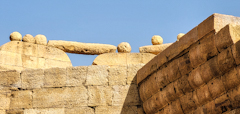
Loads of balls to defend the city walls

THE WALL SURROUNDING the fort of Jaisalmer is about three miles in circumference.  It encloses a warren of narrow streets and small squares and is home to several thousand residents.


Balls on the walls

It was during the reign of Akhai Singh, 1723 to 1762, that people began leaving the town around the fort to establish homes within it. They began laying out streets and mohallas (neighbourhoods) within the well defended fort. This continued until 1891. Why it should have stopped in 1891, I  do not know yet. Suffice it to say that this fort, like that at Carcassonne in France, is one of the few forts in the world that is still home to a settlement of local people. It is a “living fort”, not a museum.


The fort and its contents form the main tourist attraction of Jaisalmer.  Like Venice in Italy, it feels as if the tourists outnumber the locals. Many of the buildings in the fort cater to the tourist trade: guest houses, shops, and eateries. And there are plenty of men who are keen to guide you around the fort for a modest fee. However, the services of a guide would spoil, rather than enhance, the pleasure of exploring this attractive place. The best way to enjoy the fort and the richness of its ornate, yellow sandstone buildings is to lose yourself in the maze of narrow streets.


The fort’s construction commenced in about 1156 AD. You do not need to be particularly observant to notice that upon many of the fort’s outer walls there are heavy-looking stone balls and roughly hewn stone cylinders.  These were placed, ready to be rolled down on enemies attacking the fort at close range. The fort has been attacked several times over the centuries. But I  hope that it will not be attacked again. In the unlikely event that another assault  will be planned, I  am pleased to report that the stone balls are already in place.


The wonderful dwelling of a Dewan in Jaisalmer

 ONE OF THE REASONS for our visit to Rajasthan in 2024 is connected with one of my wife’s ancestors: Laxmidas Sapat (also written as ‘Sampath’). He was my wife’s great great grandfather on her mother’s side. Trained as a barrister in London’s  Middle Temple   he was Dewan (Chief Minister) of Jaisalmer between from 1903 for about six years. After that, he became Chief Justice of Jodhpur.


As yet, we have not discovered where Laxmidas resided in Jaisalmer.  But today (8th of December 2024), we have just visited the spectacular haveli (mansion) that was constructed for one of Laxmidas’s predecessors: Mohata Nathmal, who was Dewan between 1885 and 1891. The haveli is called Nathmalji ki Haveli and it was built in 1895.


The facade of the edifice, built in the Rajput style, is a riot of intricately carved yellow sandstone. One interesting detail is a carving depicting a steam engine and a bicycle. I wonder whether this was carved because Nathmal was interested in what was then modern technology. An online article (https://www.rajasthanbhumitours.com/blog/rajasthan-tourism/nathmal-ki-haveli-a-symmetrical-marvel-of-jaisalmers-heritage-architecture/) discusses the haveli in detail and gives another explanation:

“One of one of the most fascinating aspects of the façade is the addition of contemporary aspects, such as bikes and also a European-style heavy steam engine, which were unheard of in Rajasthan at the time. These makings mirror the interested and forward-thinking minds of the craftsmens who created the haveli, mixing conventional themes with contemporary motifs that were brand-new to Jaisalmer in the 19th century.”

Whatever the reason for the presence of these carvings, the facade is a showpiece of the skill of the two brothers who were commissioned to erect the building. Today, visitors can enter the haveli to view and purchase the goods in the shops that occupy the building. The rooms within the mansion have wall paintings that were created in the 19th century, and there are also a few framed historical portraits, including one of King Edward VII of England.

I am pleased that I have seen the home of one of the Dewans of Jaisalmer. I would be even happier if I could discover where Laxmidas Sapat resided during his time as Dewan of Jaisalmer.

An illustrious ancestor

QUEEN VICTORIA’S SON Prince Alfred (1844-1900) visited India in December 1869. In his honour several schools in India were founded in his name. In the present State of Gujarat, there are at least 3 still in existence. One is in Rajkot, another in Bhavnagar, and one in Bhuj (formerly the capital of the Princely State of Kutch).

Alfred High School in Bhuj

In Bhuj, we have a friend, Pramod Jethi, who is a historian of Kutch. Some of what I am about to relate is based on information kindly provided by him. Much of the rest is gleaned from what my wife’s family have told me.

My wife’s mother’s great grandfather was one Laxmidas Ravji Sapat (aka Sampat), who was born in the mid-19th century, or a bit earlier. Along with Gokaldas Parekh, Laxmidas was one of the first teachers in the Alfred High School in Bhuj (founded by Rao of Cutch, Pragmalji II in 1870). It is likely that he was its headmaster for a time. I have yet to see it, but his portrait hangs in the school. One of my wife’s relatives, also a descendant of Laxmidas, arranged to have it restored a few years ago.

In 1890, Laxmidas left the school. Later, along with his son-in-law, Cullyanji Murarji Thacker, he went to London (UK) to become a barrister. He studied for the Bar at Middle Temple and was called to the Bar on the 27th of June 1900, along with his son-in-law. Mr Thacker, who was my wife’s mother’s grandfather. The two men received financial help for their studies from the Kutch Royal family.
Both men were members of the Bhatia community in Kutch. Back at the end of the 19th and the early 20th it would have been unusual for a man and his son-in-law to travel out of India together to study.

Laxmidas, after leaving the Alfred School, became appointed as police chief of Bhuj, then diwan (Prime Minister) of Jaisalmer, and after that Chief Justice of Jodhpur. Apparently, he was very successful in reducing dacoitry in the Kingdom of Kutch and also Jaisalmer.

Recognising that the dacoits robbed because they were impoverished and starving, he helped make arrangements that reduced these poor peoples’ need to steal. It was this success that attracted other rulers of Princely States to offer him employment.

Regarding Jaisalmer, I discovered this quote:
“On his retirement, one Laxmi Das Raoji Sapat, who had lately served as Police Commissioner in the Kutch State, was appointed as Dewan of Jaisalmer”
This was in 1903.

As for Mr Thacker, he was successful enough to have owned a large house with two separate kitchens (one veg, the other for meat), and to have employed an English governess for my wife’s maternal grandmother, Benabhai, who married the surgeon Haridas Bhatia FRCS (died of septicaemia whilst on duty in 1926).

Incidentally, Benabhai was sent to London to study at the former Bedford College at the same time as her husband was studying for his FRCS. This contrasts with Mahatma Gandhi, who went to study in London, leaving his wife behind in India.

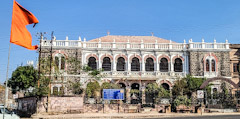
In January 2023, whilst spending a short time in Bhuj, we took a look at the elegant exterior of the city’s Alfred High School, which adjoins the Bhuj Museum. Badly damaged in the earthquake of 2001, the school building has been well restored. A less attractive, newer building was built to enlarge the school. On a future and lengthier visit to Bhuj, we hope to be able to view the portrait of Laxmidas that hangs inside the school.