
Where royalty was cremated in Kutch (Gujarat)

WHEN RAJPUT ROYALTY were cremated, their ashes were taken to be immersed in a holy river, usually the Ganges. However, at the spot where they were cremated, a memorial was erected, often in the form of a chhatri: a stone canopy supported by pillars. Often, the chhatris were quite elaborate and highly ornamented.

Next to one of the lakes in Bhuj, lies the city’s Chhatedi, a large area containing the chhatris (cenotaphs) of the Jadeja rulers of Kutch. Sadly, these cenotaphs suffered much damage during the earthquake of 2001. Thus, today the Chhatedi of Bhuj has become a picturesque set of ruins.
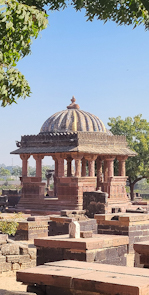
Although this is our fifth visit to Bhuj, it was only this time (December 2025) that we took a close look at the Chhatedi, now a site maintained by the Archaeological Survey of India. Apart from the remains of the grander chhatri, there are many smaller memorials. Often these bear a pair of carved footprints. I imagine that these smaller cenotaphs commemorate the cremation sites of lesser members of the Jadeja families: wives and children. One chhatri is particularly interesting because its roof is decorated with coloured tiling.

Surprisingly, the Chhatedi of Bhuj is one of the sights in the city that is less visited by tourists. It seems to be popular with young couples, who sit in shady spots passing the time of day. When we visited it one morning, there were few other tourists, but a party of local school children were being taken to see the place. They were in their pre-teens. What struck us was that many of these little girls were wearing lipstick, presumably to appear smart on their outing.

The Chhatedi provides great opportunities for photographers. While we were at the site, we saw a family of Indian tourists arrive at one of the larger cenotaphs. Their small daughter was dressed in her finest clothes. Her father got her to pose in front of a statue of a musician on the largest and most elaborate chhatri, and then clicked a photograph. Immediately after that, he told his family:
“Chalo” [‘let’s go’], and they exited the site. In my opinion, that was too rapid a visit. To enjoy exploring the Chhatedi, you should set aside about 30 to 45 minutes.

Although no longer recognised by the Government of India, the Jadeja royalty are held in high regard by many people in Kutch. During a conversation with a member of the family, he told us that the cremation of his grandfather, the last Maharao of Kutch, could not be carried out at the Chhatedi because the authorities would not allow it. In future, cremations of members of the former Royal family will probably no longer be performed in the traditional place: the Chhatedi of Bhuj.
Kutch from kingdom to district

MY WIFE’S COUSIN lives in a part of the Indian state of Gujarat called Kutch (‘Kachchh’). He and his wife have a lovely farmhouse near the port city of Mandvi, where you can watch huge wooden dhows being constructed along the riverbank. Although Kutch is now a part of the state of Gujarat, it has not always been. The people of Kutch (‘Kutchis’) speak a language quite distinct from Gujarati. The Kutchi language has closer similarity to Sindhi than to any other Indian language (Kutch is bordered to its north by Sindhi speaking people*). It is a spoken language, but not written. Even though Kutchi people can speak and write in Gujarati, they will proudly inform you that they are Kutchis and definitely not Gujaratis. During our several visits to Kutch, my wife’s cousin’s driver, who can speak good Gujarati, insists on speaking to my wife in Kutchi, which she cannot speak as well as Gujarati.

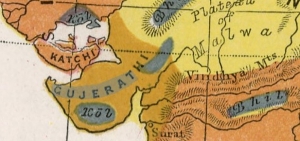
Many people with whom I have discussed my travels, look puzzled when I say that we have been to Kutch. Just in case you are wondering, it is the furthest west part of India. Most of the north of the region is bordered by Pakistan, from which it is separated by the arid Rann of Kutch. To the south and separated from it by the Gulf of Kutch (a part of the Arabian Sea) is the peninsula of Saurashtra – now also a part of Gujarat.

Until 1947, Kutch was a kingdom founded by unifying three separate kingdoms, ruled by branches of the Jadeja family, in the 16th century. In 1819, having suffered a military defeat (at The Battle of Bhuj in March 1819), the Kingdom of Kutch accepted the sovereignty of the British East India Company. Under the watchful eyes of the British, members of the Jadeja family continued to rule Kutch – it became one of India’s many ‘Princely States’. On the 16th of August 1947, one day after India became independent, Kutch voluntarily acceded to the new Indian state.

Kutch became a state of India. In November 1956, as a result of the State Reorganisation Act (1956), Kutch ceased to be a state in its own right, but became a part of the then huge Bombay State. The latter was effectively a bilingual region, most people were either speakers of Marathi or of Gujarati. The Marathis and the Gujaratis began to clash. In 1956, the Mahagujarat Movement began campaigning for a state for Gujaratis, which was separated from that for Marathis. The movement was spearheaded by Indulal Yagnik (1892-1972). His nephew, who lives in Bangalore is a family friend, whom we meet whenever we are in the city. As the Gujaratis clamoured for their own state, so did the Marathis, Blood was shed, and much property was damaged. On the 1st of May 1960, the old Bombay state was divided along linguistic grounds. The states of Maharashtra and Gujarat were formed. The latter includes the Gujarati speaking district of Saurashtra as well as the northern part of the former Bombay State, and also Kutch. And that is how it remains today.

Since 2017, we have made several enjoyable visits to Kutch, from which my wife’s maternal ancestors hail, and enjoyed many fascinating experiences there. Some of these can be found in my new book – a collection of true stories about life in India seen through my eyes. The book (also Kindle) is available from Amazon websites including https://www.amazon.co.uk/HITLER-LOCK-OTHER-TALES-INDIA/dp/B0CFM5JNX5/

*When Lord Napier conquered Sindh *which neighbours Kutch) in 1843, he is reputed to have sent a single word message to London in Latin “Peccavi”, which means ‘I have sinned’.