Making foil in the historic centre of Hyderabad

THE CHARMINAR IS a tall four-sided tower in the centre of Hyderabad (India). It was constructed in an Indo-Islamic style in 1591, soon after the capital of the Golconda Sultanate was moved to Hyderabad by Muhammad Quli Qutb Shah (c1565-1612). Today  this impressive, elegant building is surrounded by market stalls and many shops. Whenever we visit Hyderabad   we spend some time around the Charminar.


Since the first time we visited the city (2012), there has been what looks like a makeshift Hindu temple attached to one corner of the Charminar. During our most recent visit in January 2025, it was still present and looking as makeshift as when we first saw it. On one of our several visits to Charminar,  the square in which it is located was surrounded by armed police and many armoured vehicles. It was during Ramazan and the police had erected barriers around the makeshift temple. The atmosphere was tense.


This January (2025), the Charminar area was peaceful and felt as relaxed as can be in a busy Indian market place. As we strolled along, I heard loud rhythmic tapping coming from a small shop. We wandered over to see what was going on.


The small shop had four men squatting on its floor. Each one held a hefty mallet. They were rapidly banging the mallets on small square, thick leather pads, which they supported with fingers. How they managed to avoid crushing their fingers with the mallets amazed me. We asked them what they were doing. They told us that they were flattening silver and gold to produce sheets of silver and gold leaf/foil. These ultra-thin (0.2-0.8 microns) metal sheets, which are edible,  are sold to caterers, who use them to decorate Indian sweets and other food items.


Known as ‘vark’ (also varak  Waraq, or warq) , these thin foils are made by putting silver or gold particles between two sheets of thin paper, and then pounding them with mallets as we observed. Later, the papers support the incredibly fragile foils, and can be peeled off when they metal is applied to foods.


We had never seen vark being made before. Had we not visited Charminar once again, it might have been a long time before we saw that process elsewhere.

No guide, no happy

Partvif Golconda Fort

THE GOLCONDA FORT near Hyderabad was constructed between the eleventh and sixteenth centuries. It fell into disuse and ruin in 1687. This extensive ruin is very impressive. On arrival, and even after entering the protected archaelogical compound, men offer their services as guides. Employing one of these is unnecessary because the different parts of the fort each have their own information panels with English translations.

When we were approached by one of the guides, we declined his services, and he told my wife (in Hindi):
“Take guide, please your husband.”

On hearing our refusal, another man offering to be our guide said (in English):
“No guide, no happy.”

A DISH OF RICE AND MEAT IN HYDERABAD AND ELSEWHERE

HYDERABAD IS FAMOUS for its biryanis. One restaurant that is well-known and highly rated is Shadab, which is not far from the Char Minar in the centre of the old city. We have visited it on previous visits to Hyderabad and thought highly of its biryanis. Today, in late January 2025, we ate a mutton biryani. It was certainly very good, but not nearly as excellent as one we ate in Surat last year and another we ate at Berhampore (West Bengal) a few days ago. However, the best biryani I have eaten to date was a Moplah style biryani served at Paragon in Calicut (Kerala). Blending Arabic and Keralan flavours, this biryani, which we ate more than 20 years ago, was memorably fragrant and tasty: a symphony of flavours.

A hidden gem

SOMETIMES, IT PAYS TO BE “ECONOMICAL WITH THE TRUTH”, to rephrase the words used by Edmund Burke in his book “Letters on a Regicide Peace”, published in 1796, in which he wrote:

“Falsehood and delusion are allowed in no case whatever: But, as in the exercise of all the virtues, there is an œconomy of truth.”

HYD 4 real

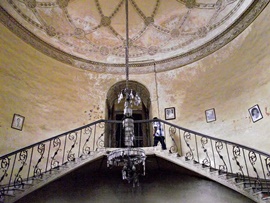
The Residency in Hyderabad was built for the British Resident (for the Princely State of Hyderabad) James Achilles Kirkpatrick (1764-1805) in the style of a Palladian villa in about 1798. As described in an excellent book, the “White Mughals” by William Dalrymple, Kirkpatrick, like many other pre-Victorian Europeans in India, adopted local Indian ways of life. This Resident went so far as to marry (not too publicly) a local aristocratic woman from Hyderabad, Khair-un-Nissa (1786-1813). She remained in purdah and lived in a zenana, a ladies’ quarter, in the garden of the Residency but quite separate from it.  

The Residency was used for its original purpose by British Residents of Hyderabad until India became independent in 1947. In 1949, it became a building within the confines of the Osmania University College for Women (founded 1924).

Having read Dalrymple’s book back in 2011 just before visiting Hyderabad, I was keen to see the Palladian style Residency. With great difficulty our driver (from Bangalore) managed to discover the whereabouts of the Osmania university. We drove up to the gate and were stopped by a security guard, who would not admit us until we revealed (somewhat deviously) that the Director was expecting us. We entered the grounds and found the Director’s office. We suggested to her that I might be a relative of Dalrymple’s and that I was keen to see the building he had written about.


The Director assigned a member of her office team to take us to the old building, adding that it was not wise to enter it as it was in a perilous condition. What we saw, although in a very poor state of repair, was a magnificent, elegant neo-classical building. If it had been in the UK and restored considerably, it would have outshined many of the great houses built in the same era, which are open to the public. Ignoring the advice of the Director, we entered the crumbling structure and viewed its wonderful twin curving staircases and glamorous rooms. Although the place was in a parlous condition, its former glory was still very evident.

We left the former Residency without any of it collapsing on to our heads and feeling very pleased that we had ‘blagged’ our way into seeing this gem hidden from the public.

DINNER WITH THE NIZAM

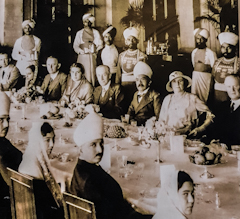
During a recent visit to the Chowmahalla Palace in Hyderabad (India), I saw a sepia photograph taken at a dinner party held by the ruling Nizam during the era when India was part of the British Empire.

Some of diners were Indian and others sitting beside them at the table were Europeans, most probably British. All of them have their faces turned towards the camera, but what was going through their minds?

The British at the table, who were probably high ranking colonial officials, and their wives probably believed, as many Europeans did in the past, that they were superior to the Indians. They were most probably outwardly polite to their Indian hosts and fellow diners, but inwardly contemptuous.

The Indians at the table were probably also outwardly civil to their fellow European diners because not only are Indians hospitable by nature but also they knew that the high positions they held in the State of Hyderabad were dependent on being respectful and loyal to the British. However, inwardly I am sure that they regarded the British as inferiors, worthy only of contempt. They felt, I imagine, an innate sense of superiority over their European guests, who unlike them were not members of a royal house.

I wonder whether, apart from the superior British military ability, it was this mutual contempt that ensured an albeit uneasy harmony between the British imperialists and the royal families that ruled the princely states that made up a sizeable portion of the British Indian Empire.

A royal palace

IT IS COSTLY PAYING A VISIT to the Faluknuma Palace in Hyderabad, but is it worth the expense?

The Faluknuma Palace, which is located on a hill, is high above the rest of Hyderabad. It was built in a neo Palladian style to the designs of an Italian architect between 1884 and 1890 as a residence for Sir Viqar al Umra, a Prime Minister of Hyderabad. To settle a debt, in 1897 Viqar handed his palace to his creditor, the 6th Nizam of Hyderabad.

The palace is now used as a luxury hotel. One night at this place will set you back by at least £440 excluding taxes. The most economical way to see the palace is by booking afternoon tea, which is not at all cheap. However, such a booking includes a guided tour around the palace. After much difficulty and numerous telephone calls to the hotel, we managed to book a couple of places for the afternoon tea experience.

The guided tour was fairly uninformative but gave us a chance to see several rooms that were used by the former Nizams and their guests.
Unfortunately, the guide was uninspired and his English was poor. It would have been better if the guide had been better informed as well as more interested in history and culture.

One thing the guide told us impressed me. He said that the palace was wired up for telephony and was supplied with electricity in the 1890s whilst the Nizam’s subjects lived without electricity until the late 1930s.

Each of the rooms and hallways of the palace look spectacular at first sight. However, after closer examination they are not so impressive. The rooms which were designed to amaze are actually rather dowdy and unrefined. The interior has a Victorian heaviness. In contrast, the Marble Palace in Calcutta, also built to mimic European tastes, is spectacular both macroscopically and in minute detail. Unlike the Faluknuma, the Marble Palace is an example of exquisite taste.

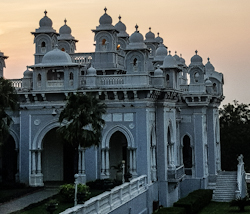
I find it sad that Indians such as the builders of the Faluknuma (and the Marble Palace) found it necessary to mimic, not always successfully, the styles favoured by their imperialist rulers rather than building in styles that have evolved from the rich legacy of pre-colonial architecture. One palace that I have visited, that at Bhavnagar, The Neelambagh, was designed by a European architect who paid tribute to India’s rich cultural heritage by successfully incorporating elements of India’s historical architectural styles. The so-called Indo-Saracenic style sometimes melds European and Indian elements successfully.

The afternoon tea was elegantly presented. The serving staff outnumbered the guests. There was a great deal of bustling about, but our requests were eventually fulfilled. Every member of staff we encountered at the palace was kind and caring. I felt that everyone wanted us to enjoy our visit, which we did.

Was our visit worth what we paid? I would say ‘yes’ cautiously, but I would have preferred to have been charged a little less. It would have been really good value at two thirds of the price. Is the palace worth seeing? I would recommend it not because it is either an aesthetic gem or an architectural marvel, but it is a great example of how the wealthy and powerful spent their money to impress their subjects and the British Colonial Officials, who guaranteed the continuing existence of their vassals, the rulers of the Princely States, of which Hyderabad was the largest, richest, and most powerful.

While we were sitting waiting for our taxi to take us away from the palace, we watched horse drawn cartiages passing by. They carry guests up the long winding drive to the hotel. We also saw staff feeding some of the more than one hundred peacocks which live in the extensive grounds of the palace, which provide a peaceful refuge from the city that sprawls all around the Faluknuma.

Some cafés and an Ottoman princess

WE WERE ADVISED TO PAY a visit to the “new Niloufer café” in Hyderabad to try its Irani Chai. We hired an Uber taxi to take us there.

The New Niloufer Café turned out to be a rather scruffy place across the road from a newer looking place called “The Niloufer Café”.

Irani chai is prepared by boiling tea leaves continuously in a large kettle. This produces a strong decoction, which is poured through a muslin filter and then added to boiling milk before being served in cups.

As the New Niloufer did not serve milk without sugar, we crossed the road to the Niloufer Café, which did. This café was very crowded. In addition to tea, it sold a wide range of biscuits, cakes, and breads. One of the breads looked like an oversized bagel or an obese Turkish simit.

After taking tea at this café, we walked past several Hindu temples, mostly dedicated to Hanuman, and many medical clinics until we spotted yet another Niloufer Café. This one is newer and more luxurious than the previous café but belongs to the same company. It described itself as the “Niloufer Café Premier Lounge”.

On reflection, we realised that it was the new Premier Lounge, rather than the unrelated New Niloufer Café, that had been recommended to us.

By the way, Princess Niloufer (1916-89) was one of the princesses of the Ottoman Empire. She married the second son of the last Nizam of Hyderabad, Moazam Jah. He died in 1952 and then she married an American, Edward Julius Pope in 1963.

Photo shows kettle for boiling tea to prepare decoction

Rice and meat

Hyderabad is justifiably renowned for tasty biryani although the very best version of this rice based dish that I have ever eaten was at Paragon in Calicut. There, they serve Moplah biryanis, which are both Arabic and Indian in taste.

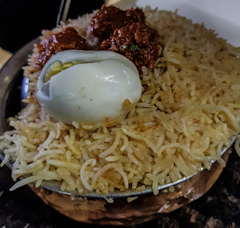
The biryani we ate at the Café Bahar in Hyderabad was delicious. It was delicately flavoured and cooked with a light touch. To enter Bahar at lunchtime it is necessary to join a long queue that extends from the top of tje stairs at the doorway to the first floor dining room down on to the busy street outside. It is worth the wait.

The restaurant itself is very noisy and as busy as London’s Oxford Circus at rush hour. We shared a table with a charming couple, who let us try their ‘double masala’ chicken biryani which is richly laden with extra spices. I preferred the less spicy ‘special lamb biryani’. It is made special by adding hard boiled egg and meatballs made with minced chicken.

One should not visit Hyderabad without eating at least one biryani, but avoid the much advertised Paradise restaurant chain, which is ok but nothing like as good as Bahar or Shadab (near the Charminar)