A SMALL SIX-SIDED stone structure stands in the heart of the town of Sherborne in Dorset (UK). It is built with a yellowish stone in the mediaeval gothic style. Open to the elements on each of its six sides, its ceiling is a perfect example of gothic fan vaulting. Although it looks like a small kiosk or somewhere to shelter from the rain, it was not built as such.
Sherborne is famous for its magnificent gothic abbey church, which stands a few yards from the structure mentioned above. Until 1539, the church was attached to a Benedictine monastery. The latter was dissolved by Henry VIII in 1539, when most of the monastic buildings were either destroyed or sold. Some of them now form part of the venerable private Sherborne School.
Like most monastic institutions, that at Sherborne had cloisters. The six-sided structure, now known as ‘The Conduit’ was originally built in the early 16th century as part of the cloisters, to serve as a washing place for the monks. It survived the demolition of the monastery, and now forms pat of the quaint urban landscape of central Sherborne.
THE CITY OF LONDON has suffered many upheavals including, to mention but a few, the great Fire of London (1666), heavy bombing during WW2, and often overzealous redevelopments after 1945. Despite these major changes, remains of mediaeval London can still be found. One of these is close to the church of St Bartholomew the Great, which escaped being damaged during WW2, and has been standing since 1123. It was founded as part of an Augustinian priory that was dissolved by Henry VIII in 1543. Close to this fascinating church, and running in a straight line from east to west is the narrow East Passage.
This alleyway is about 80 yards long and lined with the rear facades of buildings – mostly not particularly old. Yet, East Passage has been in existence since the dissolution of the priory in the 16th century (www.ianvisits.co.uk/articles/londons-alleys-east-passage-ec1-36703/). It is a thoroughfare developed on land that had belonged to the priory, and was sold to Sir Richard Rich (1496-1567), who was Lord Chancellor during the short reign of King Edward VI, successor to Henry VIII. East Passage was one of a new series of streets laid out soon after the priory was closed. As the author of the ianvisits.co.uk website pointed out, the group of small straight streets, of which East Passage is one, was one of the earliest planned developments in London (with straight rather than haphazardly arranged, curvy streets), predating the planned development of Covent Garden in the 17th century.
Today, East Passage is about half the length it used to be. Before it was known as East Passage, it was known as ‘Back Court’ or ‘Back Street’. At its west end, there is the rear of a pub called The Old Red Cow. It is one of the longest established pubs near to Smithfield meat market, although the building housing it looks as if it was built in the 19th century. Close to this hostelry, but not on East Passage, there is another pub, The Hand and Shears. Established in 1532, but housed in a more recent building, whose name reminds us that it used to be frequented by cloth merchants. A note in a website (https://darkestlondon.com/tag/old-red-cow/) mentioned that The Hand and Shears:
“… was used as the venue to settle disputes and grievances of people who visited the annual St Bartholomew’s Fair – licences were granted, weights and measures were tested, and fines imposed on fraudulent traders. For many years, the Fair was officially opened from the inn’s doorway by the Lord Mayor – but impatient clothiers would later wait at the pub the night before and declare it open on the stroke of midnight, signalling to gathering crowds that the Fair was officially open by waving a pair of shears in their hands.”
Possibly, I would not have noticed the slender East Passage had we not been sitting in a café nearby. I spotted it through the window of the Pret a Manger on Long Street that runs parallel to East Passage, and felt I had to explore it. As I walked along it, I had not idea that this small back passage had such a long history and would never have existed had Henry VIII not fallen out with the Pope in Rome.
DURING THE REIGN of King Henry VIII, many English churches were vandalised because of the monarch’s divorcing the country from the Roman Catholic Church. Many artefacts were destroyed in churches to erase their connection with the Church in Rome. These included carvings and stained-glass windows. Holy Trinity Church in the wool town of Long Melford in Suffolk was no exception. Above the south entrance to the church, you can see empty stone frames that once contained stone effigies of saints. Much of the 15th century church’s mediaeval stained-glass was also destroyed.
Luckily for us, some of the stained-glass survived. This is because it used to be located in the windows of the clerestory high above the long nave – out of reach of the people sent to destroy it. In recent times, the surviving windows have been restored and placed in the windows lining the north wall of the church. These windows are much lower than those in the clerestory, and are easily viewed from the ground. The windows depict both dignitaries and religious subjects, which were the main targets of the vandals who were destroying religious images.
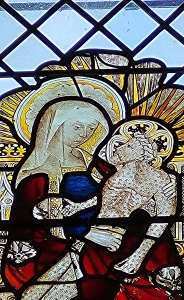
One of the windows is particularly interesting because it shows the Virgin Mary holding the dead body of Christ soon after it had been removed from the Cross. In other words, it is what is known as a Pietà. This subject matter was, and still is, extremely important in Roman Catholic imagery, and had they been able to reach it, those who attacked the church would have certainly wanted to destroy this. A knowledgeable gentleman, who was helping in the church, told us that the pre-Reformation Pietà in the church was an extremely rare survival from the time before Henry decided to break with Rome. What is more is that unlike many images of the Pietà, the dead Christ is shown with his eyes wide open.
The Pietà image in the surviving mediaeval stained-glass is just one of many interesting things that can be seen in the magnificent, large parish church at Long Melford. As the Michelin Guidebooks often say, the place is “worth a detour”.
IT HAS BEEN STANDING for many centuries, but until we saw something about the place in a recent (March 2024) issue of the free Metro newspaper, we did not know it existed. The place is located in Epping Forest on Rangers Road, which runs eastwards from Chingford (on the edge of northeast London). I am referring to a well-preserved, whitewashed, half-timbered Tudor building, which was constructed in 1543 for King Henry VIII, and renovated by his daughter Queen Elizabeth I in 1589.
This edifice, which is 481 years old, is aptly known as ‘Queen Elizabeth’s Hunting Lodge’, and is open to the public to explore. It is a timber-framed three-storey ‘standing’. That is to say that it was constructed to be used as a place from which the hunt could be observed. And Epping Forest, where it stands, was, from the 12th century until the 19th century a Royal Forest, where only the monarch had the right to hunt deer. Although now fully glazed, originally the window apertures on the two upper floors were without glass. Visitors to the lodge would have been able to watch the hunt and, maybe also, shoot animals from these raised vantage points.
Throughout the building, one can see unpainted oak beams – supporting the floors, the walls, the ceilings, and the roof. The ground floor consists of an entrance hall and a larger room (with a fireplace), which served as a kitchen. A wooden staircase leads to the upper floors. It is wrapped around a square hollow newel, which supports the stair treads. There is a glass pyramid (not Tudor) above this space, which allows visitors to see the original lath and plaster work that makes up the newel.
Much of the first floor is occupied by a large hall with windows overlooking the forest. The second floor is similar, but it has a fine hammer-beam ceiling. Another such ceiling is high above the top of the staircase.
During the reign of Queen Victoria, the first floor of the lodge was divided into small bedrooms by partitions, which have long since been removed. It was then used as accommodation by the bailiff of the local lord of the manor. The Watkins family were residents for a period. It was Mrs Harriet Watkins, who used the Lodge and its garden for providing refreshments until 1897, when she took over the adjacent barn – now known as Butler’s Retreat – for the provision of teas. Writing about the lodge in 1876, James Thorne noted:
“The open space in front of the lodge has always been a favourite resort of the East-end holiday folk, for whom ‘tea and refreshments’ are provided at the lodge. On a fine summer’s day, on Monday especially, numerous picnic and ‘van’ parties may be seen, with swings improvised between the oaks, and gipsies with their donkeys in attendance.”
Regarding the suitability of the position of the lodge, he wrote:
“The ground, sloping gently from the lodge on all sides, used to be everywhere unenclosed, the tract beyond being open forest, with some famous unlopped trees, but chiefly, as in other parts of Epping Forest, of pollard oak.”
Today, standing on the second floor, or even on the first, one gets a good panoramic view of the surrounding land.
Queen Elizabeth’s Hunting Lodge is not as grand as some other surviving Tudor buildings (e.g., Hatfield House), but it has been well looked after and it is a remarkable survivor, which is well worth a visit. But before you go, please check the current opening tomes if you wish to explore its interesting interior.
THE MAJOR AUCTION HOUSES in London, such as Sotheby’s, Christies, and Bonham’s, provide a wonderful service that benefits as well as enticing potential buyers. For several days prior to big auctions, the lots that are about to be sold are beautifully displayed in galleries, which can be viewed by members of the public. What makes these exhibitions so special is that the artworks and other objects on display are usually not viewable by most people because before and after they are sold, they are housed in places, which are completely inaccessible to the general public, such as private collections. Today (5th of June 2023), we paid a visit to Bonham’s in New Bond Street. In addition to seeing a superb display of paintings and prints by contemporary or recent artists from the Indian Subcontinent, there was a fascinating display of – for want of a better word – ‘antiques’ made mostly in India.
One of the lots that will be auctioned is a bowl made of mother-of-pearl. It is described as “Indo-Portuguese” from Gujarat. When it was made, there were already well-established Portuguese settlements in Gujarat – for example, Daman and Diu. Beside the attractive bowl, there was a hand-written note which read as follows:
“Given by Anne Boleyn Queen of Henry the 8th to Sir John Brereton Kt & given in 1839 by Miss Brereton of Brereton Hall Cheshire to Henrietta E Sharpe who has collateral descent from Sir John Brereton”.
Anne Boleyn lived from c1501-1507 until 1536. Brereton Hall, in Brereton, Cheshire, was built after Anne’s beheading in 1536 by Sir William Brereton (1550–1631). So, who was the person to whom Anne gifted the bowl? Before answering that question, I will tell you about William Brereton (c1487-1536) of Cheshire. One of Henry VIII’s courtiers, he was accused of committing adultery with Anne Boleyn, found guilty, and executed. He was a son of William Brereton, who died in 1485. Many historians no doubt that he was guilty. Guilty or not, there was at least some connection between him and Anne Boleyn. If the handwritten label I saw at Bonham’s is accurate, then the recipient of the bowl must have been alive when Boleyn lived. John might have been William’s brother, Sir John Brereton (c1447 – 1527), but I cannot be certain. As for the ‘Miss Brereton of Brereton Hall’, she is difficult to identify without her first name(s). And Henrietta Sharpe, who was given the bowl is also not readily identifiable.
How exactly the bowl came into Anne Boleyn’s possession is yet another mystery, but during the reign of Henry VIII and his predecessor, England and Portugal were on friendly terms. The bowl is not only attractive but also poses many questions, which I am as yet unable to answer. One of these is: who will become its next owner? If you want to know the answer, the auction is being held on the 7th of June. But often, the buyer is anonymous.
WE HAD INTENDED to drive along the A1 directly from London to Stamford in Lincolnshire. The A1 follows the route of the old Great North Road, but tends to bypass the small towns through which the older road ran. After driving northwards for about 1 hour and 40 minutes, I spotted a brown and white direction sign pointing towards a tourist attraction, the historic town of Buckden. We left the A1 and soon found ourselves in the village of Buckden. With its three old coaching inns, it was once a stopping place for travellers on the old Great North Road. As soon as we entered the place, we spotted some impressive, mainly brick, Tudor buildings behind crenelated boundary walls. A sign by an entrance to the grounds bore the words “Claret Centre”. We entered to discover that a sale of garden plants was being set up. We were invited to wanderin around the remains of a Tudor Palace and the knot garden next to it.
The Claret Centre is housed in the extensive remains of Buckden Palace – once a property owned by the Bishops of Lincoln. In the Domesday Book of 1086, the manor of Buckden belonged to the Bishop of Lincoln. By the time that St Hugh was Bishop of Lincoln (he had that position from 1186 to 1200), there was already a Bishop’s house in Buckden. St Hugh was by all accounts a remarkable man. Amongst his many virtues, he protected some of the Jewish people of the city of Lincoln from massacre in the 1190s. Albert Hyamson wrote in his “A History of the Jews in England”: “At Lincoln, the Jews saved themselves by taking refuge in the castle. They were befriended by the Bishop Saint Hugh, whose death ten years later was very sincerely mourned by the local community.”
The bishop’s residence at Buckden was rebuilt several times before that which can seen today was constructed in the late 15th century. With two brief interludes, the bishop’s home and grounds remained as church property until 1870, when the property was bought by James Marshall of the firm Marshall and Snelgrove. In 1919, Dr Robert Holmes Edleston bought the by then dilapidated Buckden Palace. Keenly interested in history, Edleston extensively restored the Tudor buildings. He was an admirer of Napoleon III, and wrote two books about him. He planned to open a museum of the Frenchman’s relics at Buckden Palace and in anticipation of this project, which was never realised, inserted a commemorative plaque to Napoleon III in a wall facing the palace’s courtyard. Thanks to Edleston, there are substantial remains of the Tudor structures including an impressive square tower. This overlooks a beautifully restored knot garden, now named Queen Katherine’s Garden.
After the marriage of Katherine of Aragon (1485-1536) and King Henry VIII was annulled in May 1533, Katherine was housed in various places around England. One of these was Buckden Palace, where she was held/housed between July 1533 until 1534, when she was transferred to nearby Kimbolton Castle, where she spent the rest of her life. In December 1533, when Henry VIII sent the Duke of Suffolk to move Katherine to a more secure place, the men of Buckden resisted this and the duke had to abandon the attempt. Katherine was not the only noteworthy person to have stayed at Buckden. After her death, Henry VIII stayed there with his fifth wife, Catherine Howard in 1541. Other celebrities who visited included Thomas Wolsely, James I, Samuel Pepys, and the Prince Regent (later King George IV).
During WW2, Buckden Palace was home to refugees from the London Blitz. In 1956, Bishop Leo Parker (1887-1975), Roman Catholic Bishop of Northampton, arranged for Buckden Palace to come into possession of the Claretian Missionaries. Hence, its current name – The Claret Centre. The Claretians were founded by St Anthony Mary Claret (1807-1870) in Vich (Spain) in 1849. His followers grew widely in the Spanish-speaking world, and the movement came to Britain in 1912. After founding the first Claretian community in Hayes (Middlesex), others were established at Gorseinon (Wales), Langley Park (Durham), and Buckden.
Had it not been for the sign on the A1, I am not sure that we would have ever visited, or even known about, Buckden Palace. We were lucky to find the grounds accessible because of the flower market that was being arranged when we turned up. I am not sure that it is always possible to wander about the place as freely as we did on other days. Buckden has an attractive parish church as well as the three inns already mentioned. There is a high-end boutique hotel in the George Inn. Nearby, there is also an excellent hairdresser. Even if the palace is not open, Buckden is a charming place to rest a while on a journey along the frequently busy A1.
WILTON IN WILTSHIRE was capital of Wessex between the 9th and 11th centuries (AD). Today, it is famous for its carpet manufacturing and the wonderful Wilton House, which has been home to the Earls of Pembroke since 1544, when King Henry VIII gave it to them after the Dissolution of the Monasteries. The House, which contains a fabulous collection of paintings by the great masters, was built on the site of Wilton Abbey (established in 871 AD).
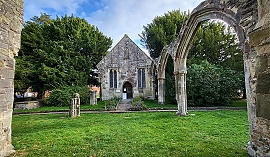
St Mary’s church in the centre of Wilton was originally the first Anglo-Saxon church in the town. It was first built in the 9th century, and then rebuilt in the 12th century. The newer church was further modified in the 15th century. However, by the 18th century it was becoming dilapidated. In 1751, the surving part of the church became used as a mortuary chapel for the Earls of Pembroke. This situation remained unchanged until 1848, when the construction of the large Italianate church of St Mary and St Nicholas was completed in nearby West Street. Then, the old St Mary’s was demolished except for the chancel and the first bay of the nave (than next to the chancel). This survivor is rarely used for services and is now cared for by the Churches Conservation Trust, which looks after historic churches of interest that have become redundant. Outside the preserved part of St Mary’s there are a few gothic arches, remains of the previously much larger church.
We have visited Wilton several times, to see both Wilton House and the Italianate church, as well as to partake of refreshments in the town’s cafés, but it was only today (7th of October 2022) that I first noticed the remains of St Mary’s. This only goes to show that revisiting a place often can be rewarding.
FOR PERSONAL REASONS King Henry VIII dissolved all the monasteries and similar establishments in England during the 16th century. Many of their buildings were destroyed or left to disintegrate. Their lands were sold or given to new owners. Some of them incorporated the remains of the monastic structures that they had acquired into new buildings. A good example of this can be seen in Devon’s Torquay. It is the remains of Torre Abbey.
The abbey was founded by members of the Premonstratensian Order in 1196. By the time of the Dissolution in 1536, Torre Abbey was the wealthiest of the houses of the Order in Britain. In 1539, the monastery was given over to one of King Henry VIII’s commissioners. After that, the first leaseholder of the former abbey and its lands was the lawyer Sir Hugh Pollard (?1498-?1576). What was left of the monastic buildings was incorporated into a large house built for Thomas Ridgeway. After several others had owned the property, it came into the hands of the Cary family in 1662. In 1740, the residential building was remodelled in the Georgian style, which is what can be seen today. This family retained ownership of the abbey remains, the house, and its lands, until 1930, when a member of the family sold them to Torquay Borough Council. Since then, the house has been used for municipal administrative purposes and during WW2, it was occupied by the RAF.
Near to the main house, there is a large, intact tithe barn. This was constructed in about 1300. In the summer of 1588, the Spanish sent a large fleet, the Armada, to invade England with the intention of restoring the Roman Catholic religion in what had become a Protestant country. The Spanish failed miserably, and many of them became prisoners of war. Francis Drake (c1540-1596) forced one of the Spanish vessels to surrender and as a result captured 397 Spanish prisoners. They were held in the tithe barn for 23 days before they were transferred to Exeter. As a result of this, the barn is now known as The Spanish Barn. during WW2, the RAF used it as a gymnasium. Now, the barn is hired out for weddings and other special occasions.
The remains of the abbey, the barn, and the house built within the abbey ruins, overlook a park, a small golf course, and a few yards away, the waves in Tor Bay. The abbey grounds are a short walk from the commercialised harbour area in the centre of Torquay, and provide a pleasant contrast to the latter.
THERE IS A SUPERB Vietnamese eatery on London’s Bermondsey Street, called Caphe House. After eating a tasty banh mi, a baguette filled with meat and fresh vegetable, a dish no doubt inspired by the French occupation of Vietnam, and a pho, a clear broth with meat, vegetables, and noodles, we crossed the road to examine a sculpture. This eye-catching artwork had not been present when last visited Caphe House, sometime before the pandemic and well before October 2019. It consists of a row of seven piles of stone carvings of differing heights, resembling short totem poles. Made of Portland stone, Bath stone, marble and other materials found in the River Thames, this was created in 2020 by Austin Emery and members of the local community. Over 100 members of the community made carvings in a workshop, and these have been assembled by Emery to create what we saw, an artwork named “Cornerstone”. Cornerstone also incorporates fragments from Southwark Cathedral, Westminster Abbey, London Bridge Station, and bones from the Thames.
Cornerstone, a sculpture in London’s Bermondsey
After admiring this unusual and intriguing sculpture, I spotted a notice nearby. It relates to the history of Tanner Park, where the sculpture stands, and includes the following:
“… Originally part of the grounds of Bermondsey Abbey the site of the Park was later in use as a Tannery …”
Reading this notice, I realised that this was the first time I had seen mention of an abbey at Bermondsey.
There had been an abbey in Bermondsey since the early 9th century (https://en.wikipedia.org/wiki/Bermondsey_Abbey). This was centred on the site of the present-day Bermondsey Square, about 390 yards south of the Cornerstone sculpture. The abbey to which the notice at Tanner Park refers was a Benedictine abbey, which was dedicated to St Saviour and was founded in the early 11th century. A wealthy religious establishment, it was, like so many other similar institutions, dissolved by King Henry VIII in the 16th century, in 1537. But where was it?
By 1822, only tiny fragments of the abbey were still standing. Today, nothing remains, although occasional archaeological digs have exposed parts of it, albeit temporarily. Fathome’s map of Southwark compiled in 1643-48 shows that then the abbey was still standing intact in its grounds (https://www.british-history.ac.uk/old-new-london/vol6/pp117-133). According to one writer (https://knowyourlondon.wordpress.com/2018/07/06/bermondsey-abbey/), who does not give the source(s) of his information, the site of the abbey was:
“The abbey lands extended from the present church of St Mary Magdalene, across today’s Tower Bridge Road.”
A map included by this writer marks the abbey church as lying along Abbey Street with the nave to the west of Tower Bridge Road and the chancel east of it. A wall plaque (www.londonremembers.com/memorials/bermondsey-abbey) which I have not yet seen informs that the abbey:
“… occupied ground between Bermondsey Street, Abbey Street, and Grange Walk…”
The church of St Mary Magdalen stands on Bermondsey Street just before its crossing with Abbey Street. This stands on the site of a church that existed in 1290 and which served lay workers of the abbey. This was demolished in 1680, but the late mediaeval tower was kept. It was rebuilt ten years later. During the 19th century, the exterior was covered with rendering and various other architectural modifications were made both internally and externally (https://en.wikipedia.org/wiki/St_Mary_Magdalen_Bermondsey). Apparently, the church’s mediaeval arches are visible inside the tower behind the organ and the church also contains some mediaeval stone capitals that might well have been parts of Bermondsey Abbey. St Mary Magdalen is the oldest surviving building in the area. It is open occasionally. I have entered it once, but that was long before I knew about the mediaeval remnants it contains.
Despite the fact that Bermondsey Abbey is now merely a historical memory, Bermondsey Street is an interesting place to visit. Amongst its attractions are Peter Layton’s glass studio, where you can watch glassblowers creating fantastic artworks in glass; Rachel Eames Gallery, which often has good exhibitions of contemporary artists’ works; The Fashion and Textile Museum; The White Cube (Bermondsey), which hosts spectacular shows of contemporary art; and the Cornerstone sculpture, described already. I suggest starting your visit with an early lunch at Caphe House, rounding it off with Vietnamese filter coffee, and ending it with another good coffee at the cheekily named, quirkily decorated Fuckoffee café.
YORKSHIRE IS RICH in the ruins of abbeys and other religious institutions, which were all dissolved (closed down) by Henry VIII in the 16th century and left to decay. The better known of Yorkshire’s ruined abbeys include those at Fountains, Rievaulx, and Whitby. In the North Yorkshire district of Ryedale, there are the extensive ruins of a former Cistercian abbey, founded in 1137 and called Byland Abbey. Having visited ancient but still intact and well-preserved Cistercian monasteries in various places in France, I have a reasonable idea of what these places look like. What I particularly liked about the ruins at Byland was that although much of the old stonework has been taken away and incorporated in other buildings, sufficient remains not only of the abbey church but also of the many buildings (e.g., the refectory, the cloisters, the chapter house, and the abbot’s house) that made up the monastic settlement. Having seen the monasteries in France I was able in my mind’s eye to create an image of how Byland might have looked in its heyday.
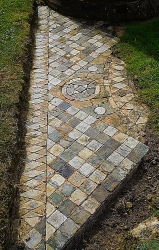
Apart from its great beauty as a ruined church, the abbey’s vast former church has something that I cannot recall ever having seen at other ruined abbeys I have visited. Exposed to the open air and risking being trod upon by visitors are many quite large expanses of mediaeval floor tiling. Many of the fired clay tiles still bear their coloured glazes. There are patches of tiling where they are laid out in circular geometric patterns. It was surprising to see such a great number of these tiles because even in many of the still intact British churches and cathedrals, such ancient flooring is quite rarely preserved to such an extent as in the ruined Byland Abbey.
I was told that when the abbeys were dissolved by Henry VIII, their roofs were removed, and this ensured that the buildings became unusable and fell into decay. The west end of Byland’s huge church contains the remains of a masonry circle that was once the frame for an enormous rose window, believed to be a prototype for the rose window that still can be seen at York Minster. While the Minster is a sight not to be missed, so is Byland Abbey. The latter might not have such a spectacular location as the ruins at Whitby and Rievaulx, it is, in my opinion, a far more interesting place to explore.







 yamey
yamey 