
Cabot: from Venice to Newfoundland

THE DISCOVERY OF Canada by Europeans is not usually at the forefront of my mind, especially just after an airflight landing in Venice. Yet when we disembarked from the waterbus that carried us from Marco Polo Airport to the city, I noticed a building that surprised me at the south end of the Via Garibaldi (in the Castello ‘sestier’ of Venice). It has one plaque commemorating Giovanni Caboto (c1450-c1500) and his son Sebastiano Caboto (c1450-c1557). Giovanni is better known (to me) as John Cabot. I had no idea that Cabot, the ‘discoverer’ of Newfoundland was from the Italian peninsular. Sebastiano was also a maritime explorer. His most famous work was done in South America.

Cabot(o) lived here in Venice

Giovanni Caboto’s birthplace is unknown, but is likely to have been in the Province of Genoa. By 1476, he had become a Citizen of Venice. He was a trader there. Getting into financial difficulties, he left Venice for Spain in the late 1480s. After seeking financial support for a trans-Atlantic expedition, which never happened, he set off for England in 1495. Cabot, as he became known in England, went to Bristol. From that seaport, he led at least three expeditions to explore the east coast of North America. During these voyages, he set foot on what is now called Newfoundland and probably also on parts of what is now Nova Scotia. One of his later expeditions is believed to have been one of the earliest attempts to discover a Northwest Passage.

Cabot received a reward for his services from England’s King Henry VII. Where John Cabot died is uncertain. It might have been during his last expedition to North America during the period 1498-1501, but no one knows for sure whether he died at sea, or in North America, or after his expedition had returned to England.

A monument on the house in Via Garibaldi, which was placed in 1982 by the Canadian Province of Newfoundland, records that John’s discoveries in 1497 were made with his son Sebastiano. The house that bears this monument (written both in English and French) and another one in Italian, is said to be the house where John Cabot lived in Venice. From many of its windows, the great explorer would have had a good view of the lagoon and the quays, where trading vessels might well have been loaded and unloaded.

Our rented apartment was on a narrow street leading off the Via Garibaldi. I was pleased to see that this is close to a narrow alleyway called Ramo Primo Caboto.
Henry the Eighth and Chelsea

CHEYNE WALK RUNS along the left bank of the River Thames from midway between the Battersea and Albert Bridges to 245 yards downstream of the Albert Bridge. Before 1866, Cheyne Walk ran along the shoreline, but after the construction of Chelsea Embankment it became separated from the waterfront. Today, while walking along this lane east from the Albert Bridge, we spotted the narrow Cheyne Mews. A sign at its entrance intrigued me. It reads:

“King Henry VIII’s manor house stood here until 1753 when it was demolished after the death of its last occupant, Sir Hans Sloane. Nos. 19 to 26 Cheyne Walk were built on its site in 1759-65. The old manor house garden still lies beyond the end wall of Cheyne Mews and contains some mulberry trees said to have been planted by Queen Elizabeth I.”

The manor and village of Chelsea was already in existence in the Anglo-Saxon era (between the departure of the Romans and 1066), when a document records it as ‘Cealchylle’. The 11th century Domesday book names it ‘Cercehede’ and ‘Chelched’. The manor was owned by the Abbey at Westminster until the reign of King Henry VII, when it was in the hands of Sir Reginald Bray (c1440-1503), a highly influential figure during the king’s reign. Next, it changed hands a couple of times before being possessed by William, Lord Sandys (1470-1540), a diplomat, Lord Chamberlain, and a favourite of King Henry VIII (ruled 1509-1547). Sandys, who disapproved of Henry’s marriage to Anne Boleyn (c 1501/07 – 1536), accompanied the unfortunate Anne to the Tower of London, where she was imprisoned.

In 1536, Sandys gave the manor to King Henry VIII. The much-married king gave it to his last spouse, Katherine Parr (1512-1548) as part of her dowry.  She lived in the manor house after the coronation of King Edward VI in January 1547 until she died. After her death, the manor was owned by the soldier and politician John Dudley, Duke of Northumberland (1504-1553). Then the manor passed through many owners until the physician and founder of the British Museum Sir Hans Sloane (1660-1753) bought it in 1712 from the Tory politician Lord William Cheyne (1657-1728).

There were two manor houses in Chelsea, an old one and a new one. The old one, which was given to the Lawrence family by Henry VIII was close to Chelsea Old Church that stands to the west of the Albert Bridge. The New Manor House stood on Cheyne Walk where we saw the sign. It stood near a coffee house that was flourishing when Sloane bought the manor, Don Saltero’s Coffee House, founded in 1695 by James Salter. Saltero’s was originally a barber’s shop until Sloane began donating unwanted specimens to his former servant and travelling companion, the owner of Saltero’s. Salter displayed these specimens (botanical, zoological, and other), collected on Sloane’s travels, in cabinets and gradually the barber shop was transformed into ‘Don Saltero’s Coffee House and Curiosity Museum’. This establishment attracted local men to become its customers, including Sir Isaac Newton.

Sloane’s purchase was a shrewd investment because at the time London was expanding westwards. His biographer James Delbourgo wrote:

“The manor cost the considerable sum of £17,800 and included a total of eleven houses and the Manor House itself … As a suburban equivalent of a country seat, the manor grounded Sloane’s gentlemanly identity. It also bought him about 90 acres of land … as a freeholder, and an unknown number of tenements, on which he began to collect his own rents.”

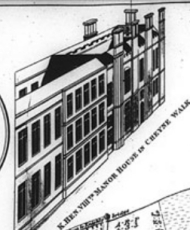
I have found an engraving of the appearance of the Chelsea manor house that stood on Cheyne Walk in a book published in the 1880s. The image resembles that included on a map of Chelsea surveyed in 1664 by James Hamilton and redrawn in 1717 (www.britishmuseum.org/collection/object/P_1880-1113-1221), but the exact location of the house is not marked on the map.

Apart from the commemorative sign at Cheyne Mews and the garden, to which we were unable to gain access, King Henry VIII’s manor house has completely disappeared. I wondered whether Chelsea’s Kings Road had any links to Henry VIII’s ownership of the manor, but it does not. It began as a private road used by King Charles II, who came to the throne long after Henry VIII, when travelling from London to Kew, and was only made a public thoroughfare in 1830. The site of the former manor house owned by Sloane is but a few minutes’ walk from the Chelsea Physic Garden, some of whose land was leased to the Society of Apothecaries for a small amount by Sloane when he acquired the manor.

Finding small things of great interest like the sign on Cheyne Mews is one of many things that increases my ever-growing fascination with London.