
Two sculptors: one famous and one forgotten

DURING THE 1950S and the first half of the 1960s, my mother, Helen Yamey, created sculptures in the sculpture workshops of St Martins School of Art, which was then located on Charing Cross Road. Although my mother was not a student at St Martins, she worked alongside one of the school’s teachers of sculpture, the noted sculptor Anthony Caro (1924-2013). Caro became famous for his metal sculptures that consist of pieces of metal either welded or bolted together. While my mother was making sculptures at St Martins, she like other sculptors including Phillip King, Tim Scott, and William Tucker, was undoubtedly influenced by, and learned from, Caro’s work. She learned welding and created several abstract sculptures that consist of pieces of steel welded together. Unlike Caro, who achieved great fame, my mother, who was unambitious and only created sculpture to fulfil a creative urge, my mother and her sculptures became forgotten.

Today, 8 March 2025, we visited the Annely Juda Fine Art Gallery in central London to see a small exhibition of sculptures by Anthony Caro. Unlike many of Caro’s works, the metal sculptures on display, are not enormous. They are small enough to be fitted comfortably into one’s living room or a small garden. Indeed, one of the sculptures, in my opinion the most attractive, has the title “Table Piece CCCXLI”. It was constructed in oxidised steel. The five Caro pieces in the exhibition display a variety of compositional style, and together demonstrate the artist’s versatility. They were all made between 1970 and 1990. My mother left St Martins before this period, sometime in the mid-1960s. I know that she maintained an interest in Caro’s output, but. Sadly, I cannot recall what she thought of its quality.

The exhibition at Annely Juda continues until 15 March 2025. You can read about my mother’s life in art and her time at St Martins in my book “Remembering Helen: My Mother the Artist” [ available from Amazon, e.g.: https://www.amazon.co.uk/REMEMBERING-HELEN-MY-MOTHER-ARTIST/dp/B0DKCZ7J7X/ ]
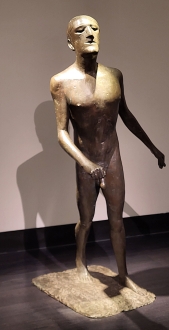
Some sculptures at an auction house in London’s Mayfair

THE FAMOUS SCULPTOR Elisabeth Frink (1930-1993) was a regular visitor to our family home in Hampstead Garden Suburb during the 1960s. During that period, I met her whenever she was invited home for dinner, but then I was too young to realise how famous an artist she had become. She was a good friend of my mother, Helen Yamey (1920-1980), who was also a sculptor. Elisabeth and my mother got to know each other when they were both creating art in the Sculpture Department of the St Martins School of Art, when it was in Charing Cross Road.

By Elisabeth Frink

Today (15th of November 2024), I was reminded of my mother’s friendship with Frink when we entered Christie’s auction house in Mayfair. We always enter this place when we are passing near it to see some of the works of art that are on display prior to being auctioned. You never know what gems you are likely to see. Today, there was a small collection of British art created during the past 100 years. Amongst the works on display were two by Elisabeth Frink. There were also some pieces by Henry Moore (1898-1986) and by Barbara Hepworth (1903-1975). One of the works by Hepworth was a painting, the other two were sculptures. Each of these artists has become some of the greatest of 20th century British artists.

During the first half of the 1960s, my mother’s sculptures were chosen to be exhibited in prestigious exhibitions, mainly in London. In these various exhibitions, her work was selected to be exhibited alongside the creations of the three artists mentioned above, as well as other artists, who have now achieved fame (e.g., David Hockney, Paula Rego, Michael Ayrton, and Bridget Riley). Despite this, my mother’s artistic work is now largely forgotten. In my recent book about her, “Remembering Helen: My Mother the Artist”, I describe her life, her character, and consider why her art, which was judged worthy of display with the best artists of the time, has faded into obscurity.

[The book is available from Amazon: https://www.amazon.co.uk/REMEMBERING-HELEN-MY-MOTHER-ARTIST/dp/B0DKCZ7J7X/]

Bringing a forgotten artist out of the shadows

THE BEN URI Gallery and Museum began its life in 1915 as a place where Jewish immigrant craftsmen and artists could exhibit their works. At that time, mainstream British artistic institutions were reluctant to include artists from recently arrived minority immigrant communities. Things have moved on a long way since then, and the organisation no longer confines itself to Jewish artists. Ben Uri’s remit:

“… has expanded to include relevant works by immigrant artists to the UK from all national, ethnic and religious origins, who have helped to enrich our cultural landscape.” (https://benuricollection.org.uk/)

My mother, the painter and sculptor Helen Yamey, was born in South Africa, and came to England in 1948. She was an immigrant artist.

When I was researching her life to write her biography, I discovered something about her which I had not known before. It was that during the first half of the 1960s, her sculptural work was chosen to be exhibited in several prestigious exhibitions. She exhibited alongside now famous artists such as Elisabeth Frink, Anthony Caro, David Annesley, Eduardo Paolozzi, Menashe Kadishman, William Tucker, Phillip King, David Hockney, Henry Moore, Barbara Hepworth, Paula Rego, Bridget Riley, Duncan Grant, and Jean Arp. As a youngster in the early 1960s, I was unaware that my mother’s work was rated as highly as those with whom she exhibited. It was only when writing her biography to accompany some photographs of her work, which had recently come into my possession, that I realised that although she was now forgotten by the art world, she had achieved something quite significant in the artistic world of the early 1960s. Having learned this about her artistic prowess, I discussed the matter with my daughter, who is a curator and a historian of art. In turn, she mentioned it to the current director of the Grosvenor Gallery in Mayfair. He suggested that I should contact the Ben Uri to find out whether they had any information about my mother.

The Ben Uri had no material about my mother, and were interested when I sent them information about her association with the Sculpture Department of St Martins School of Art and the exhibitions in which her work was shown. They decided to add her to their already extensive database listing immigrant artists from of 100 countries. After donating a copy of my book to the Ben Uri’s research library and having been interviewed by one of the organisation’s researchers, they added my mother, a long-forgotten sculptor, to their database. In addition, the researcher, Ms Milcic, has added an 800-word profile of my mother and her art to one of their websites. It can be read online here: https://www.buru.org.uk/contributor/helen-yamey- . This webpage also gives links to a site where some pictures of my mother’s sculptures can be viewed.

It gives me great satisfaction that my mother’s works, which had become largely forgotten, have at last been given some of the prominence they deserve. The reasons why she became forgotten and many other details about her life can be found in my recently published book “Remembering Helen: My Mother the Artist” (available from Amazon: www.amazon.co.uk/REMEMBERING-HELEN-MY-MOTHER-ARTIST/dp/B0DKCZ7J7X/)

Finding a box of photographs and rediscovering a forgotten artist

UNTIL ABOUT 1991, my widowed father resided in my childhood home in northwest London. For as long as I can remember, there was a collection of black and white photographs in a cardboard Kodak photographic paper box. The photographs contained images of sculptures, which my mother Helen Yamey (1920-1980) had created at St Martins School of Art in London during the later 1950s and first half of the following decade. In 1991, my father married again, and moved from our childhood home to another address. Every now and then, after my father moved, I used to ask him what had happened to the photographs. He used to reply that he did not know where they were. Maybe, he suggested, they were stored somewhere in the garage of his new home. He died in 2020. After that, I thought that it was extremely unlikely that I would ever set eyes on the photographs again.

A year or two after my father’s demise, his widow, my stepmother, arranged to meet me at a café. When she arrived, she was carrying a plastic carrier bag, which she handed to me. To my great delight, I found that it contained the Kodak box filled with photographs of my mother’s sculptures. I posted a few of these images on the Internet. Some months after that, my friend Edesio mentioned that he was impressed by the images of my mother’s sculptures, and suggested to me that I should write something about my mother and her art. This I have done.

When I began writing my mother’s biography, our daughter Mala, who is an art historian and a curator, sent me a pdf file containing the contents of a catalogue of an exhibition held at London’s Grosvenor Gallery in the 1960s. It contained mention of some of my mother’s work that appeared in the exhibition. Mala did a little more research and discovered the existence of catalogues of other exhibitions in which my mother’s sculpture was included. I investigated these catalogues and came across a few more, I was surprised by what I discovered.

During the first half of the 1960s, my mother’s sculptures were selected to appear in exhibitions alongside artworks created by artists, many of whom are now quite famous. These include, to mention but a few, David Hockney, Henry Moore, Barbara Hepworth, Howard Hodgkin, Bridget Riley, Kim Lim, and LS Lowry. These exhibitions were held when I was between 8 and 13 years old. In those days, I was not particularly interested in my mother’s artistic activities and was too young for the names of these artists to mean anything to me. In addition, I do not recall even having been told that my mother was participating in exhibitions, let alone showing her work alongside that of these now famous creators.  So, until I studied these catalogues more than 40 years after my mother died, I had no idea that for a while she was in the vanguard of 20th century British sculpture. Had I not been stimulated into beginning to write about her, I would not have known that my mother, who never boasted about her achievements, had been an artist of such a high calibre.

I have written my memories of my mother in a book called “Remembering Helen: My Mother the Artist” (available from Amazon: https://www.amazon.co.uk/dp/B0DKCZ7J7X/) . In it I have tried to describe her upbringing; what she was like as a mother; and her achievements in the world of sculpture. I have included many of the images I found in the box of photographs, and our daughter has written some insightful notes on her grandmother’s sculptural styles and the techniques. I hope that my book will help bring my mother’s artistic  achievements out of obscurity. Modest as she was, I feel that it would be good if she were to get at least a little of the fame she deserved.

Remembering Helen Yamey, who was my mother and an artist

My mother, HELEN YAMEY (1920-1980) was born in South Africa. In 1948, she came to the UK, and by 1952, she had become a sculptor. In the 1950s and ‘60s, she worked in the Sculpture Department of London’s St Martins School of Art alongside now famous sculptors including Elisabeth Frink, Anthony Caro, David Annesley, Eduardo Paolozzi, Menashe Kadishman, William Tucker, and Phillip King. Helen’s work was of a sufficiently high quality for it to be selected for showing in exhibitions that included the above-mentioned artists as well as others including David Hockney, Henry Moore, Barbara Hepworth, Paula Rego, Bridget Riley, Duncan Grant, and Jean Arp. Yet, unlike the artists listed, she and her work have become largely forgotten.

In my biography of Helen, “Remembering Helen: My Mother the Artist”, I describe her career as an artist, what she was like as a person, and explore why she did not make a reputation like those with whom she worked and exhibited. The book contains illustrations of many of Helen’s sculptures, and my daughter, Mala Yamey, an art historian and curator, has written notes about my mother’s sculptural works.   

The book is available as a paperback in other Amazon marketplaces, such as https://www.amazon.co.uk/REMEMBERING-HELEN-MY-MOTHER-ARTIST/dp/B0DKCZ7J7X/ .

There is also a Kindle edition.