
A small detail in a large painting by an artist from Flanders

DURING A VISIT to the Frieze Masters art fair in London’s Regents Park in October 2025, we looked at a collection of Flemish paintings being exhibited by the De Jonckheere Gallery. One of these was “Allegory of Sight: A Collector’s Cabinet with Venus and Cupid”. It was painted in Antwerp between 1601 and 1678 by “Workshop of Jan Brueghel the Younger”. It is an example of several paintings with this title. According to Wikipedia, these artworks:

“… showcases varied objects associated with sight, the arts, and navigation. The painting was heavily influenced by The Five Senses, a series of allegorical paintings done by the younger Brueghel’s father, Jan Brueghel the Elder.”

Indeed, the picture we saw at Frieze is chockfull of objects: paintings, sculptures (many of them portrait busts), navigational & astronomical instruments, documents, animals, a mirror, and many other things. The painting is a depiction of a Kunstkammer, which is (https://galleryintell.com/artex/allegory-of-sight-by-jan-brueghel-the-elder-and-peter-paul-rubens/):

“…translated as “rooms of art” and are meant to offer a glimpse into the depth and variety of these collections accumulated by the Dutch aristocracy.

The painting at Frieze contains a gold chandelier that hangs from the ceiling. It is a decorative example, which includes an object that has interested me greatly since I was a teenager. At the top of the chandelier there is a double-headed eagle (‘DHE’). This is a bird with two heads, each on its own neck. In the painting, each of the heads is surmounted by a crown topped with a small cross. My interest in the DHE began when my fascination with Albania, whose flag contains a DHE, began in the mid-1960s. Chandeliers with  DHEs appear in several other paintings by members of the Brueghel family (and their studios) in which the subject matter described above was depicted. I asked one of the gallery assistants about the DHE on the chandelier, and she had no idea about it. I was hoping that she would confirm my suspicion that the two-headed bird in the painting was related to the Holy Roman Empire and the Habsburgs, both of whose emblems included the DHE.

On returning home, I investigated further, and found a book (available online), “Rubens & Brueghel, A Working Friendship” by Anne T. Woollett and Ariane van Suchtelen. It deals mainly with paintings by Rubens and Jan Brueghel the Elder (1568-1625), the father of Jan Brueghel the Younger (1601-1678). In relation to the painting of “Sight” by Brueghel the Elder, it noted:

It has often been assumed that this costly series of paintings was commissioned by Archdukes Albert and Isabella. Rubens had, after all, held the post of court painter since his return from Italy in 1 6 0 8, and Brueghel regularly worked for the court at Brussels. The couple’s palaces serve as background scenery in three of the five depictions, and Sight contains a double portrait of the regents and an equestrian portrait of Albert, as well as a brass chandelier crowned with the Habsburgs’ double-headed eagle.”

This being the case and because Brueghel’s son (and his workshop) would have been influenced by his father’s art, it is perhaps unsurprising to see the DHE on the chandelier in the painting we viewed at Frieze.
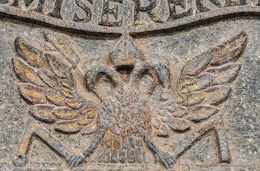
Some eagles in Old Goa

THE MUSEUM OF Christian Art has been recently been upgraded and is now a truly excellent display of Christian religious artefacts. It is housed in part of the convent of Santa Monica on Holy Hill in Old Goa. The convent Church was built in the early 17th century.

On arrival at the outside (south side) of the church, I spotted a bas-relief carved in stone above the main entrance to the church. It depicts an example of a heraldic creature that has long fascinated me: a double-headed eagle.

Inside the church, we met Natasha, who is the curator of the museum. I asked her if she knew about the reason for the double-headed eagle on the church. She informed us that the convent had been an Augustinian establishment, and that the double-headed eagle is a symbol used by that Order. That was news to me. She also directed me to another depiction of this creature on a carved tablet set into the church’s north wall.

When I returned to our lodging in Panjim, I consulted the internet, and learned about the connection between the Augustinian Order and the bird with two heads. It appears that although the main emblem of the Augustinians was a heart pierced with two arrow, the Hapsburgs allowed this Order to use their emblem, the double-headed eagle.

It will be recalled that there was a significant linkage of the Habsburgs and Spain. And Spain ruled Portugal between about 1580 and 1640. The Convent of Santa Monica was constructed between 1606 and 1627, and that was during the time that Portugal, which colonised Goa, was united with Spain. During that period, the united countries were ruled by Habsburg kings.

Although the museum, which I will describe later, was well worth the visit, discovering yet another example of the use of the double-headed eagle was a great thrill for me.

Buried in Madeira

IN CENTRAL SARAJEVO, there used to be a pair of footprints carved on the corner of a pavement where two roads met. I do not know whether these impressions, which I saw in the 1980s, still exist. They marked the spot where a young sharpshooter, Gavrilo Princip, took aim and assassinated Archduke Franz Ferdinand of Austria-Hungary in 1914. Had his aim not been so accurate, the last Emperor of Austria might not have been buried in a church high above the city of Funchal in Madeira.

Emperor Karl of Austria-Hungary

Had Princip’s aim not been so good,  his victim, Franz Ferdinand, would have been successor to the imperial throne. With the Archduke eliminated, his nephew, Karl (1887-1922), succeeded Emperor Franz Joseph when he died in 1916.

Following the end of WW1 in 1918, Austria’s last Emperor, Karl, fled to Switzerland. After a couple of attempts to regain his throne,  the British exiled him and his wife to Madeira in 1921.

In 1922, Karl died of pneumonia.  He was interred in a chapel on the north side of the nave in the Igreja Nossa Senhora in the Monte district high above Funchal.

Plenty of tourist gawp at Karl’s simple tomb in the lovely church, which overlooks the city and the Atlantic Ocean far below.  I wonder whether Madeira would have been the final home of the Archduke had he not been so unlucky in Sarajevo.

Curiously, Karl was beatified in 2004. Equally strange was the British choice of a Portuguese island for Karl’s exile. After all, Napoleon Bonaparte was eventually exiled to a British possession: St Helena.