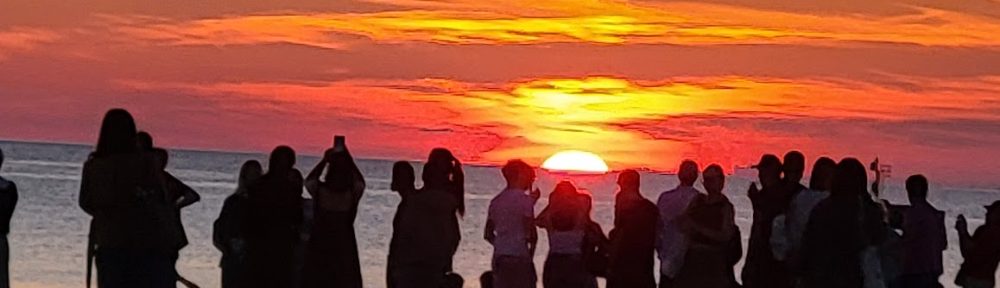
The Bengal Biennale was in progress while we were staying in Calcutta in January 2025. One of its venues was at Arts Acre – Museum & International Centre for Creativity (‘Arts Acre’) – artists’ village on the eastern edge of the city of Kolkata, 10.7 miles directly east of Flurys on Park Street. It was founded in 1984 by the artist and cultural activist Shuvaprasanna Bhattacharjee (‘Shuva’,born 1947). This essay was inspired by one of Shuva’s paintings on display at Arts Acre.
The painting that attracted my curiosity is “In search of Oscar”, in which Shuva depicts the German author, illustrator, and artist Gunter Grass (1927-2015) as Oscar – a character in his novel “The Tin Drum”. The painting is supposed to evoke solidarity with the marginalised people in Kolkata.
In July 2026, I visited an exhibition of paintings from the collector Kiran Nadar’s collection of Indian art. There was a painting by KG Subramanyan (1924-2016). Painted in 1990, it is called “Kali and Gunter Grass”. For those who do not know, Kali is a Hindu goddess usually depicted with her tongue sticking out of her mouth. She is often associated with destruction, death, passing of time, and more.
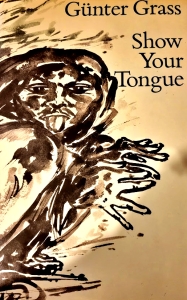
Seeing Subramanyan’s painting reminded me of Shuva’s painting of Grass at Arts Acre. I became curious about these paintings of Gunter Grass. Soon, I discovered, and then purchased a book, “Show Your Tongue”, published in 1988, and written by Gunter Grass. Not only does it contain both prose and poetry, but also a collection of dramatic sketches drawn by the author. The title refers both to Kali and a common facial expression.
The book is in three sections. One is Grass’s diary of his stay in Kolkata between August 1987 and January 1988. Another is a collection of the vivid sketches the author made while in the city. And the third is a long poem that incorporates his observations, reflections, and feelings about the city. In brief, the book expresses Grass’s fascination of, and his despair about, the city and its amazing poverty, as it was in 1987. Concisely, his diary manages successfully to produce a brilliant portrait of Kolkata, its problems and its history. The book is a ‘must’ for anyone with an interest in Kolkata.
Three pages into the diary, the following is written:
“The painter Shuvaprassana shows us the private art school he runs on Calcutta’s north side … I am asked if, at the start of the new year, I will dedicate an artists’ colony (‘art acres’) near Dum Dum Airport. My half-assent is taken as a full one.”
Throughout the diary section, there are references to Shuva., with whom he spent much time. Near the end of the diary, after having returned from a trip to places outside Bengal. Grass wrote:
“Home from our trip, here I am, as promised, at the dedication of ‘arts acre’. Shuva looks happy … He leads us, the first group of visitors, through the exhibition pavilion, where my etchings are hung. On a brass plate embedded in the wall next to the date of dedication, my name is engraved.”
Given this, and his friendship with Shuva, it is not surprising to find that the artist portrayed Grass in one of his paintings.
As for the other painting, “Kali and Gunter Grass”, its creator, KG Subramanyan was Professor of Painting, Kala Bhavan, Visva Bharati, Santiniketan. This institution founded by Rabindranath Tagore is north of Kolkata. Gunter Grass visited it during his stay in Kolkata in 1987/88, as well as at an earlier date. It is most probable that the author met Subramanyan.
Two paintings depicting Gunter Grass and my love of Kolkata led me to purchasing a copy of “Show Your Tongue”, which has given me great pleasure. On our next visit to the city, I hope to visit Arts Acre again, and this time, I will look for the plaque with Gunter Grass’s name.

