A shared taxi and Greeks buried in Kolkata (Calcutta)

Having visited the Jewish cemetery in Kolkata, we hailed an autorickshaw to carry us to College Street. There was already one passenger in the three-wheeler that stopped for us. He moved from his seat in the rear of the vehicle to make room for us, and then sat next to the driver on his seat. After going a short distance, our driver stopped to pick up another passenger, who squeezed into the seat alongside us. She disembarked after we had driven a few blocks further, and handed the driver a few rupees. After we left the autorickshaw and paid the driver a modest fee, the other passenger continued his journey in the vehicle. Like most autorickshaws in Kolkata, the one we had just taken was a shared cab that ran on a pre-determined route.

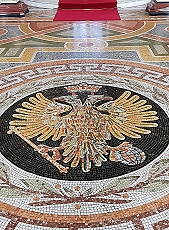
On the way, our autorickshaw rushed past a gateway on Narkeldanga Main Road, which I noticed was marked “Greek Cemetery”. Established in 1777, it is India’s only Greek cemetery. In Henry Cotton’s encyclopaedic “Calcutta Old and New” (published in 1907), he noted that the first “eminent” Greek settler in Kolkata was Hadjee Alexios Argyree, who arrived in Bengal in 1750, and worked as an interpreter. Other Greeks in Kolkata were involved in trade and commerce. The city’s only Greek church was erected in 1780, and still stands near Kalighat on Shyama Prasad Mukherjee Road, along which we often travel between central Kolkata and Tollygunge to the south of it. The well-maintained building is neo-classical in style, and Greek Orthodox services are held there regularly.  Today, there are few if any Greeks left in Kolkata, and the cemetery in Narkeldanga, home to about 300 graves, is in a sad state of disrepair (according to a report in the online Times of India, dated March 2018).
ONCE A VILLAGE ON THE MARMARA SEA, NOW A SUBURB OF ISTANBUL

THE FIRST TIME I visited Turkey was in about 1960. My father was participating in a conference organised by the Eczacibaşi Foundation. It was held in the then luxurious Çinar Hotel on the European shore of the Marmara Sea at a place called Yesilköy, which is about 9 miles west of old Istanbul. This April (2024), we visited Yesilköy both for old times sake and because we had read that the place has several interesting sights to be seen. Incidentally, it was in Yesilköy that I had my first piece of chewing gum.

After disembarking from the Marmaray train, which connects settlements on the coast of the Sea of Marmara, we enjoyed the best cheese börek we have eaten since arriving in Turkey. Then, despite constant rain, we walked along Istasyon Caddesi, admiring the many houses with decorative timber cladding that line the avenue.

We made a small detour to look at a Syriac Christian Church, which looked recently built. We could not enter because a service was in progress. Thence, we walked to the rainswept seafront, where we looked around a museum dedicated to the life of Ataturk. It was housed in a mansion once owned by Greeks. The ground floor is dedicated to the first decade of the Turkish Republic, which was founded in October 1923. The first floor has a display of ethnographic exhibits from Turkey. The second floor is a collection of photographs, items, and books relating to the life of Ataturk.

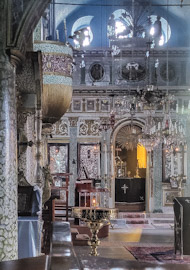
Greek Orthodox church in Yesilköy

Next, we came across a Greek Orthodox church. We could enter its covered porch in which candles were flickering. Through the windows of the porch we could see enough of the church’s interior to realise it is quite beautiful. Unfortunately, the church was locked.

Nearby, we found the huge Latin Catholic Church, which was open. Its interior was nothing special, apart from one religious painting which contained words in the Ottoman Turkish script. The size of the church suggests that there might once have been a large Roman Catholic community in Yesilköy.

Yet another church is a few yards away from the Latin church. It is an Armenian church, enclosed in a compound surrounded by high walls. The entrance was open, and after looking at the church, we joined the congregation (at least 40 people), who invited us to have tea and cakes. A couple of gentlemen began speaking with us in English. They told us that the Çinar Hotel was no longer in business, but it was still standing. They also told us that they are in the textile business. They are waiting for Indian visas because they are planning to visit Bangalore and Tiripur soon because they are looking to buy textile machinery there.

Several people told us that the Çinar Hotel is about a mile from the centre of Yesilköy. As it was cold and raining we decided against looking for it. Despite not revisiting the place I first stayed in Turkey more than 60 years ago, we saw Yesilköy and some of its fascinating sights. It is close to the railway tracks and not on most tourists’ beaten tracks.

Greek in north London’s Golders Green

IN THE EARLY 1960s, the first proper self-service supermarket opened on the corner of Golders Green Road and a small service road called Broadwalk Lane. I cannot recall the name of this store, but it was soon taken over by the Macfisheries company. Later, it became a supermarket where many imported foods, especially products from Israel, were sold. Now, it has become a Tesco Express.

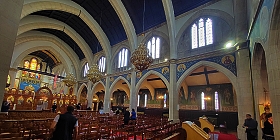
Facing the supermarket (across Golders Green Road) is a gothic revival style church. It has been used by a Greek Orthodox (Christian) congregation since 1968. Now, the The Greek Orthodox Cathedral of the Holy Cross & St. Michael, it was constructed as the Church of England’s ‘St Michael’s Church’ in 1914 to the design of JT Lee. A clock tower, surmounted by a delicate cupola supported by thin columns, was added to the church in 1960. On one of its walls, there is a bas-relief of St Michael with one foot on a serpent. On the northeast corner of the church, there is a plaque listing people who died in WW1. Near this, there is a crucifix standing in the garden next to the church. Its design, typical of C of E crucifixes, predates the arrival of the Greek congregation.

Although the interior of the church maintains some of its original Cof E fittings, such as stained-glass windows, the font designed in a mock mediaeval style, and some wall mounted memorials in English, a great deal of effort has been made to create the atmosphere of a Greek Orthodox place of worship. The walls of the side aisles have been painted with religious scenes. There is a decorated iconostasis and several framed icons. Elaborate chandeliers hang above the nave. Despite the additions to convert the church for Greek Orthodox worship, the original gothic revival features of the building’s interior are evident, but harmonise well with the later additions.

Mosaics and Greeks in Moscow Road

THE SYNAGOGUE IN Bayswater’s St Petersburg Place, a gothic revival edifice, looks no more exotic or out of place than the Victorian gothic Church of St Matthew built 1881-82 on the same street. In fact, it is another building to the north of these two that is unashamedly exotic in appearance: Aghia Sofia (Saint Sophia), the Greek Orthodox cathedral on Moscow Road. This domed building constructed for a community of prosperous Greek merchants was designed by John Oldrid Scott (1841-1913 and completed in 1877.

The first Greeks began arriving in London at the end of the 17th century. By the late 19th century (according to the website http://www.stsophia.org.uk), members of the Greek community in London:

“… were distinguished for their industry and their business acumen, and … soon became for the most part financially independent. They now wished to enjoy a more comfortable life, both for themselves and their families. They kept their offices in the City, but took up their private residences in other parts of London. The favourite districts were Lancaster Gate and Bayswater. These districts, which today are almost in the centre of the unending metropolis, were then only on its fringe, and to go from the City to Hyde Park, for instance, was considered a long excursion, which was undertaken, normally, only on holidays, as a relaxation and in order to enjoy the fresh country air.

After three decades had passed from the founding of the Church of Our Saviour [in the City near London Wall], no one any longer had his private residence in the City; and whereas previously all had lived within a very short distance of the Church, now five whole miles divided the Church from the residential district of the faithful.

For the men, in particular, who had every day to make the journey to the City, a tiring one with the means of transport then available, it was hard to undergo the same fatigue on Sundays also, when they were supposed not only to perform their religious duties, but also to rest from the labours of the week. Moreover, the number of the Greeks had greatly increased, and there was scarcely room for them all in the Church then existing. These various difficulties made it imperatively necessary to build a new larger Church, situated closer to the residences of the Brothers.”

Just as the Jewish people, who had also settled in Bayswater, far from the older synagogues in the City and established a new one near their new homes, the Greeks did the same. Moscow Road’s St Sophia’s church interior is filled with icons and other religious paintings is colourful and attractive. Instead of frescos on the walls, which were believed to be at risk of damage from London’s damp climate, the church’s interior is lined with mosaics. Some of the earliest of these were designed by Arthur George Walker (1861-1939). In 1926, the Russian born mosaic artist Boris Vasilyevich Anrep (1883-1969) created some more mosaics for the cathedral. The marble floor of the edifice is also attractive.