
OF MY FOUR GRANDPARENTS, I met only one of them – my father’s mother. The other three died before I was born. My mother’s mother was called Ilse – her parents were born in Prussia and Baden Württemberg before the Unification of Germany in 1870. From what I can recall, my mother told me that her mother was gifted artistically. She painted and made various kinds of objects by hand. One of these came into our possession some years ago. It is a large purse made from leather. With two industrial press-studs, it is held together with stitched leather. The front flap has a leafy design tooled in it. The image has the characteristics of the art-nouveau style that was popular in the late 19th century, and the early part of the following century. In the centre of the design, there is a pair of intertwined initials tooled in the leather. These appear to be “J” and “B”.
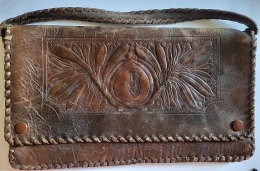
When Germans wrote in the late 19th century, they often used what looks to our eyes like the upper-case letter ‘J’ where we would now use the upper-case letter ‘I’. To write the letter ‘J’ (as in jelly), the old German alphabets used a ‘J’ that differed slightly from the ‘J’ used to denote ‘I’. Therefore, the initials on the purse are most likely ‘IB’. Now, IB could either refer to Ilse or to her husband, my grandfather, Iwan B.
Inside the purse, there is some handwriting, which I recognise as my mother’s. It gives her name, Helen B, and the address of the farm her mother bought after having been widowed twice:
“Bantouzelle, Stellenbosch. Phone No. Stellenbosch 2646.”
Beside this, she had written “Poste restante”. I imagine that she had done this because most of the time she was living not in Stellenbosch, but in Cape Town. This would have been before 1948 when she travelled to England to marry my father.
Apart from a few old photographs, this well-made purse is one of the very few material souvenirs of a grandmother whom I never met.
 yamey
yamey 