
Inverted images by an artist born in Germany at a gallery in London

CERTAIN IMAGES IMMEDIATELY come to mind when the names of some artists are mentioned. For Vincent Van Gogh it is sunflowers; for Claude Monet it is waterlilies; for Salvador Dali it is melting clocks; and for Edvard Munch it is “The Scream”. In the case of the German artist Georg Baselitz (born as ‘Hans-Georg Kern’ in Deutschbaselitz, Saxony, Germany in1938), mentioning his name conjures up inverted images: paintings in which the images appear to be upside down. He signs them with his signature, but it is not upside down.

Recently, we viewed an exhibition of this octogenarian’s latest paintings at the White Cube Gallery in London’s Bermondsey Street. The show is on until the 16th of June 2024. If you miss it, you will not have missed much worth seeing. As you can tell, I was not over-impressed by what I saw, but it did get me thinking about why the artist often chooses to paint his subjects – human and others – upside down.

Does he choose to do this because his childhood in Germany was spent in a country that had been turned upside down by the Nazi regime, the 2nd World War, and its immediate aftermath in the early years of the German Democratic Republic? The White Cube website quotes the artist as having said:

“I’ve got my early childhood drawings of eagles, stags, deer, dogs and so on in folders,’ Baselitz remarks. ‘Every now and then I look at them, and I think was it a good time, was it a bad time?”

Or does he paint his images upside down to attract the viewer – to make his artwork ‘stand out from the crowd’? Alternatively, does he invert his images so that the viewer is forced to consider not only the subject matter, but also his painting techniques (brush strokes, colour choices, and so on)?

I do not know the answers to these questions. However, I am glad I have seen the exhibition, which did not particularly thrill me, because it did stimulate me to consider his art a little more that I had expected.
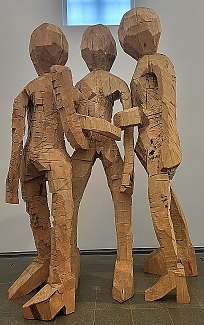
Creating art with wood and a chainsaw

BORN IN WHAT BECAME EAST GERMANY in the town of Deutschbsaselitz, the artist christened as Hans-Georg Kern (b. 1938), is better known by the name of Georg Baselitz. His first education in art was at Hochschule für Bildende und Angewandte Kunst in East Berlin, commencing in 1955. After two semesters, he was expelled from this academy because of his lack of compliance with the socialist diktats of the German Democratic Republic. By 1957. he was a student at the Hochschule der Künste in West Berlin. In 1961, he changed his name to Georg Baselitz in honour of the town where he was born. In 1979, he began creating sculptural works, some of which are on display at London’s Serpentine South Gallery until the 7th of January 2024.

The works being shown at the Serpentine are all made of wood. They were created between 2011 and 2015 as models (maquettes) for finished works, and as such were not originally intended for public display. The wood has a rough finish and is pitted with many saw marks. After making preliminary drawings, some of which are displayed at the exhibition, Baselitz used axes, chisels, and chainsaws to fashion huge bits of timber into intriguing sculptural forms. These works are beautifully displayed in the various spaces of the gallery.

Although Baselitz’s timber sculptures are more figurative and much more complicated than those produced by my mother, seeing them reminded me of her. After leaving the sculpture workshops of St Martins School of Art, my mother hired a garage near Golders Hill Park, and used it as her studio. There, she worked on huge pieces of wood, creating abstract sculptures. Unlike Baselitz, she had no power saws, but only chisels and a power drill. I recall that when she wanted to create a ring-shaped piece of timber, she would first trace circles on the wood and then using a power drill she would drill holes around the circumference until the circle was complete. After that, she had to smooth the edges to produce a perfect circle. It was laborious, and lifting the heavy timber (without lifting gear) damaged her back.

The works on display in the Serpentine  (and one outside it) appear to be crudely finished when looked at closely, but as semi-abstract sculptures they seem to mock the grandeur of classical Greek or Roman sculptures. Born a rebel, the artist has produced attractive works that comfortably go against the grain of traditional sculpture.