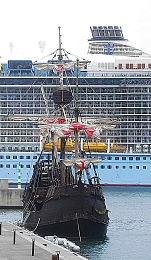
Standing on a bench in Funchal, Madeira

ON THE FLIGHT FROM Stansted to Funchal, I sat next to a young man who was born in Madeira and now lives in the UK. He told me that we were just in time for the grand parade of the island’s annual flower festival. It would be happening on the afternoon of Sunday, the 30th of April (2023) at 430 pm, and that it always attracts large crowds.

At about 2.50 pm on the Sunday, we found an empty bench on the Avenida do Mar. This is a wide dual-carriageway that runs close to the seafront. Our bench was beside one of the carriageways. The parade was due to proceed along the other carriageway. By as early as 3 pm, people were gathering on the grassy divider that separates the two carriageways. They were between us and the route to be taken by the parade. More and more people assembled there, and we wondered how we would be able to see the proceedings.
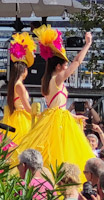
At about 3.30, an elderly English couple joined us on the bench. We did not speak with them until a few minutes before 4.30. Then, the rather frail looking old lady said to us:
“We’re going to stand on the bench to watch the floats pass by.”
I had thought about doing this but had been concerned about the stability of both the bench and me. But when this older lady and her even older husband climbed on the bench we joined them.

The colourful floats covered with floral decorations and lively girls and ladies moved a little faster than snail’s pace. They were separated by crowds of girls in folk costumes, who were singing and dancing as they proceeded. From our vantage point, we could see the floats easily, but the dancing girls were mostly hidden by the crowds on the grassy divider; only their headdresses could be seen.

After three floats had passed, the lady hopped off the bench, and said to me:
“We’ve got to go now. We don’t want to miss our team, Liverpool, playing.”

All this goes to show that one should never judge people by how old they look. Even some the oldest members of our species can be surprisingly full of life.

Places called London

MANY YEARS AGO, I used to visit Yugoslavia frequently. I stayed with friends in both Sarajevo and Belgrade. During almost every stay in Belgrade, several friends and I used to travel to the town of Novi Sad to eat good Chinese food in a restaurant called Szećuan. We used to order, and consume everything on its menu. This food was washed down with copious amounts of alcohol.

After one if these boozy lunches, we began walking to the railway station and as we passed a pub called Bar London, my friend Miša said to me:
“It would be surrealist if you take us for a drink in this bar”.
We had one or more ‘for the road’, and then staggered towards the station.

This memory was aroused by coming across the Restaurante Londres in central Funchal (Madeira). We ate dinner there. The food was excellent. For the first time in my life, I ate limpets. These aquatic snails were grilled in their shells with butter and garlic – they tasted wonderful. The other dishes we tried were so good that we have booked there again.

Returning to the past, if I recall correctly, there was also a restaurant or bar called London in central Belgrade, but oddly I never entered it.

Looking familiar in Funchal

THEY STAND SIDE by side on a pavement outside a post office on the sloping Avenida Zarco in central Funchal. There are two sets of them. In each pair, one is painted red, the other is blue. They are postboxes (letter boxes). These cylindrical mailing boxes have a familiar look about them, especially if you live in England.

Having seen several old British style post boxes in various places in India, seeing these boxes in Funchal aroused my curiosity. I looked at their bases. The two red boxes had no manufacturer’s marks. However, both the blue ones had the following on them in English: “Cooperative Industrial Society”. This suggests that at least these two boxes were made in the UK. It appears that many Cooperative Industrial Societies have existed. So just by looking at them, it cannot be said exactly where these boxes were made. In any case, it seems that these items were imported from the UK.

As for the two colours – red and blue – there are two postal methods/speeds in Portugal. Red boxes are for normal mail, and blue for priority or express mail.

An amazing bookshop in Madeira

I AM ADDICTED to visiting bookshops. In the heart of Madeira’s capital, Funchal, not far from the cathedral in a steep narrow street stands the Livraria Esperança. Founded in 1886, this bookshop is the largest in Portugal, and maybe one of the largest in Europe. It is housed on three storeys of an 18th century Palace. On each floor, there is a veritable warren of rooms, each filled with books and magazines.

The unique feature of this well stocked bookshop is that each book is displayed so that its whole front cover can be seen. This differs from many other bookshops in which most books are shelved so that only their spines can be seen. Many of the books in the Livraria are held between the jaws of clips hanging from pegs on the bookshelves.

Although books are arranged according to subject matter in different rooms, within each of these rooms the books seem to be randomly arranged. For example, a book about Salazar might be hanging between one about Roman archaeology and another about East Timor. I am not sure how the salespeople lay their hands on a particular volume that a customer requires.

More than 99% of the books are in Portuguese. There is a small collection of books in other languages. I do not understand Portuguese sufficiently well to read a serious text in that language. So, sadly I left the wonderful shop without having made a purchase.

Flying with Ryan

THE FIRST TIME I flew with Ryanair was to and from Friedrichshafen in Bavaria. On the return journey, I asked a lady at an information desk whether our flight was on time or running late. She replied:
“Ryanair never runs on time.”

Since November 2022, we have made 13 flights – some domestic and others international. Of these, the majority did not run on time and many of them had aspects worthy of criticism.

Today, the 27th of April 2023, we flew yet again. We flew from London’s Stanstead Airport to Funchal in Madeira. Both the ground staff and the crew on board were both friendly and efficient. The flight departed two minutes early and arrived at exactly the scheduled time. And the airline was … Ryanair!

Dwarfed by a cruise ship

DURING THE ELEVEN days we spent in Funchal, the capital of Madeira, the city was visited by two enormous cruise ships. Resembling huge blocks of flats (apartments, my North American friends!) floating on water, they arrived in the port at night, remained a whole day, and then departed the next evening.

When these vessels disgorge their cargos of tourists, the centre of Funchal becomes crowded; the queue t the cable-car grows longer; and the frequency at which toboggans slide down from the Monte increases.

The port at Funchal is designed to accommodate these ‘humungous’ people carriers, so their arrival does not have the same damaging effect (on buildings and the shoreline) as is created by them in Venice (Italy). Cruising in vessels of this size appeals to many but not to me.

Amongst the agapanthus

We visited Funchal in Madeira in early June 2022. Although we were recommended to visit some of the numerous botanical gardens in and around the city, it was hardly necessary. I do not think that I have ever visited a place filled with such a profusion of flowers as is the case for Funchal. The whole city seems to be one great garden.

During our visit, we were in time to see a vast number of blue flowered agapanthus plants. Although they are commonly known as ‘lily of the Nile’ or ‘African lily, they are not of the lily family. They are members of the Asparagales order of plants, a part of the Asparagus genus. Had I not seen so many of these flowers in Funchal, I might never have bothered to find out anything about them. As the saying goes, travel broadens the mind.

Black and white beneath your feet

WHEN WALKING IN central Funchal, it is worth looking down at the pavements. Like those in Lisbon and other towns in Portugal, their surfaces are covered with small black and white stones arranged to create pleasing patterns. I imagine that these compositions created using irregularly sized stones must be laid by hand rather than by using a machine.

Funchal

Often the stones are laid on the pavements as well as on large open spaces in such a way that fascinating optical effects are achieved. By making such lovely places on which to walk, the cities and towns become beautiful in whichever direction you look.

A lady from Lichtenstein

FUNCHAL IN MADEIRA is famed for its glorious gardens, which can be visited by members of the public. Actually, the whole city is filled with so many flowering plants and trees that it is almost like a huge garden. Nevertheless, we decided to see one of the gardens  for which the city is known. We chose the Palheiro Gardens, which are located about 500 metres above sea level.

To reach the gardens, we took local bus number 37 from the Pingo, a square near the  Mercatos Lavradores. While waiting for the bus to depart, we began chatting with another passenger, a lady who spoke English with a Germanic accent, who last visited the Palheiro 18 years ago. It turned out that she is from Lichtenstein. As far as I can recall, she is the first person from that tiny country next to Switzerland with whom I have ever spoken.

The bus trip up to the Palheiro is spectacular. The road winds ever upwards along the edges of deep ravines. As the road ascends, there are many dramatic views of Funchal and its bay.

The gardens are well-tended and are laid out in a seemingly informal way, in the English garden style. The gardens flourish on slopes overlooking the city far below and a golf course nearby. I do not know enough about trees and flowers, but suffice it to say that the place provides a colourful feast for the eyes.

The Palheiro gardens are laid out in the former estate of the wealthy Count of Carvalhal. The place was purchased in 1885 by the Blandys, a family of British entrepreneurs, bankers, makers of Madeira wine, and merchants who have been important in the development of Madeira’s economy. Part of the gardens retain features laid out by the Count in the 18th century, but much of the rest of the grounds have been developed since then.

Being at about 500 metres,  the garden is noticeably cooler than in the centre of Funchal.  In fact, during our visit, we were close to the clouds and occasionally felt the moisture contained within them. I am pleased that we visited the Palheiro, but feel that given the profusion of lovely plants all around Funchal, I wonder whether visiting gardens like this one is a ‘must do’ activity unless you have a special interest in gardens and gardening.

The journey between Funchal and Palheiro and my first meeting with a person from Lichtenstein enhanced my trip to the gardens.