
THE MOST FASCINATING exhibit I saw at the Frieze Masters art fair in London’s Regents Park, was unlike most of the other exhibits, not man-made. The item was about four feet high and slightly less wide. At first sight, it looks like a piece of modern sculpture, and one side of it resembles a vorticist version of the famous Michelin Man. But it is neither modern, nor made by human hands. It is between 300000 and 50000 years old, a fine example of a gogotte.
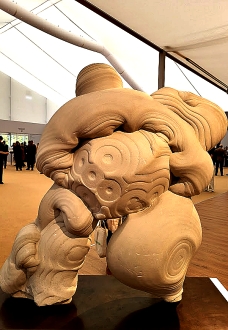
Made of silica, gogottes are (see https://www.robertsimon.com/gogotte-first-journey):
“… natural creations formed out of sands deposited in Northern France during the Oligocene Period, approximately 30 million years ago. Much later, in a process that has only recently become understood, groundwater rich in silica flowed through the sands, creating swirling organic shapes and cementing the sand into the fluid forms that we see today. This geological process took place during two cold periods of the Quaternary—one approximately 300,000 years ago, the other more recent, during the last glaciation, between 30 and 50,000 years ago.”
Apart from being interesting looking geological specimens, they have attracted the attention of artists. Some of them collected gogottes, and they and others have been influenced by their forms. These artists included: Henry Moore, Jean Arp, Constantin Brancusi, Barbara Hepworth, the Surrealists, and others. In addition, the curious gogottes have attracted the interest of collectors since as early as during the Song Dynasty (960–1279).
Gogottes are quite easily available. Their price depends on size. The specimen on display at Frieze is large. I asked one of the gallery assistants working on the stand where it was displayed for how much it was being sold. Sadly, she did not know.

 yamey
yamey 