
TAKE A LOOK AT THIS:
“The sculpture reimagines the palm tree as a meditation on movement, ecology and the industrialized nature of urban environments. Rather than mimicking the setting’s vegetation, Black Palm engages with The Regent’s Park’s curated landscape, drawing attention to the systems of labour and global trade that influence public spaces. By using discarded rubber to depict once-thriving palms, the piece reflects on colonial exploitation and its impact on tropical beauty, where Europe’s fascination with the exotic depleted its natural resources by transforming rubber into a global commodity.”
And now try this:
“Shawcross continues to explore themes such as the Big Bang and the origins of time through geometry. His installations evoke the ancient mysteries of the cosmos and challenge conventional temporal boundaries through continuously shifting forms. By merging cosmic geometry with dynamic light patterns, the artist transforms our interpretation of cosmic events into a tangible, immersive experience.”
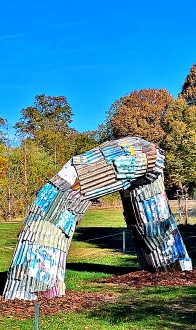 I did not write these two quotes. They are extracts from the labels next to two of the sculptures on display at the Frieze Sculpture 2026 outdoor exhibition in London’s Regents Park. The show is held annually. The exhibits are provided by commercial art galleries. This year’s show is marginally more interesting than last year’s, but none of this year’s works particularly excited me. In some ways, the curatorial notes accompanying each exhibit, two of which I have quoted from above, were more intriguing than the sculptures they described.
I enjoy viewing sculpture in the open-air. And the great thing about Regents Park is that it provides a delightful backdrop for the artworks. In fact, placing these sculptures in such beautiful surroundings puts them at a disadvantage because nature’s creations, trees, plants, and so on, are so much more superior to the artists’ often mediocre products.
Frieze Sculpture 2026 continues until 1 November 2026.

