
An artist struck by illness but not defeated

AT TWO TEMPLE PLACE, which is close to Temple Underground station, there is an exhibition, “The Weight of Being”, showing until 19 April 2026. The theme of the exhibition is “vulnerability, resilience, and mental health in art”. The show contains a good number of paintings and other creations by the artist John Wilson McCracken (1936-1982), an artist who is new to me. The reason for his inclusion in the show will become obvious soon.

From an early age, McCracken, who was born in Belfast and educated in Birmingham, displayed artistic talent. In 1956, he applied to enter London’s prestigious Slade School of Fine Art, and was accepted as a student. One of his teachers there was the artist Lucien Freud, who was a visiting tutor at the school. Soon, McCracken became a regular at the Colony Room, a drinking hole in Soho. It was here that leading artists including Freud, Francis Bacon, Frank Auerbach, and others met to drink, discuss, and argue. McCracken found himself in one of the epicentres of the world of then modern British art, and valued his encounters in this inspiring artistic milieu.
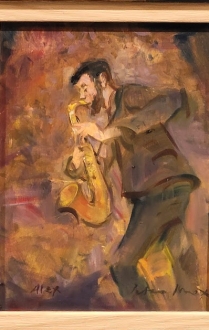
Near the end of his second year at the Slade, disaster struck. McCracken had a severe nervous breakdown. He was hospitalised, and diagnosed with schizophrenia. In the late 1950s and early 1960s, being diagnosed with ‘mental disease’ was a great social stigma, and an impediment for a young artist hoping for success in the London art world. His mother decided that the family should move away from London to the northeast, far away from London’s temptations and the intense atmosphere of the city’s art scene. They moved to Hartlepool, where the family had relatives.

McCracken continued his art education at West Hartlepool College of Art, where later he became a teacher. In addition, he worked in the town’s public Gray Art Gallery. While there, he not only arranged for a Lucien Freud exhibition to be brought from London to the gallery, but also got the gallery to acquire a wide range of then modern artworks by artists including LS Lowry, Frank Auerbach, John Bratby, and others. At that time, the works of these now very famous artists were affordable, and by purchasing them, McCracken ensured that the gallery acquired an important collection of modern British art. In addition, he formed a collective of artists called Front Group, whose members believed that contemporary art should not be confined to galleries in London.

While all this was going on in Hartlepool, McCracken never stopped painting. Most of his work depicts people. But like Francis Bacon, whom he knew, his subjects often are in awkward poses. Whereas Bacon distorted his subjects in a modern expressionist way, McCracken depicts them more realistically. As Angela Thomas, the curator of the exhibition, wrote in the catalogue:

Like Freud he captured the humanity of his subjects: their gestures, postures, and unspoken stories, rendered with empathy and attentiveness.

I am not greatly enthusiastic about Lucien Freud’s art, but what I have seen of McCracken I much prefer. Freud does not seem to like the people he portrays; he highlights their less attractive features. In contrast, McCracken appears to see what is likeable about his subjects, and gives them an empathetic rendering.

Bacon, the Bard, and Butler’s Retreat in Epping Forest

VISITORS TO QUEEN Elizabeth’s Hunting Lodge in Epping Forest can obtain food and drink at the nearby Butler’s Retreat. I will describe the Hunting Lodge in another essay, and will now concentrate on the small weatherboard clad building called Butler’s Retreat, and something that stands close to it. The Retreat is housed in an edifice that was originally built as a barn in about 1859. The Conservators of Epping Forest converted it into a retreat – a refreshment place – in about 1878.

The Retreats in Epping Forest were originally refreshment stalls set up by the Temperance movement to serve non-alcoholic drinks to the many trippers who came to enjoy the forest. Butler’s Retreat is one of the last surviving Victorian retreats in the forest. Its name derives from that of:

“John Butler who took over the lease of the barn on 1st January 1891 having previously operated a kiosk in the forest.” (www.chingfordhistory.org.uk/butlers-retreat-and-drinking-fountain)

His wife, Hannah, took over the refreshment business in 1903, and the Butler family ran it until 1971. After closing in 2009, the building was refurbished by the City of London Corporation (which maintains the forest) and re-opened as a cafe in 2012. The café no longer confines itself to non-alcoholic beverages. In addition to drinks, it serves a range of snacks and light meals. These can be eaten at tables outside the building or within its attractive dining areas in which supporting timber beams can be seen. They support the roof above the first-floor dining room.

Forty-five feet away from the northeast corner of Butler’s Retreat, there is an intact, but disused, pink granite drinking fountain, which was restored in 2011. Constructed in 1899, it was donated by Sir Edwin Durning-Lawrence, Bart, MP (1837-1914). After studying law at London’s University College, he qualified as a barrister at Middle Temple in 1867. During his working life he was both a Justice of the Peace and served as a Member of Parliament for Truro (from 1895 to 1906). Two of his brothers served as Lord Mayors of London.

Sir Edwin was a prolific author. He is best known for his writing in support of the idea that the plays attributed to William Shakespeare (1564-1616) – the Bard – were not written by him but by Francis Bacon (1561-1626). I am in no position to assess Sir Edwin’s arguments, but I believe that most modern scholars tend to believe that it was not Bacon but Shakespeare who wrote the plays.

Apart from providing the fountain near Butler’s Retreat, Sir Edwin donated his extensive library to the University of London. Also, some of the money he left to the university was used to endow a professorial chair in the History of Art department at his alma mater – University College London.

The drinking fountain at Butler’s Retreat is nothing too out of the ordinary to look at, but I am pleased that I did examine it closely to see what was inscribed on it, and noticed the name of Sir Edwin. It is interesting that this drinking fountain, which was donated by someone who doubted Shakespeare’s authorship, should be situated only a few yards away from a building that was standing during the Bard’s (and Bacon’s) lifetime – Queen Elizabeth’s Hunting Lodge.