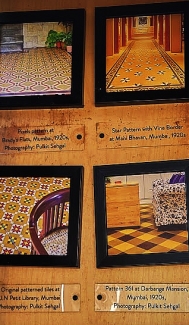
WHEN WE WERE in Bombay in November 2025, we saw exhibition related to the Bharat Tile Company. Founded in 1922, this company produces cement floor tiles. It pioneered this manufacturing process in India as part of the Swadeshi Movement, which encouraged self-sufficiency as opposed to a dependence on goods manufactured abroad, notably in Britain. It was part of the road to Indian Nationalism and independence from British rule. Bharat’s aim was to produce high quality tiles that reduce or replace imports and meet the highest international standards. In this it was successful. The company captured the Indian market, and as its website noted:
“Our craftsmanship graces the palaces of Maharajas, Raj Bhavans, distinguished residences, prestigious hotels, vital hospitals, vibrant clubs, bustling offices, bustling factories, cooperative housing societies, esteemed educational and religious institutions, as well as busy airports and railway stations.”
The exhibition displayed the types of tiles, how they are made, their designs, examples of their usage, and how they have been exported to destinations all over the world. The patterned floors that can be created with these tiles, and there are many of them to be seen in buildings all over India, are described in the exhibition as “tapestry in cement”.
MOST VISITORS TO London’s Tate Britain and National Gallery tend to look at the paintings hanging on the walls and sculptures on pedestals. Fewer people look down to see what they are walking on. The floors of the main entrance portico of the National Gallery and of Gallery II at the Tate Britain are well worth examining.
National Gallery, London (UK)
The mosaics on these floors were created by the Russian artist Boris Vasilyevich Anrep (1883-1969). Born in St Petersburg, he studied law at the Imperial School of Jurisprudence in that city, graduating in 1905. In 1908, he abandoned law and went to Paris (France) to study art. Between 1910 and 1911, he studied at the Edinburgh School of Art. While in France, Boris met several British artists and intellectuals, many of them members of the Bloomsbury Set. His fascination with mosaics began in about 1904 after seeing the early Christian mosaics in Ravenna (Italy). In 1917, Boris settled in England, where he created many of his mosaics.
The floor of Gallery II at what is now the Tate Britain, but was formerly ‘The Tate Gallery’, was damaged by bombing during a Zeppelin raid in WW1. In 1921, Anrep was commissioned to make a mosaic floor for this gallery. By 1923, it was ready. The dramatic-looking creation consists of scenes representing William Blakes “Proverbs”. Each of the vignettes in the octagonal gallery, which used to house pictures by Blake, includes one of Blake’s proverbs. They are surrounded by a depiction of the flames of Hell.
The floors of the Portico at the national contain a much greater area of mosaics than that of the gallery in Tate Britain. Anrep created the mosaics between 1926 and 1952. Some of them are becoming worn out after having been walked on for so many years since the were put in place. A website (https://artuk.org/discover/artists/anrep-boris-18831969) explained that the mosaics in the National Gallery consist of:
“… four floors on and around the main staircase, executed between 1926 and 1952. The subjects are ‘The Awakening of the Muses’, ‘The Modern Virtues’, ‘The Labours of Life’, and ‘The Pleasures of Life’; portraits of many well-known contemporaries are incorporated in them, for example the philosopher Bertrand Russell representing Lucidity and the film actress Greta Garbo as Melpomene, the Muse of Tragedy.”
The attractive, intriguing mosaics at both the National and the Tate Britain are far less famous than many of the works to which most visitors make a beeline. However, Anrep’s mosaics should not be overlooked. In fact, I believe they are worth lingering over at least as long as one might when viewing, say, a Rembrandt in the National, or a Turner in the Tate.
Incidentally, after Anrep died, his body was cremated at Golders Green Crematorium, a place which I have described in my book “Beneath a Wide Sky: Hampstead and its Environs”.


 yamey
yamey 