
IN 1899, RUDYARD Kipling (1865-1936), who was born in Bombay (when India was under British rule), wrote a poem called “The White Man’s Burden”. The content of this piece was in harmony with the then current idea that the ‘white race’ was morally obliged to ‘civilise’ the non-white races of the earth, and through colonisation to encourage their economic development and ‘progress’. Well, this was an illusion happily believed by most of the colonisers. The reality was that colonisation was not designed to benefit the colonised but to increase the prosperity of the colonisers. The white man’s burden was in truth much more the burden which had to be borne by the non-white races, which were colonised. This is beautifully characterised in an art installation, “The Procession”, on display in London’s Tate Britain until the 22nd of January 2023. Conceived and created by the Guyanese-British artist Hew Locke (born 1959 in Edinburgh), I have seen it twice so far, and loved it each time.
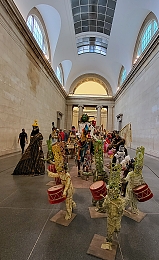
“The Procession” consists of a large number of models of people dressed in colourful and fantastical costumes. They are arranged as if they are taking part in a carnival or parade. Many of the models appear slightly grotesque or even menacing. If these models were real people, they would inspire awe and maybe fear. Some of them carry banners, others carry skulls, and there are some supporting poles from which objects are either suspended, or on which objects are supported.

There are banners in the procession. Some of these depict colonial dwellings and institutions. Others show enlarged photographs of company share certificates and financial bonds. Some of the characters in the parade wear clothes on which these old-fashioned records of financial investment are printed. Thus, the artist has portrayed the fact that success of the investments of the European and American colonists and their backers rested on the shoulders of the hard-working black colonial subjects, who derived few if any benefits from their labour.
“The Procession” is not only a highly original way of conveying the unfortunate history of colonization, but also a feast for the eyes. It is both a reminder of Britain’s not always too glorious colonial past, as well as a celebration of the cultural diversity, which this country enjoys. The installation is housed in the magnificent neo-classical Duveen Galleries (opened in 1937), whose design is derived from architecture characteristic of the ancient imperialist regimes, which dominated the Mediterranean many centuries ago. Was it accidental or deliberate to place an essentially anti-imperialist exhibit in rooms that evoke an imperial past and by their immensity dwarf the exhibits? Whatever the answer, this is an exhibition for which it is well-worth making a detour.

 yamey
yamey 