
Depicting a sea creature at a garden in Devon

DESPISED BY MARINERS whose boats are fouled by these creatures that attach themselves firmly to the hulls of vessels, they are important in the seawater eco-systems. I am referring to barnacles, which are arthropods of the subclass Cirripedia. The mature barnacle attaches itself to surfaces including boats, seashells, sea creatures including whales, and rocks, using an incredibly strong glue that they secrete. Once stuck in place, they feed by filtering the water through their bodies, extracting plankton from it. Thus, barnacles assist in the purification of seawater. For those who are concerned with ecological matters, barnacles are a useful indicator of water quality in coastal environments.

Our daughter, who is the curator at UP Projects, an organisation that commissions and executes public art works, has been involved in producing a sculpture, “I travelled 66 million years to be with you and then you came”, created by the artist Anne Duk Hee Jordan. It was unveiled on 4 June 2025. The sculpture is a depiction of the bodies of barnacles, greatly enlarged, perched on a pile of slate stones on which shapes of fossils have been carved. The barnacles are sculpted in porous materials that, like real barnacles, filter and purify water that passes through them. As UP’s website explained, the barnacle forms:

“… are made from materials with water-filtering properties, including Roman concrete, a plant-based version of activated charcoal known as biochar, shell fragments, zeolite minerals and iron oxide …”

By using these materials, the barnacle sculptures not only resemble the creatures’ forms but also their filtration functions.

The sculpture is being displayed in the garden of A La Ronde, a curious eighteenth-century house near Exmouth in Devon for a few months. Maintained by the National Trust, this (almost circular) building has sixteen sides and a central octagonal lightwell. It was built in 1796 by two cousins, Jane and Mary Parminter. With fine views of the River Exe and its estuary, the eccentrically designed house is filled with curiosities collected by the Parminters. These objects include many natural items such as seashells, bird feathers, fossils, bones, and rocks. No doubt some of these specimens have the shells of dead barnacles attached to them.

It is quite appropriate that Duk Hee’s modern sculpture, which simultaneously celebrates the importance of barnacles and purifies water falling on it, has been placed in the garden of a house once owned by two ladies who, judging by their extensive collection of seashells and other natural objects, had a great interest in the environment in which they lived. The artist’s creation serves as an object on which to concentrate while contemplating the importance and fragility of the eco-system that supports life as we know it.

Taking the plunge

MOST COFFEE DRINKERS will be familiar with the cafetiere or French press (‘caffettiera a stantuffo’ in Italian and ‘Stempelkanne’ in German). The earliest versions of this were patented in the 1920s. For those not familiar with these devices, let me explain how they are used. Coffee grounds and hot water are introduced into an open topped cylindrical vessel, often made in glass but also in metal and plastic. After waiting for the coffee to brew, and people argue how long this should be, a plunger that snugly fits the opening of the vessel is placed on the surface of the hot coffee mixture. The plunger has a metal sieve that does not permit the passage of coffee grounds through it. This plunger is attached to a metal rod, by which pressure can be exerted to drive the sieve through the liquid towards the bottom of the vessel. As it moves downward, the coffee grounds become separated from the liquid (the brewed coffee) above it. Then the coffee, free of grounds, can be served.

BLOG CAF

In the early 1960s, the cafetiere became a fashionable way of preparing and serving coffee. My mother and her sister were quick to buy one for each of their homes. They were elegantly designed with clear glass vessels and shiny steel holders with black handles. And, the coffee they produce is good.

My mother kept using our cafetiere until disaster struck. It did not happen to her but to her brother-in-law. One evening after dinner, my uncle began plunging the filter through the hot coffee when something slipped causing the plunger to descend far too rapidly. As it shot down into the boiling hot coffee, the liquid shot up onto my uncle’s arm and caused him serious burns. Hearing of this unfortunate event, my over-cautious mother decided that far from being useful, the cafetiere was a potentially lethal weapon. So, our cafetiere was decommissioned, never to be used again. My uncle’s family continued to use their cafetiere(s) despite the accident.

Many years later, my wife and I were entertaining guests one evening. My wife had filled a large glass cafetiere with coffee and hot water and told me to plunge the filter whilst she sat down with our friends. Usually when you press the filter plunger into the brew, there is some resistance as the coffee grounds begin the reduce the flow of water through the fine filter mesh. On this occasion, I encountered some resistance as expected but then something unexpected happened. Each time I applied pressure and then released it, the filter disc began rising up towards the opening of the glass vessel. This happened repeatedly and it became increasingly difficult to depress the filter. It seemed as if the coffee was fighting back, pushing the filter plunger upwards.

Eventually, I managed to force the plunger down sufficiently and I served the coffee, somewhat mystified. After the guests had left, I examined our weirdly behaving cafetiere. I removed the plunger and found a deformed stainless-steel spoon amongst the compressed coffee grounds. The formerly straight stem of the spoon had become bent into a ‘U’ shape. I had applied sufficient pressure to the plunger to bend the spoon. I felt as if I had become Uri Geller, famous for his spoon bending tricks. Fortunately, and amazingly, the glass vessel of the cafetiere did not break or even crack.

Breakages are common amongst the glass vessels used in cafetieres. It is not the making of coffee that breaks them but dropping them on hard surfaces does them no good. We now use cafetieres with stainless-steel vessels. Not only do these not break but also many of them have double walls to help keep the coffee warm.

Filter coffee

South Indian filter coffee is wonderful. Here is how it is prepared. First coffee powder is placed in the upper chamber of a cylindrical metal vessel with a finely perforated base. Hot water is poured on it. Then, the water slowly filters through the powder to produce an intensely strong, undrinkable filtrate, known as ‘decoction’. This filtration takes many hours.

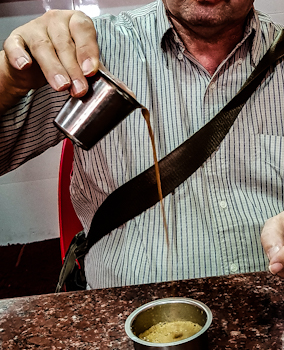
The coffee-maker ladles some decoction into a vessel, often a stainless steel beaker. Then, he or she fills the rest of the beaker with freshly boiled milk (With or without sugar).

If you want your coffee without sugar, ask for “sugarless”.

The coffee cup comes with a deep saucer. To cool the coffee, you pour the coffee from the beaker to the saucer and vice versa.

Then, ENJOY!