An ancient manor house in Falmouth (Cornwall)

FALMOUTH IS A small port on the south coast Cornwall, It was founded near their ‘palace’, Arwenack, by the Killigrew family in 1613.

In 1385, the Killigrew family acquired a property, a manor house called Arwenack, now in Falmouth. Although fragments of the 14th century house remain, the shape of Arwenack that can be seen today was established in the mid-16th century by John Killigrew. After that, the family continued to modify this grand residence. During the Civil War (1642-1651), Arwenack was badly damaged. Nothing much was done to the building until the 18th century when extra wings were constructed. Thereafter, the building fell into decline until 1978 when a firm from Redruth repaired and modernised it before converting it into several dwellings, which are still in use today. Arwenack faces a 44-foot-high granite obelisk/pyramid that was erected in 1738 by Martin Lister Killigrew to celebrate his illustrious family.

Now, Arwenack faces a large car park, and behind that a complex of modern buildings that contains shope, restaurants, and the National Maritime Museum (Cornwall)

Footsteps of the famous in Falmouth and Sarajevo

IN THE 1980s when Yugoslavia existed, I used to visit the Bosnian city of Sarajevo regularly. In the centre of the town there was (and might still be) a museum about the assassination of Archduke Franz Ferdinand in 1914. Near this, there were impressions of two footprints in the pavement. These mark the supposed spot from which Gavrilo Princip fired the shots that killed the Archduke. You could stand in that very spot if you wished. I have no idea whether this curious memorial still exists but I was reminded of it when walking along the waterfront in Cornwall’s Falmouth.

On the 14th of June 1968, Sir Robin Knox-Johnson (born in 1939) set sail from Falmouth as a competitor in the Sunday Times Golden Globe race. In his small boat, the 32-foot Suhaili (a Bermudan ketch), he circumnavigated the World non-stop. Having won the race, he disembarked at Falmouth on the 22nd of April 1969.

Just as Princip’s exploit was commemorated by imprints of footprints, so was Sir Robin’s. However, at Falmouth there are two sets of footprints embedded in brass plates. One set has its toes pointing towards the sea, and the other, commemorating Sir Robin’s return, has its toes pointing towards the land (away from the sea).

Whereas the impressions of Princip’s footsteps make us remember the terrible consequences of his actions, those of Sir Robin celebrate a great achievement.

Going up in smoke

CORNWALL’S COAST WITH its numerous, sometimes almost inaccessible, coves is perfect for smuggling. It is not by chance that Gilbert and Sullivan’s opera is named “The Pirates of Penzance”, rather than, say, “The Pirates of Suffolk”.  When we visited Falmouth, a Cornish seaport, in May 2022, I noticed a souvenir of an era of smuggling, now long past.

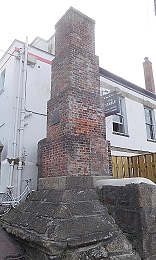
Next to the old customs house (now a pub) on the Town Quay, the old harbour of Falmouth, there is a tall brick structure. On a square base, it is built in four sections, each one slenderer than the one beneath it. The tall object bears a plaque inscribed with an anchor framed by a shield and above it a double-headed eagle. Below these symbols are the words:

“King’s Pipe. Formerly used for the destruction of contraband tobacco.”

According to the website historicengland.org.uk, the King’s Pipe was likely to have been constructed in about 1814, when the customs house was built. The tall chimney stands on a base that contained a furnace that was accessible from the courtyard of the customs house. Overshadowing the town and its harbour, I imagine that many of the townsfolk were far from happy when they saw and smelled the tobacco smoke, which they would have enjoyed creating in their pipes, being emitted from the King’s Pipe.

The double-headed eagle on the plaque affixed to the former chimney interested me. Two major families in Cornwall use this mythical creature in their heraldry: the Godolphins and the Killigrews. It is most likely the latter to which the creature on the plaque refers because in the early 17th century (1613), Sir John Killigrew (1583-1633), helped create the port of Falmouth.

Although we had spent several pleasant days in Falmouth a few years ago, we did not spot the King’s Pipe on that visit. It only goes to show that revisiting places can enhance one’s enjoyment of, and interest in, them.