The town of Eye in Suffolk is twinned with Pouzauges in France. There is a French milestone from the region of France is in the centre of Eye.
Seeing this reminded me of the three months that I attended the University of Chicago Laboratory School in Chicago in late 1963. Every morning before classes began, we used to play a card game called “Mille Bornes” (i.e., ‘1000 milestones’). The game was vaguely educational in that it taught the players a few words of French. We were all obsessed with playing it. When I left the school to return to England, the class clubbed together and bought me a set of “Mille Borne” cards as a farewell gift. although my fellow students at the Lab School were about two years older than me, they made me feel very welcome and were extremely friendly towards me. The same was the case for my class teacher, Ms Alice Flickinger, and the sports teacher, Mr Patlak.
THADDEUS ROPAC GALLERY, in a most elegant building on central London’s Dover Street is four minutes’ walk from Waddington Custot Gallery on Cork Street. We visited both today (the 13th of September 2022). At Thaddeus Ropac, we saw an exhibition, “City of Silence” by Wolfgang Laib (born in Germany in 1950), and at Waddington Custot, we saw “In the Studio”, a collection of works by March Avery (born 1932 in New York City).
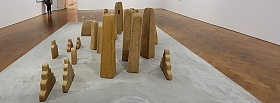
Works in beeswax by Wolfgang Laib
Laib’s works, the best of which is a collection of objects made in beeswax that resemble towers and ziggurats, were not particularly visually appealing at first sight. Neither were his numerous minimalistic works on paper or even a set of identical model boats made in brass. It was only after reading some of the explanatory material provided by the gallery that these artworks began to become interesting. They did not become more appealing to the eye, but they began to make some kind of sense to me. For example, the beeswax towers and other objects alongside them are supposed to evoke thoughts of dwellings in the Middle East and the Towers of Silence where Zoroastrians leave corpses to be devoured by vultures. To some extent, these objects achieve the artist’s mental vision of the structures, which inspired them. However, without the explanations, Laib’s exhibition would have ‘left me cold’.
Immediately on entering Waddington Custot, Avery’s colourful, mostly figurative paintings appealed to my eyes and provided feelings of visceral satisfaction. Although it is highly likely that the paintings are manifestations of the artist’s thoughts and ideas, the viewer can get enjoyment from the artworks without knowing anything about what was going through Avery’s mind while she was creating them.
We left Avery’s exhibition both visually and intellectually satisfied. In contrast, we felt that Laib’s works on their own without explanation were far less fulfilling than Avery’s.


 yamey
yamey 