The Virgin Queen visited here to watch the hunt in Epping Forest

IT HAS BEEN STANDING for many centuries, but until we saw something about the place in a recent (March 2024) issue of the free Metro newspaper, we did not know it existed. The place is located in Epping Forest on Rangers Road, which runs eastwards from Chingford (on the edge of northeast London). I am referring to a well-preserved, whitewashed, half-timbered Tudor building, which was constructed in 1543 for King Henry VIII, and renovated by his daughter Queen Elizabeth I in 1589.

This edifice, which is 481 years old, is aptly known as ‘Queen Elizabeth’s Hunting Lodge’, and is open to the public to explore. It is a timber-framed three-storey ‘standing’. That is to say that it was constructed to be used as a place from which the hunt could be observed. And Epping Forest, where it stands, was, from the 12th century until the 19th century a Royal Forest, where only the monarch had the right to hunt deer. Although now fully glazed, originally the window apertures on the two upper floors were without glass. Visitors to the lodge would have been able to watch the hunt and, maybe also, shoot animals from these raised vantage points.

Throughout the building, one can see unpainted oak beams – supporting the floors, the walls, the ceilings, and the roof. The ground floor consists of an entrance hall and a larger room (with a fireplace), which served as a kitchen. A wooden staircase leads to the upper floors. It is wrapped around a square hollow newel, which supports the stair treads. There is a glass pyramid (not Tudor) above this space, which allows visitors to see the original lath and plaster work that makes up the newel.

Much of the first floor is occupied by a large hall with windows overlooking the forest. The second floor is similar, but it has a fine hammer-beam ceiling. Another such ceiling is high above the top of the staircase.

During the reign of Queen Victoria, the first floor of the lodge was divided into small bedrooms by partitions, which have long since been removed. It was then used as accommodation by the bailiff of the local lord of the manor. The Watkins family were residents for a period. It was Mrs Harriet Watkins, who used the Lodge and its garden for providing refreshments until 1897, when she took over the adjacent barn – now known as Butler’s Retreat – for the provision of teas. Writing about the lodge in 1876, James Thorne noted:

“The open space in front of the lodge has always been a favourite resort of the East-end holiday folk, for whom ‘tea and refreshments’ are provided at the lodge. On a fine summer’s day, on Monday especially, numerous picnic and ‘van’ parties may be seen, with swings improvised between the oaks, and gipsies with their donkeys in attendance.”

Regarding the suitability of the position of the lodge, he wrote:

“The ground, sloping gently from the lodge on all sides, used to be everywhere unenclosed, the tract beyond being open forest, with some famous unlopped trees, but chiefly, as in other parts of Epping Forest, of pollard oak.”

Today, standing on the second floor, or even on the first, one gets a good panoramic view of the surrounding land.

Queen Elizabeth’s Hunting Lodge is not as grand as some other surviving Tudor buildings (e.g., Hatfield House), but it has been well looked after and it is a remarkable survivor, which is well worth a visit. But before you go, please check the current opening tomes if you wish to explore its interesting interior.

A numerical oddity in Cornwall

TRERICE HOUSE IN Cornwall was built mainly between 1570 and 1573. It is one of the loveliest National Trust (‘NT’) properties in the county and one of my top ten. In one of the upper rooms there is an ornate bas-relief above the fireplace. The top of this bears the following:

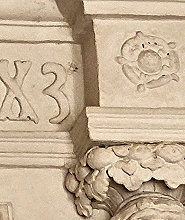
“ANNO: DOMINI: M : CCCCC : LXX3”

It is clearly a date in mostly Roman numerals, (i.e., 1573). However, this date has several odd features.

‘CCCCC’ is 500, but usually abbreviated to ‘D’ in Roman numerals. There is a surplus of colons (‘:’) and instead of ending in a Roman numeral, there is the Arabic numeral ‘3’.  Or is it the symbol for a serpent, rather than a ‘3’? It is a curiously shaped 3: it is widest at the top and tapers towards its lower end.

The NT volunteer offering information in the room with this curious date suggested three possible explanations for this peculiar form of the date above the fireplace. One is that the creator of this date miscalculated the amount of space, and instead of ending the date in ‘: III’, used the Arabic ‘3’ to fit in the last part of the date. Had he used ‘D’ instead of the unusual ‘CCCCC’, there would have been plenty of space to fit in the entire date using only Roman numerals. Another explanation offered is that the ‘3’ is really a stylised serpent, a symbol of wisdom often associated with Queen Elizabeth I, during whose reign the house was built.

3 or a serpent?

The last explanation was provided by a builder, who had visited Trerice some weeks before us. He suggested that the ‘3’ was added to indicate that the building works were supposed to have been completed in 1570, but had finished 3 years later than expected; the builders were running behind schedule.

Whatever the explanation of the curiously written date, and you might have another theory, Trerice is well worth a visit.

Henry the Eighth and Chelsea

CHEYNE WALK RUNS along the left bank of the River Thames from midway between the Battersea and Albert Bridges to 245 yards downstream of the Albert Bridge. Before 1866, Cheyne Walk ran along the shoreline, but after the construction of Chelsea Embankment it became separated from the waterfront. Today, while walking along this lane east from the Albert Bridge, we spotted the narrow Cheyne Mews. A sign at its entrance intrigued me. It reads:

“King Henry VIII’s manor house stood here until 1753 when it was demolished after the death of its last occupant, Sir Hans Sloane. Nos. 19 to 26 Cheyne Walk were built on its site in 1759-65. The old manor house garden still lies beyond the end wall of Cheyne Mews and contains some mulberry trees said to have been planted by Queen Elizabeth I.”

The manor and village of Chelsea was already in existence in the Anglo-Saxon era (between the departure of the Romans and 1066), when a document records it as ‘Cealchylle’. The 11th century Domesday book names it ‘Cercehede’ and ‘Chelched’. The manor was owned by the Abbey at Westminster until the reign of King Henry VII, when it was in the hands of Sir Reginald Bray (c1440-1503), a highly influential figure during the king’s reign. Next, it changed hands a couple of times before being possessed by William, Lord Sandys (1470-1540), a diplomat, Lord Chamberlain, and a favourite of King Henry VIII (ruled 1509-1547). Sandys, who disapproved of Henry’s marriage to Anne Boleyn (c 1501/07 – 1536), accompanied the unfortunate Anne to the Tower of London, where she was imprisoned.

In 1536, Sandys gave the manor to King Henry VIII. The much-married king gave it to his last spouse, Katherine Parr (1512-1548) as part of her dowry.  She lived in the manor house after the coronation of King Edward VI in January 1547 until she died. After her death, the manor was owned by the soldier and politician John Dudley, Duke of Northumberland (1504-1553). Then the manor passed through many owners until the physician and founder of the British Museum Sir Hans Sloane (1660-1753) bought it in 1712 from the Tory politician Lord William Cheyne (1657-1728).

There were two manor houses in Chelsea, an old one and a new one. The old one, which was given to the Lawrence family by Henry VIII was close to Chelsea Old Church that stands to the west of the Albert Bridge. The New Manor House stood on Cheyne Walk where we saw the sign. It stood near a coffee house that was flourishing when Sloane bought the manor, Don Saltero’s Coffee House, founded in 1695 by James Salter. Saltero’s was originally a barber’s shop until Sloane began donating unwanted specimens to his former servant and travelling companion, the owner of Saltero’s. Salter displayed these specimens (botanical, zoological, and other), collected on Sloane’s travels, in cabinets and gradually the barber shop was transformed into ‘Don Saltero’s Coffee House and Curiosity Museum’. This establishment attracted local men to become its customers, including Sir Isaac Newton.

Sloane’s purchase was a shrewd investment because at the time London was expanding westwards. His biographer James Delbourgo wrote:

“The manor cost the considerable sum of £17,800 and included a total of eleven houses and the Manor House itself … As a suburban equivalent of a country seat, the manor grounded Sloane’s gentlemanly identity. It also bought him about 90 acres of land … as a freeholder, and an unknown number of tenements, on which he began to collect his own rents.”

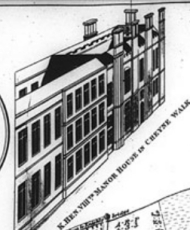
I have found an engraving of the appearance of the Chelsea manor house that stood on Cheyne Walk in a book published in the 1880s. The image resembles that included on a map of Chelsea surveyed in 1664 by James Hamilton and redrawn in 1717 (www.britishmuseum.org/collection/object/P_1880-1113-1221), but the exact location of the house is not marked on the map.

Apart from the commemorative sign at Cheyne Mews and the garden, to which we were unable to gain access, King Henry VIII’s manor house has completely disappeared. I wondered whether Chelsea’s Kings Road had any links to Henry VIII’s ownership of the manor, but it does not. It began as a private road used by King Charles II, who came to the throne long after Henry VIII, when travelling from London to Kew, and was only made a public thoroughfare in 1830. The site of the former manor house owned by Sloane is but a few minutes’ walk from the Chelsea Physic Garden, some of whose land was leased to the Society of Apothecaries for a small amount by Sloane when he acquired the manor.

Finding small things of great interest like the sign on Cheyne Mews is one of many things that increases my ever-growing fascination with London.